B1: Theo Jansen's Strandbeest: How Walking Structures Think
Quality checked lesson
Explain how Theo Jansen's Strandbeesten turn wind and repeated linkages into walking sculptures, and use them to discuss design, failure, and learning from prototypes.

Transcript
Choose how to use this lesson
You can switch anytime.
Today's path
One clear way through the lesson
Start with Read core, then move forward when you feel ready.
- 1 Read core
- 2 Check understanding
Selected
Study mode: article with quick checks.
Study Layout
Experience
Read-along works with this web player.
Introduction
Explain how Theo Jansen's Strandbeesten turn wind and repeated linkages into walking sculptures, and use them to discuss design, failure, and learning from prototypes.
A Strandbeest looks like a walking skeleton, but it is also a lesson in design.
Theo Jansen uses simple tubes, repeated legs, wind, and careful ratios to make sculptures that move on sand.
In this lesson, we study the structure, not only the surprise.
The puzzle is how a machine can look alive without being alive.
Have you ever seen a machine that moved in a surprisingly natural way?
What is more interesting to you: the artwork, the engineering, or the learning process?
Why do people sometimes learn more from a prototype that fails than from a perfect final product?
Reading
A is a by the The name means in of the are made from yellow and some with power. They are not things, but talks about them as if they to an
The most point is A does not simply roll a It Its rise, and return again. When several together, the can a in a and
Check your understanding
What makes a Strandbeest different from a simple cart?
You can start like this: I think...
This is why the sits between art and The may first that it Then the student can the that makes that possible.
his around 1990. versions used pipes and tape. versions more and often the as because each to one stage of a
Check your understanding
Why does Jansen's project feel like a long experiment?
You can start like this: Because...
That matters. He does not only make one and stop. He tests a from it, it or and The Associated Press reported in 2025 that a Delft showed this from simple to more
For students, story is because it shows as a A is not a just because it has It is The what the old taught.
The from a A is a of by In is as a with one main In simple words, one and the through a
Check your understanding
What does the crank do in the Jansen leg mechanism?
You can start like this: I think...
The is the shape of that The stays the for of the so it can the Then it and returns, for the step. This is why the does not need a separate at
special for the lengths. He these the Students do not need to the The lesson is that in length can the
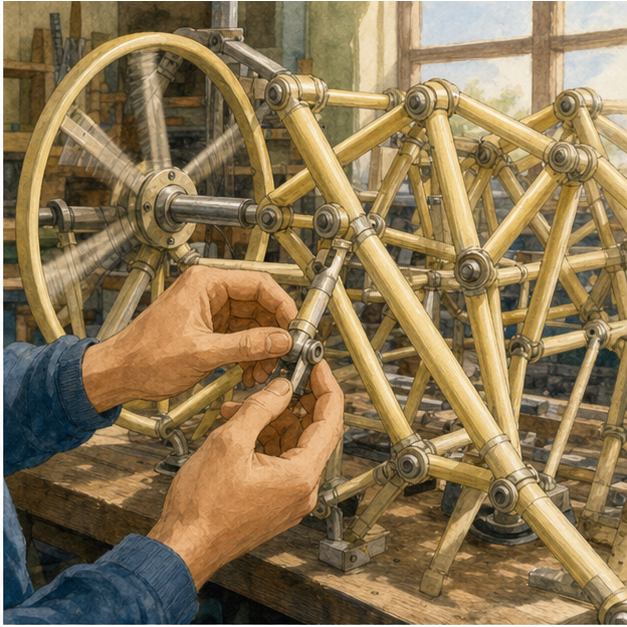
A because the is open, and thin The can through the so the both and mechanical.
Check your understanding
Why is a light structure useful for a wind-powered walking sculpture?
You can start like this: Because...
This is practical. A be too The must times, and the must and also If one unit can place related units the and them to a
But have a matter. A that is too loose, a tube that or a that is slightly can the The on
The first lesson is the materials and the and a of the he them.
The second lesson is their a A shows its openly. You can watch the and This makes the a of
Check your understanding
Why can a Strandbeest be called a teaching object?
You can start like this: Because...
The third lesson is patient are not They are of the A or learner can the same keep the the and the with more
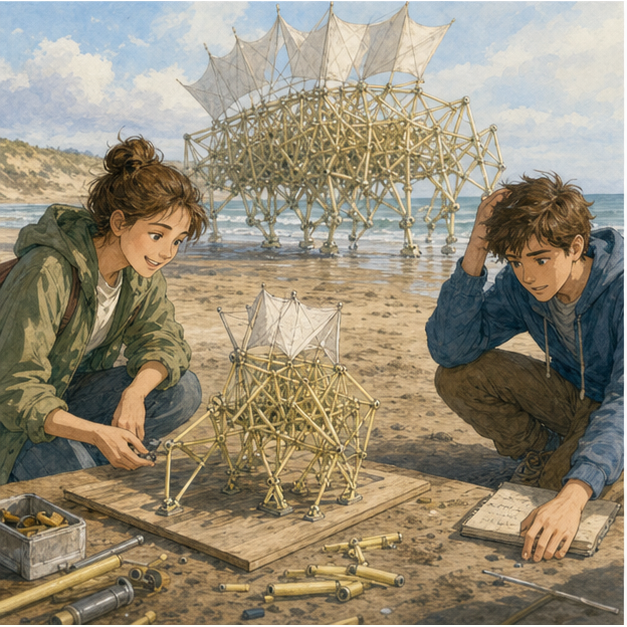
and from large the 2025 in Delft. Students and make from kits, 3D-printed wood, or also because one simple can a
These are not the same as A a robot, or an the of a in the But they help understand the They wonder into a practical a can make a and the
Check your understanding
Why do people build small Strandbeest-style models?
You can start like this: Because...
That is the of the Not that the are but that the new
A to a is to and
Check your understanding
What are the four parts in the design map?
You can start like this: I think...
The is or The is the and The is The is what on real slip, turning, bending, helpful or
This for too. A does not only judge or A what in, what what out, and what
Practice
What makes a Strandbeest different from a simple cart?
A Strandbeest walks with repeated leg mechanisms instead of simply rolling on wheels.
When you see a moving sculpture, do you notice the beauty first or the mechanism first?
Why does Jansen's project feel like a long experiment?
Because he keeps building new versions, testing them, learning from them, and treating older versions like fossils.
What kind of project in your life could improve through many versions?
What does the crank do in the Jansen leg mechanism?
It gives one rotating input that moves the connected rods and creates a walking foot path.
Why is it useful if one input can control many linked parts?
Why is a light structure useful for a wind-powered walking sculpture?
A light structure is easier for wind and repeated leg motion to move.
Can something look fragile and still be strong enough for its job?
Why can a Strandbeest be called a teaching object?
Because its rods, joints, and repeated leg motion show the logic of the structure openly.
What mistake have you learned from because you could clearly see what went wrong?
Why do people build small Strandbeest-style models?
They build small models to understand the linkage, test the walking motion, and learn from the structure.
Would you rather see a full-size Strandbeest on a beach or build a small model yourself?
What are the four parts in the design map?
The four parts are input, mechanism, output, and feedback.
Choose a simple machine or app you know.
What are its input, mechanism, output, and feedback?
Summary
Theo Jansen's Strandbeesten are memorable because they make structure visible.
They are art, but they are also a study of movement, material, wind, and repeated trial.
They show that a beautiful result can come from strict limits.
The deeper lesson is not "copy this exact machine."
The lesson is to think like a careful builder.
Choose a problem.
Make the logic visible.
Test it in the real world.
Learn from what breaks, slips, bends, or surprises you.
Then build the next version with more respect for reality.
Final Reflection
are because they make They are art, but they are also a of material, and trial.
They that a can come from strict
The lesson is not this The lesson is to a
a Make the
it in the real world. from what slips, or surprises you.
Then the with more respect for
Simple Meaning
Word
This word has no saved lesson sentence yet.
Simple Meaning
Preparing dictionary popup...
In this sentence
No context meaning available yet.
Simple version
Example sentence
Reference
Language assist
Loading assist...
Extra language help is not ready for this word yet.
Question
Lesson vocabulary
Vocabulary
Save words from this lesson, then use flashcards and quiz here.
Practice your saved words. We'll bring back the ones you need to review.
Flashcards
No saved words yet
Tap words in the transcript to start your lesson vocabulary.
Article complete
Choose your next step
Open the next same-level lesson, replay the article, or save this page for later.
Listen Again
Replay the lesson once after studying and notice how much more you understand.
One replay is enough. Then move on.
Save, rate, or report an issue
Quick issue note
Mark one confusing or broken spot on the page, then send a short note.
Resources
Save, share, or contact support from one place.