Tennis: Rallies, Court Surfaces, and Smart Choices
Quality checked lesson
Understand tennis rallies, safe and risky shots, court surfaces, and four famous tournament examples.
 English lesson
Article
Choose how to use this lesson
You can switch anytime.
Study mode
Introduction
Lesson Goal · Introduction
Typing practice
Type the text exactly. Timer starts with your first key.
Text to type: Understand tennis rallies, safe and risky shots, court surfaces, and four famous tournament examples. Tennis is not only hitting the ball hard. This lesson shows one clear idea: players make smart choices inside a rally. You will learn what a rally is, why some shots are safe or risky, and how clay, grass, and hard courts can change the match.
Ready. The timer starts with your first key.
Complete
Great job!
Strong finish — your speed stayed steady.
Your rhythm
Speed over time- Time
- 0:00
- Raw speed
- 0 WPM
- Wrong keys
- 0
- Corrected
- 0
Before you begin
Warm-Up Questions
Have you ever played tennis or watched a tennis match?
In a sport, when is it better to play safe?
What do you think can change when the same sport is played in a different place?
What a Rally IsReading
1. What a Rally Is
Typing practice
Type the text exactly. Timer starts with your first key.
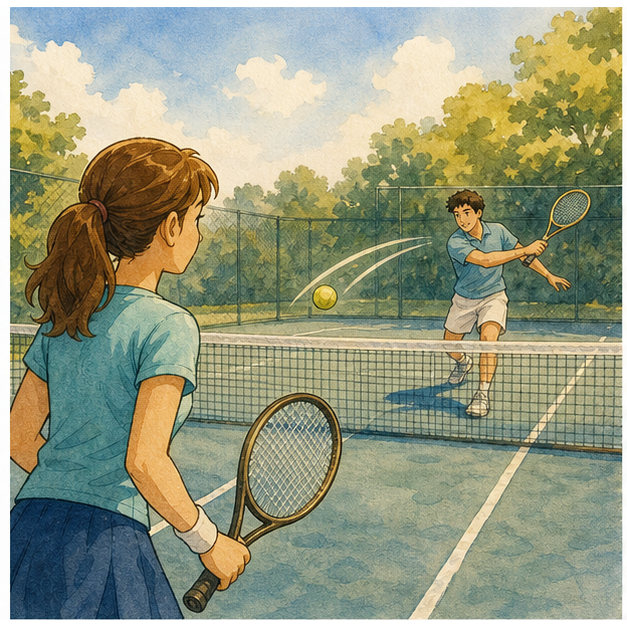
Text to type: A tennis point starts with a serve. The other player tries to return the ball. If both players keep hitting the ball over the net and inside the court, they are in a rally. A rally is like a small conversation with the ball. One player hits deep to push the other player back. The next player may return safely to stay in the point. Then someone may see open space and attack.
Ready. The timer starts with your first key.
Complete
Great job!
Strong finish — your speed stayed steady.
Your rhythm
Speed over time- Time
- 0:00
- Raw speed
- 0 WPM
- Wrong keys
- 0
- Corrected
- 0
Check your understanding
1. What is a rally in tennis?
Sample answer
A rally is the part of a point when players keep hitting the ball over the net and inside the court.
Think one step further
What can feel like a small conversation in another sport, game, or daily situation?
Helpful clue
- A small conversation can happen when...
- Each side answers by...
 Safe Shots and Risky Shots
Reading
2. Safe Shots and Risky Shots
Typing practice
Type the text exactly. Timer starts with your first key.
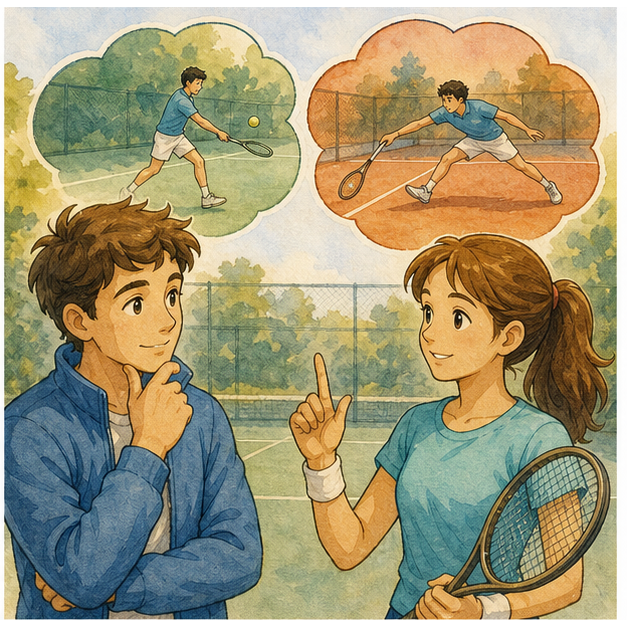
Text to type: A safe shot gives the player more room for error. It often goes higher over the net or deeper into the court. Safe does not mean weak. A deep safe shot can make the opponent move back and wait. A risky shot tries to finish the point faster. It may go close to a line, close to the net, or into a small open space. If it works, the player may win the point. If it misses, the point is over. Good tennis players do not attack every ball. They ask a quick question: Is this a good moment to stay safe, or is this the moment to take a risk?
Ready. The timer starts with your first key.
Complete
Great job!
Strong finish — your speed stayed steady.
Your rhythm
Speed over time- Time
- 0:00
- Raw speed
- 0 WPM
- Wrong keys
- 0
- Corrected
- 0
Check your understanding
1. Why is a safe shot not always weak?
Sample answer
Because a safe shot can still be deep and can make the opponent move back.
Think one step further
When do you choose a safe plan instead of a risky plan?
Helpful clue
- I choose a safe plan when...
- I take a risk when...
 Surfaces Change the Match
Reading
3. Surfaces Change the Match
Typing practice
Type the text exactly. Timer starts with your first key.
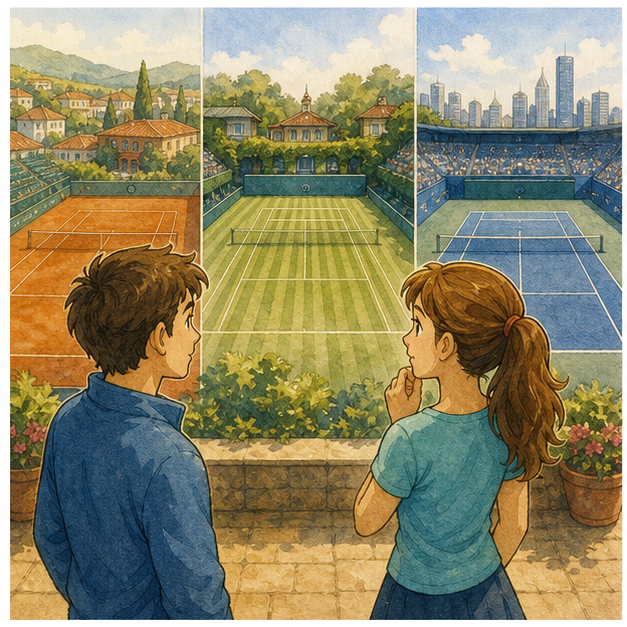
Text to type: Tennis is played on different court surfaces. The main three are clay, grass, and hard court. The surface changes how the ball bounces and how fast a point can feel. Clay often makes the ball slower and higher after the bounce. This can make rallies longer, so patience matters. Grass often makes the ball stay lower and move faster, so quick reactions matter. Hard courts are often more balanced, so many styles can work. The same player may need a different plan on each surface. On clay, one more patient shot may be smart. On grass, a fast first move may be important. On a hard court, balance and timing can matter a lot.
Ready. The timer starts with your first key.
Complete
Great job!
Strong finish — your speed stayed steady.
Your rhythm
Speed over time- Time
- 0:00
- Raw speed
- 0 WPM
- Wrong keys
- 0
- Corrected
- 0
Check your understanding
1. Why do court surfaces matter?
Sample answer
They can change the bounce, speed, and plan of a tennis point.
Think one step further
What activity changes when the place or surface changes?
Helpful clue
- It changes because...
- In that place, people need to...
 Four Tournament Examples
Reading
4. Four Tournament Examples
Typing practice
Type the text exactly. Timer starts with your first key.
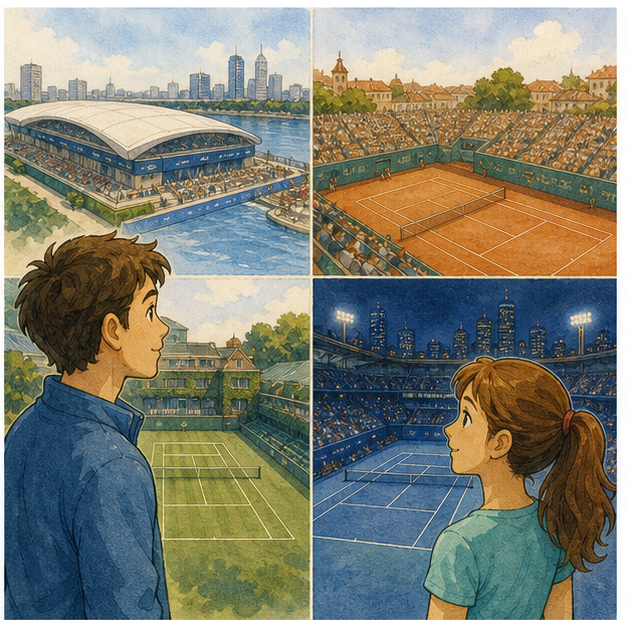
Text to type: The four Grand Slam tournaments show different tennis tests. The Australian Open is on hard courts in Melbourne. Roland-Garros, also called the French Open, is on clay in Paris. Wimbledon is on grass in London. The US Open is on hard courts in New York. These names are not only sports trivia. They show why a player needs more than one plan. On clay, patience can help. On grass, quick reactions can help. On hard courts, timing and balance can help.
Ready. The timer starts with your first key.
Complete
Great job!
Strong finish — your speed stayed steady.
Your rhythm
Speed over time- Time
- 0:00
- Raw speed
- 0 WPM
- Wrong keys
- 0
- Corrected
- 0
Check your understanding
1. Which tournament is played on grass?
Sample answer
Wimbledon is played on grass.
Think one step further
Which tournament example sounds most interesting to you, and why?
Explain a tennis rally in simple English.
What is the difference between a safe shot and a risky shot?
How can clay, grass, and hard court change a match?
Helpful clue
- I am interested in... because...
- That surface sounds...
What you can do now
Final Reflection
Learning cards
My cards
Tennis: Rallies, Court Surfaces, and Smart Choices
0 due · 17 new · about 3 min
Learn the sense first · then retrieve it
Focused Reading Mode is open.
Listening
Lesson audio
Listen from the beginning, or choose “Play this part” as you read along.
Reading
1. What a Rally Is
Reading
2. Safe Shots and Risky Shots
Reading
3. Surfaces Change the Match
Reading
4. Four Tournament Examples
Finished listening?
Mark this listening practice complete when you have followed the lesson audio.
Listening complete
Listen Mode
Word-by-word syncPlay the audio and follow the highlighted word.
Article complete
Choose your next step
Open the next same-level lesson, replay the article, or save this page for later.
Listen Again
Replay the article once and notice how much more you understand.
One replay is enough. Then move on.