Italy: Food, Famous Places, and History
Quality checked lesson
Learn real facts about Italy, including its map, local food, Rome, Venice, Florence, and why history is visible in everyday places.
 English lesson
Article
Choose how to use this lesson
You can switch anytime.
Study mode
Introduction
Lesson Goal · Introduction
Typing practice
Type the text exactly. Timer starts with your first key.
Text to type: Learn real facts about Italy, including its map, local food, Rome, Venice, Florence, and why history is visible in everyday places. Italy is in Southern Europe. It reaches into the Mediterranean Sea, with mountains in the north, long coastlines, and large islands like Sicily and Sardinia. You use English to understand Italy through real names: Naples, Rome, the Colosseum, Venice, Florence, and the Renaissance. The goal is not to memorize a list. The goal is to see how food, places, and history connect.
Ready. The timer starts with your first key.
Complete
Great job!
Strong finish — your speed stayed steady.
Your rhythm
Speed over time- Time
- 0:00
- Raw speed
- 0 WPM
- Wrong keys
- 0
- Corrected
- 0
Before you begin
Warm-Up Questions
What real place in Italy do you already know?
Would you rather learn about food, old buildings, art, or daily life?
Why can one country have many different local worlds?
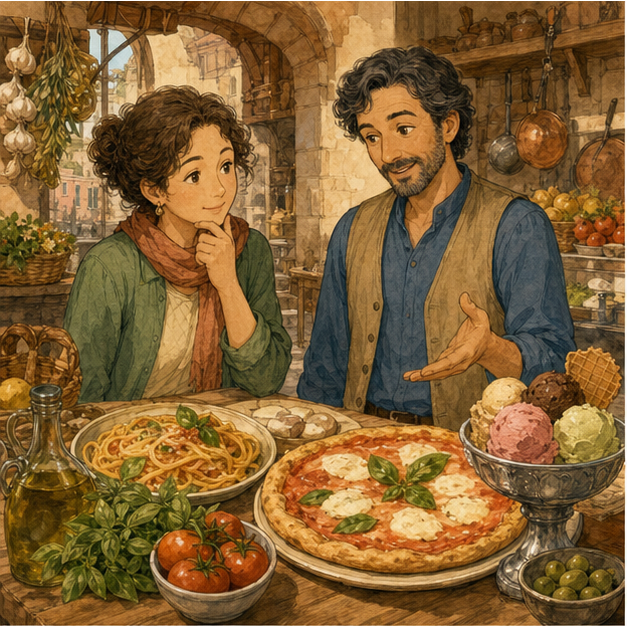
Italian food is local: Naples and pizza, pasta by region, and gelato.Reading
1. Food Is Local, Not Just Famous
Typing practice
Type the text exactly. Timer starts with your first key.
Text to type: Italian food is famous around the world, but in Italy food is often local. A dish can belong strongly to one city or region. Pizza is closely connected with Naples. UNESCO lists the skill of Neapolitan pizza makers as important culture. This means people protect it as a food tradition from the past. Pasta also changes from place to place. Different regions use different shapes, sauces, cheeses, and local ingredients. Gelato is another famous food word. Good gelato is usually softer than hard ice cream, so the flavor is easy to taste. The useful question is not only about national food. A stronger food question asks what is local in this city or region.
Ready. The timer starts with your first key.
Complete
Great job!
Strong finish — your speed stayed steady.
Your rhythm
Speed over time- Time
- 0:00
- Raw speed
- 0 WPM
- Wrong keys
- 0
- Corrected
- 0
Check your understanding
1. Why is "What is local here?" a useful food question in Italy?
Sample answer
Because food changes by city and region, so local food can teach local culture.
Think one step further
What food from your area feels local, not just national?
Helpful clue
- In my area,... feels local.
- People often eat it when...
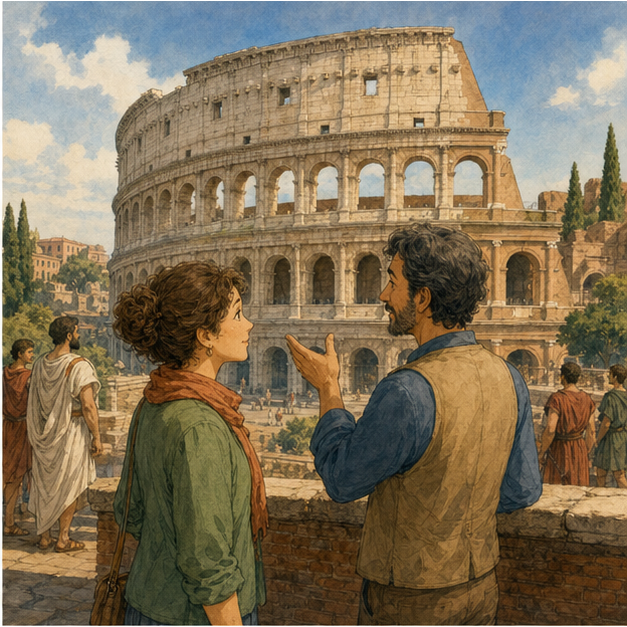 Rome connects modern city life with ancient public places like the Colosseum.
Reading
2. Rome Connects the Present and Ancient History
Typing practice
Type the text exactly. Timer starts with your first key.
Text to type: Rome is the capital of Italy. It is also a city where modern life and ancient history stand close together. A normal walk can pass a cafe, a busy street, and a very old stone wall. The Colosseum is one of the clearest examples. It was a large Roman amphitheater for public events. It shows that ancient Rome built huge public places, and some of them are still part of the city. The Roman Forum was once a center of public life in ancient Rome. The Pantheon is also famous because its large dome still shows Roman building skill. Rome teaches a simple world fact: history is not only in books. In some cities, history is in the streets.
Ready. The timer starts with your first key.
Complete
Great job!
Strong finish — your speed stayed steady.
Your rhythm
Speed over time- Time
- 0:00
- Raw speed
- 0 WPM
- Wrong keys
- 0
- Corrected
- 0
Check your understanding
1. What does Rome teach about history?
Sample answer
Rome shows that history can be visible in streets, buildings, and public places.
Think one step further
Is there a place near you where old history is still visible?
Helpful clue
- In my city, old history is visible in...
- A visitor can see...
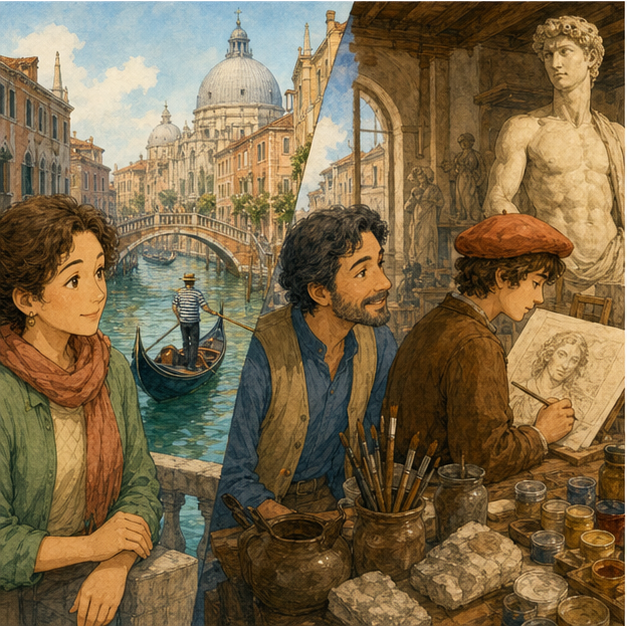 Venice teaches water city life; Florence teaches art and the Renaissance.
Reading
3. Venice and Florence Tell Different Stories
Typing practice
Type the text exactly. Timer starts with your first key.
Text to type: Venice tells a water story. It was built in a lagoon, with canals, bridges, and boats. Water shapes movement in the city. Places like the Grand Canal and the Rialto Bridge help visitors understand why Venice feels different. Florence tells an art story. It is closely connected with the Renaissance, a time when art, science, building, and learning grew in new ways. The city is famous for places like the Cathedral of Santa Maria del Fiore and the Uffizi Galleries. Venice and Florence are both Italian, but they do not teach the same thing. Venice teaches water, trade, and city movement. Florence teaches art, ideas, and Renaissance buildings. This is why real place names matter. They help learners understand the world more clearly in English.
Ready. The timer starts with your first key.
Complete
Great job!
Strong finish — your speed stayed steady.
Your rhythm
Speed over time- Time
- 0:00
- Raw speed
- 0 WPM
- Wrong keys
- 0
- Corrected
- 0
Check your understanding
1. How are Venice and Florence different?
Sample answer
Venice teaches a water city story, while Florence teaches an art and Renaissance story.
Think one step further
Which city would you choose first, Venice or Florence? Why?
Helpful clue
- I would choose... because...
- I want to learn about...
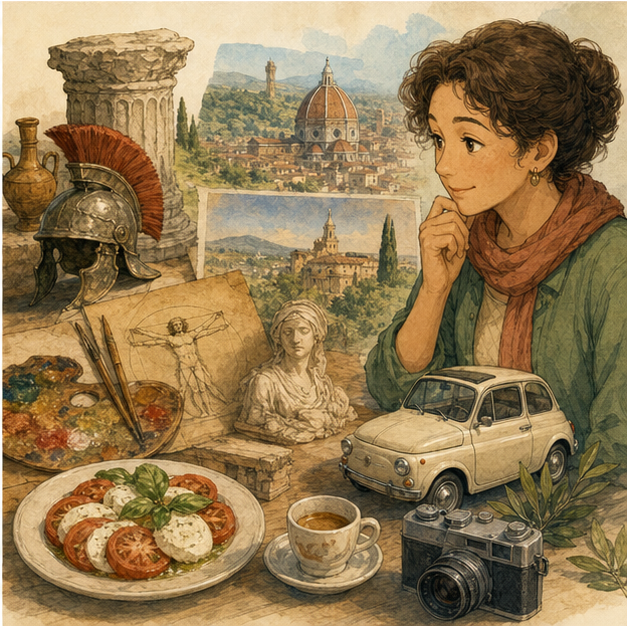 Italy has mountains, coastlines, islands, old cities, and many local histories.
Reading
4. The Map and History Make Many Local Worlds
Typing practice
Type the text exactly. Timer starts with your first key.
Text to type: Italy looks like a long boot on the map. This shape matters because the sea is close to many parts of the country. Italy also has the Alps in the north and the Apennine Mountains running down the country. Because the land changes, local life changes too. The north has mountain areas and business cities. Central Italy has hill towns, farms, and famous art cities. The south has warm coastlines and strong food traditions. Sicily and Sardinia are large islands with their own local stories. Italy's long history also changes from place to place. Ancient Rome, Venice as a sea city, Florence in the Renaissance, Naples and food culture, and the islands all show different parts of the country.
Ready. The timer starts with your first key.
Complete
Great job!
Strong finish — your speed stayed steady.
Your rhythm
Speed over time- Time
- 0:00
- Raw speed
- 0 WPM
- Wrong keys
- 0
- Corrected
- 0
Check your understanding
1. Why is Italy not one simple picture?
Sample answer
Italy has different landscapes, cities, islands, food traditions, and historical stories.
Think one step further
Which part of Italy sounds most interesting to you: mountains, islands, old towns, or big cities?
What does Italy's map help explain?
Why is Naples important for pizza?
What can the Colosseum teach visitors?
Helpful clue
- I am interested in... because...
- I want to see...
What you can do now
Final Reflection
Learning cards
My cards
Italy: Food, Famous Places, and History
0 due · 11 new · about 3 min
Learn the sense first · then retrieve it
Focused Reading Mode is open.
Listening
Lesson audio
Listen from the beginning, or choose “Play this part” as you read along.
Reading
1. Food Is Local, Not Just Famous
Reading
2. Rome Connects the Present and Ancient History
Reading
3. Venice and Florence Tell Different Stories
Reading
4. The Map and History Make Many Local Worlds
Finished listening?
Mark this listening practice complete when you have followed the lesson audio.
Listening complete
Listen Mode
Word-by-word syncPlay the audio and follow the highlighted word.
Article complete
Choose your next step
Open the next same-level lesson, replay the article, or save this page for later.
Listen Again
Replay the article once and notice how much more you understand.
One replay is enough. Then move on.