Why We Feel Like Our Phone Is Part of Our Body
Quality checked lesson
Many people feel that their phone is not just a tool, but something very close to them. You will learn why that happens in simple English.
 English lesson
Article
Choose how to use this lesson
You can switch anytime.
Study mode
Introduction
Typing practice
Type the text exactly. Timer starts with your first key.
Text to type: Many people feel that their phone is not just a tool, but something very close to them. You will learn why that happens in simple English. We will look at three main ideas: separation from the phone can feel uncomfortable because it gives access to people and plans; checking the phone again and again can become a habit; and phones can work like an outside memory for maps, notes, messages, and photos.
Ready. The timer starts with your first key.
Complete
Great job!
Strong finish — your speed stayed steady.
Your rhythm
Speed over time- Time
- 0:00
- Raw speed
- 0 WPM
- Wrong keys
- 0
- Corrected
- 0
Before you begin
Warm-Up Questions
How often do you check your phone without thinking?
How do you feel when your phone is not in your pocket or bag?
What do you use your phone for most often: messages, maps, photos, calendar, or something else?
Do you ever feel that your phone helps you remember things better than your own memory?
Show a public space design moment where a small playful change makes a better everyday choice easier to notice and enjoy, with no readable text.Reading
1. When the Phone Feels Like Access to the World
Typing practice
Type the text exactly. Timer starts with your first key.
Text to type: For many people, the phone is connected to daily life in a very practical way. It is the place where messages arrive, plans are stored, and contact with other people is kept. Because of that, leaving the phone behind can feel bigger than forgetting an object. It can feel like losing access to your social world and your daily organisation. A simple example is noticing an empty pocket. A person may suddenly feel uneasy, even before they remember where the phone is. That feeling is not only about the object itself. It is also about the possible loss of access: no messages, no calls, no maps, no schedule, no photos. This idea helps explain why some people describe the phone as part of the body. It is not literal biology. The phone is not physically part of the brain or the body. But it can still feel emotionally close, because it is tied to communication, safety, and planning. Researchers have also found interesting results in this area. In one study, separated iPhone users who could hear their phone ring showed worse emotional and physical reactions and did worse on a word-search task. This does not prove that everyone reacts strongly, but it suggests that separation can matter for some people.
Ready. The timer starts with your first key.
Complete
Great job!
Strong finish — your speed stayed steady.
Your rhythm
Speed over time- Time
- 0:00
- Raw speed
- 0 WPM
- Wrong keys
- 0
- Corrected
- 0
Check your understanding
1. Why can leaving the phone behind feel uncomfortable for some people?
Sample answer
For many people, the phone is connected to daily life in a very practical way.
Think one step further
Do you think your phone feels more like a tool, a habit, or a part of your daily life? Why?
 Show several commuters choosing the piano stairs while the escalator remains nearby, making the behavior change visible through body language only.
Reading
2. Short Checking Can Become a Habit
Typing practice
Type the text exactly. Timer starts with your first key.
Text to type: Another reason phones feel almost body-like is habit. Many people check their phones in very small, repeated moments: while waiting, while walking, or after hearing a sound. Over time, this behavior can become automatic. The important point is that the checking is often triggered by context. A person sees a pause in the day, feels a small moment of boredom, or hears a notification, and reaches for the phone without a clear decision. The action becomes fast and familiar, like a routine the body already knows. This is one reason the phone can feel close to the hand or the pocket. The movement becomes so repeated that it starts to feel natural. People may unlock the screen even when they do not need anything specific. The hand moves before the mind fully explains why. Research on smartphone habits has supported this idea. One study found that short checking behaviors can become habitual and are often linked to the situation around the user. This is useful because it shows that phone use is not only about choice in the moment. It is also about automatic patterns built by repetition.
Ready. The timer starts with your first key.
Complete
Great job!
Strong finish — your speed stayed steady.
Your rhythm
Speed over time- Time
- 0:00
- Raw speed
- 0 WPM
- Wrong keys
- 0
- Corrected
- 0
Check your understanding
1. What makes short phone checking become automatic?
Sample answer
Another reason phones feel almost body-like is habit.
Think one step further
What situations make you check your phone almost without thinking?
Helpful clue
- You can mention triggers such as waiting, boredom, silence, stress, or hearing a notification.
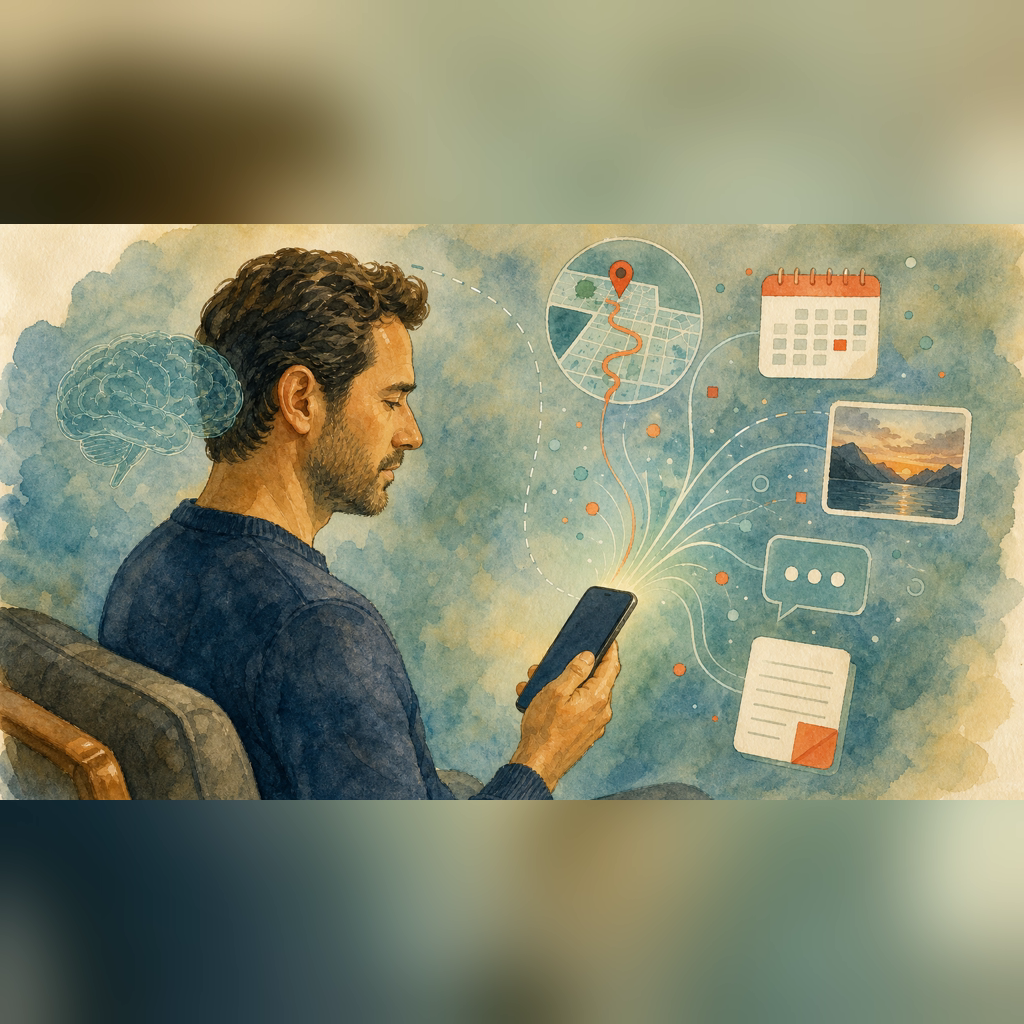 Show a public space design moment where a small playful change makes a better everyday choice easier to notice and enjoy, with no readable text.
Reading
3. The Phone as Outside Memory
Typing practice
Type the text exactly. Timer starts with your first key.
Text to type: A third reason is that phones store information for us. People often use maps to find places, calendars to remember appointments, messages to keep track of plans, photos to save moments, and notes to store ideas. In this sense, the phone acts like an external memory system. This does not mean that the phone replaces human memory completely. It means that people often trust it with information they do not want to keep in their heads all the time. If a phone remembers an address, a time, or a shopping list, the brain can focus on something else. This is where the phrase second brain becomes useful as a metaphor. It is a way of saying that the phone helps with thinking and remembering. It is not a scientific claim that the phone is literally part of the brain. It is a practical idea about how people use tools to support memory. This idea has a long philosophical background. In the extended mind view, some reliable outside tools can become part of thinking because people depend on them again and again. The phone is a modern example of this idea in daily life.
Ready. The timer starts with your first key.
Complete
Great job!
Strong finish — your speed stayed steady.
Your rhythm
Speed over time- Time
- 0:00
- Raw speed
- 0 WPM
- Wrong keys
- 0
- Corrected
- 0
Check your understanding
1. What kinds of information do people often store on their phones?
Sample answer
A third reason is that phones store information for us.
Think one step further
What is one thing your phone remembers for you that you might forget on your own?
 Show a public space design moment where a small playful change makes a better everyday choice easier to notice and enjoy, with no readable text.
Reading
4. What Research Suggests, and What It Does Not Prove
Typing practice
Type the text exactly. Timer starts with your first key.
Text to type: It is important to be careful with this topic. Some studies show strong effects, but the overall evidence is mixed. That means different studies do not always find the same result, and results can depend on the design of the research. For example, one well-known study found that when people’s own smartphones were present, they sometimes had less available cognitive capacity, especially if they were more dependent users. This is an interesting result, but it is not the final word on the subject. Other research reviews suggest that the effect of phone presence is sensitive to the method used in the study. In simple language, this means the science is not settled in a single, simple way. Phones may affect some people more than others, and some situations may matter more than others. This is a good reminder for learners: a strong feeling does not always mean a universal rule. Many people feel closely connected to their phones, but not everyone reacts in the same way. Good discussion should keep both ideas in mind: the phone can feel important, and the science is still developing.
Ready. The timer starts with your first key.
Complete
Great job!
Strong finish — your speed stayed steady.
Your rhythm
Speed over time- Time
- 0:00
- Raw speed
- 0 WPM
- Wrong keys
- 0
- Corrected
- 0
Check your understanding
1. Why should we be careful about making universal claims in this topic?
Sample answer
It is important to be careful with this topic.
Think one step further
Do you think most people feel affected by their phones, or only some people in some situations? Explain your view.
Reading
5. Everyday Scenes That Show the Idea
Typing practice
Type the text exactly. Timer starts with your first key.
Text to type: The idea becomes clearer in ordinary life. Think about three common scenes. First, a person notices an empty pocket and feels a small shock. This shows how quickly the phone is linked to security and access. Second, a person unlocks the phone without a clear reason. This shows how checking can become a habit, not just a decision. Third, a person uses maps, calendars, messages, photos, and notes all in one day. This shows how the phone can act like an external memory system, helping with daily life in many small ways. These scenes are ordinary, but they are powerful. They show that the phone is not only an object we carry. It is also a system for connection, memory, and routine. That is why it can feel like part of the body or mind, even though it is still a separate device. Real-life examples help us see this clearly. Apple’s iPhone is a strong example because many users keep it close for communication, scheduling, and media. Google Maps shows how people rely on the phone for navigation instead of remembering every route. Digital calendars, such as those used on many phones, show how planning moves from the head into the device. These examples show the same pattern: the phone supports tasks that used to depend more on memory and attention.
Ready. The timer starts with your first key.
Complete
Great job!
Strong finish — your speed stayed steady.
Your rhythm
Speed over time- Time
- 0:00
- Raw speed
- 0 WPM
- Wrong keys
- 0
- Corrected
- 0
Check your understanding
1. Which everyday scene shows habit, and which scene shows outside memory?
Sample answer
The idea becomes clearer in ordinary life.
Think one step further
Which of the three scenes feels most familiar to you? Why?
What you can do now
Final Reflection
Learning cards
My cards
Why We Feel Like Our Phone Is Part of Our Body
0 due · 13 new · about 3 min
Learn the sense first · then retrieve it
Focused Reading Mode is open.
Listening
Lesson audio
Listen from the beginning, or choose “Play this part” as you read along.
Reading
1. When the Phone Feels Like Access to the World
Reading
2. Short Checking Can Become a Habit
Reading
3. The Phone as Outside Memory
Reading
4. What Research Suggests, and What It Does Not Prove
Reading
5. Everyday Scenes That Show the Idea
Finished listening?
Mark this listening practice complete when you have followed the lesson audio.
Listening complete
Listen Mode
Word-by-word syncPlay the audio and follow the highlighted word.
Article complete
Choose your next step
Open the next same-level lesson, replay the article, or save this page for later.
Listen Again
Replay the article once and notice how much more you understand.
One replay is enough. Then move on.