Coffee Knowledge 3: Blends, Origins, and Roasts
Quality checked lesson
Coffee bags and café menus often use words such as blend, single origin, light roast, and dark roast. You will learn what these words mean and how to explain a coffee to a customer in clear English.
 English lesson
Article
Choose how to use this lesson
You can switch anytime.
Study mode
Introduction
Typing practice
Type the text exactly. Timer starts with your first key.
Text to type: Coffee bags and café menus often use words such as blend, single origin, light roast, and dark roast. You will learn what these words mean and how to explain a coffee to a customer in clear English.
Ready. The timer starts with your first key.
Complete
Great job!
Strong finish — your speed stayed steady.
Your rhythm
Speed over time- Time
- 0:00
- Raw speed
- 0 WPM
- Wrong keys
- 0
- Corrected
- 0
Before you begin
Warm-Up Questions
What information do you notice on a coffee bag?
Do you like chocolate, nut, fruit, or flower flavours?
What makes a coffee easy to drink with milk?
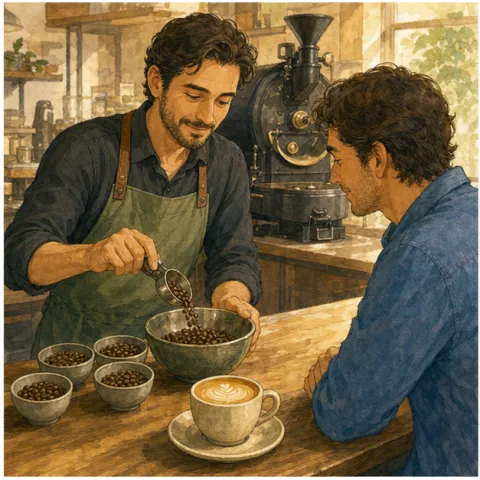
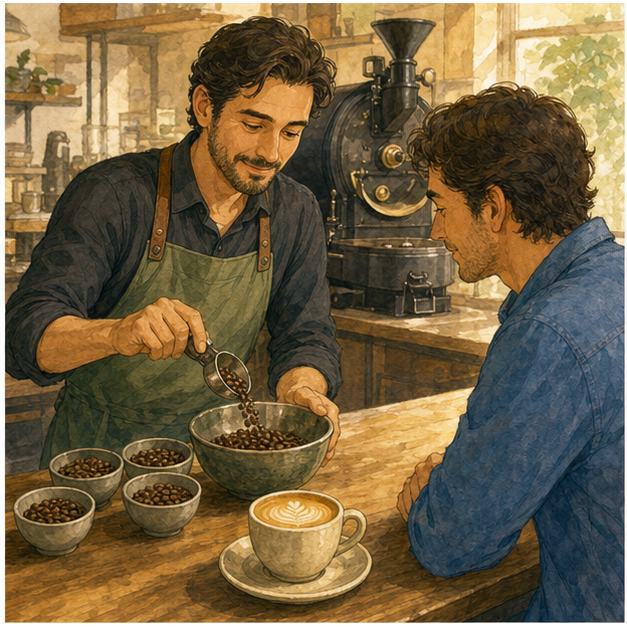 A barista combines beans from several bowls into one house blend beside a milk coffee.
Reading
1. What Is a Blend?
Typing practice
Type the text exactly. Timer starts with your first key.
Text to type: A blend combines two or more coffees. The coffees may come from different farms, regions, countries, plant varieties, or processing methods. A roaster chooses the parts carefully to make one planned flavour. Blends can help a café offer a stable house coffee through the year. If one seasonal coffee changes, the roaster can adjust another part of the blend. Many espresso blends are also designed to keep a clear coffee taste when milk is added. They may have familiar chocolate, caramel, or nut flavours that work well in a flat white or latte.
Ready. The timer starts with your first key.
Complete
Great job!
Strong finish — your speed stayed steady.
Your rhythm
Speed over time- Time
- 0:00
- Raw speed
- 0 WPM
- Wrong keys
- 0
- Corrected
- 0
Check your understanding
1. Why do cafés often use blends for milk drinks?
Sample answer
Roasters can design blends to keep a clear, balanced coffee flavour when milk is added.
Think one step further
What flavours would you choose for a house blend?
Helpful clue
- I would choose __ and __ flavours.
- These flavours may work well with milk.
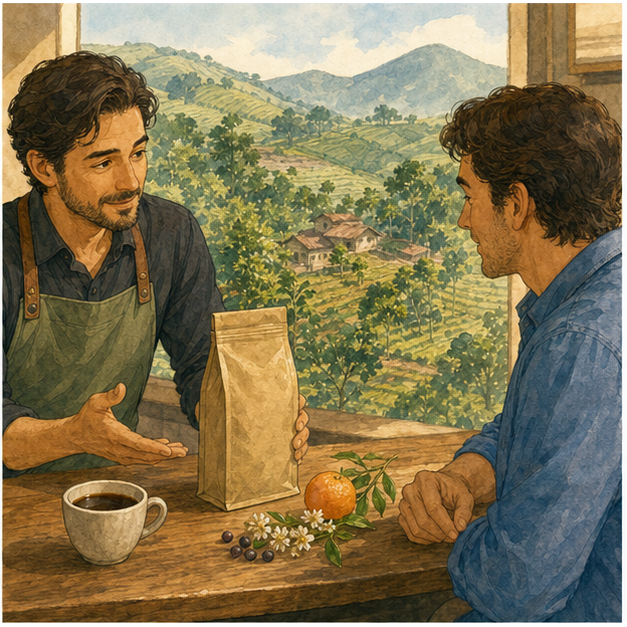 One coffee bag and cup are connected visually to one specific highland farm origin.
Reading
2. What Is Single Origin?
Typing practice
Type the text exactly. Timer starts with your first key.
Text to type: Single origin means the coffee comes from one defined origin. The origin can be a country, a region, a cooperative, one farm, or even one small lot. The label should tell the customer how specific the origin is. Cafés often serve single-origin coffee when they want people to notice a special flavour. One coffee may remind people of berries or citrus. Another may have chocolate, nuts, or flowers. These words describe flavour memories. They do not usually mean that berries, chocolate, or flowers were added to the beans.
Ready. The timer starts with your first key.
Complete
Great job!
Strong finish — your speed stayed steady.
Your rhythm
Speed over time- Time
- 0:00
- Raw speed
- 0 WPM
- Wrong keys
- 0
- Corrected
- 0
Check your understanding
1. Does single origin always mean one farm?
Sample answer
No. It can mean one country, region, cooperative, farm, or individual lot.
Think one step further
Which flavour note would make you curious about a coffee?
Helpful clue
- I would like to try a coffee with __ notes.
- It sounds __.
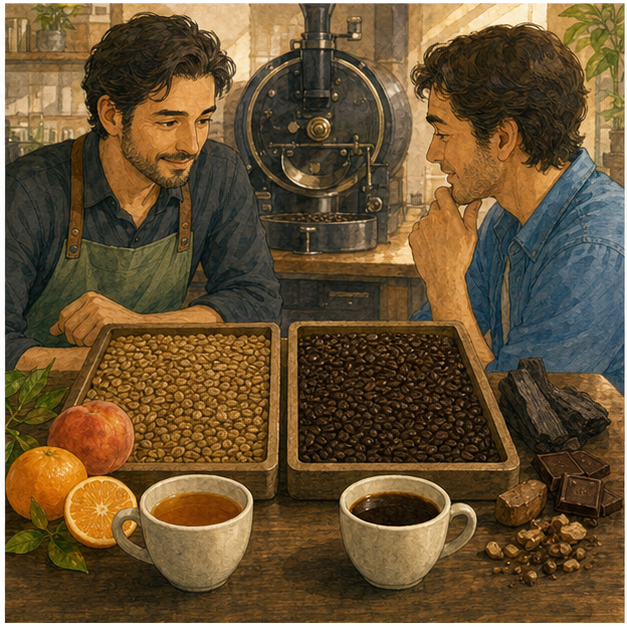 Light and dark roasted beans and cups are compared beside a small coffee roaster.
Reading
3. Light and Dark Roasts
Typing practice
Type the text exactly. Timer starts with your first key.
Text to type: Roasting changes green coffee into brown, aromatic coffee. A light roast usually keeps more of the coffee's original fruit, flower, and bright character. It may also feel lighter in the mouth. A dark roast develops more roasted flavours. It may taste more bitter, smoky, or like dark chocolate. Light does not always mean weak, and dark does not always mean stronger caffeine. Roast level mainly tells us how far the roaster developed the beans. The final strength in the cup also depends on the dose, water, recipe, and brewing method.
Ready. The timer starts with your first key.
Complete
Great job!
Strong finish — your speed stayed steady.
Your rhythm
Speed over time- Time
- 0:00
- Raw speed
- 0 WPM
- Wrong keys
- 0
- Corrected
- 0
Check your understanding
1. What flavours are more common in a dark roast?
Sample answer
Dark roasts more often have roasted, bitter, smoky, or dark-chocolate flavours.
Think one step further
Would you choose a light or dark roast for your next coffee? Why?
Helpful clue
- I would choose a __ roast because __.
- I prefer __ flavours.
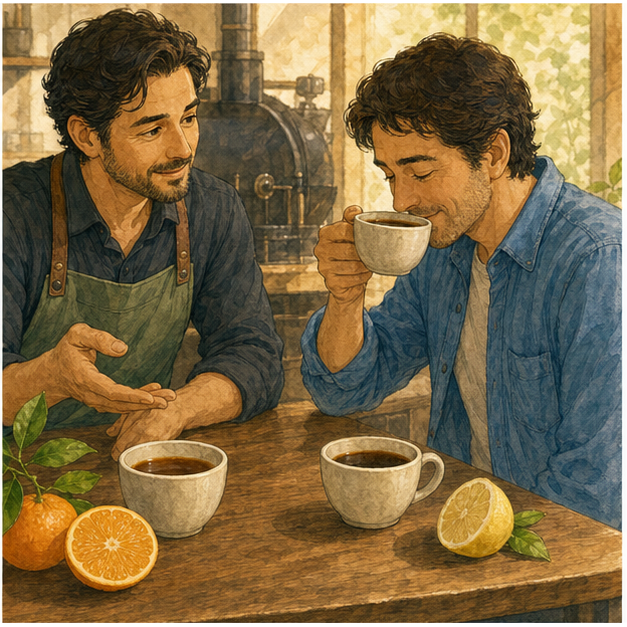 A barista helps a customer compare bright balanced acidity with a sharper sour cup.
Reading
4. Acidity Is Not Always Sourness
Typing practice
Type the text exactly. Timer starts with your first key.
Text to type: Coffee professionals often use the word acidity for a bright, lively taste. Pleasant acidity can remind people of orange, apple, berries, or sparkling fruit. It can make a coffee feel fresh and interesting. Bad sourness is different. It can taste sharp, aggressive, and unbalanced. A poorly made espresso may taste sour because the water did not take enough flavour from the coffee. However, a fruity light roast can be well made and still have pleasant acidity. A good barista listens carefully before deciding that a customer dislikes all acidity.
Ready. The timer starts with your first key.
Complete
Great job!
Strong finish — your speed stayed steady.
Your rhythm
Speed over time- Time
- 0:00
- Raw speed
- 0 WPM
- Wrong keys
- 0
- Corrected
- 0
Check your understanding
1. What is the difference between pleasant acidity and unpleasant sourness?
Sample answer
Pleasant acidity is bright and balanced, while unpleasant sourness is sharp and unbalanced.
Think one step further
How could you explain acidity without making it sound negative?
Helpful clue
- It has a bright taste like __.
- It is fruity and balanced, not sharply sour.
- Would you like something rounder and more chocolate-like?
Reading
Useful Speaking Patterns
Typing practice
Type the text exactly. Timer starts with your first key.
Text to type: - This is our house blend. - It has __ flavours and works well with milk. - This single origin is lighter and fruitier. - It is bright and balanced, not sharply sour.
Ready. The timer starts with your first key.
Complete
Great job!
Strong finish — your speed stayed steady.
Your rhythm
Speed over time- Time
- 0:00
- Raw speed
- 0 WPM
- Wrong keys
- 0
- Corrected
- 0
Story
Typing practice
Type the text exactly. Timer starts with your first key.
Text to type: A customer usually drinks dark-roasted coffee with milk. Today, the barista offers a house blend and a lighter single origin.
Ready. The timer starts with your first key.
Complete
Great job!
Strong finish — your speed stayed steady.
Your rhythm
Speed over time- Time
- 0:00
- Raw speed
- 0 WPM
- Wrong keys
- 0
- Corrected
- 0
Roleplay
Dialogue Practice Role-play
Practise with the dialogue audio
Read once.
Customer
I usually drink dark-roasted coffee. What is your house coffee like?
Barista
Our house blend has chocolate and caramel flavours. It works well with milk.
Customer
And what is the single origin like?
Barista
It is lighter and fruitier, with a bright orange-like acidity.
Customer
Is it very sour?
Barista
No. It is bright but balanced. The house blend is rounder and less fruity.
Customer
I think I will try the house blend as a flat white today.
Barista
Great choice. I will make that for you now.
Customer
Thanks for explaining it clearly.
Barista
You're welcome. I will call your name when it is ready.
Customer
Great. Thank you.
Barista
Have a good day.
Speak
Final Speaking Task
Explain why a café may use a blend and what single origin means.
Compare a light roast and a dark roast.
Recommend one coffee to a customer who wants milk and a strong coffee flavour.
What you can do now
Final Reflection
Learning cards
My cards
Coffee Knowledge 3: Blends, Origins, and Roasts
0 due · 10 new · about 3 min
Learn the sense first · then retrieve it
Focused Reading Mode is open.
Listening
Lesson audio
Listen from the beginning, or choose “Play this part” as you read along.
Reading
1. What Is a Blend?
Reading
2. What Is Single Origin?
Reading
3. Light and Dark Roasts
Reading
4. Acidity Is Not Always Sourness
Finished listening?
Mark this listening practice complete when you have followed the lesson audio.
Listening complete
Listen Mode
Word-by-word syncPlay the audio and follow the highlighted word.
Article complete
Choose your next step
Open the next same-level lesson, replay the article, or save this page for later.
Listen Again
Replay the article once and notice how much more you understand.
One replay is enough. Then move on.