Meeting New People at a Language Exchange Café
Quality checked lesson
At a café language exchange, you trade languages with new people, write your languages on a sticker, say your name with a handshake, and ask follow-up questions.
 English lesson

Article
Choose how to use this lesson
You can switch anytime.
Study mode
Introduction
Typing practice
Type the text exactly. Timer starts with your first key.
Text to type: Today we visit a language exchange in a café. We learn how the evening works, how to order and how to introduce yourself. Then we practise keeping a conversation going with new people.
Ready. The timer starts with your first key.
Complete
Great job!
Strong finish — your speed stayed steady.
Your rhythm
Speed over time- Time
- 0:00
- Raw speed
- 0 WPM
- Wrong keys
- 0
- Corrected
- 0
Before you begin
Warm-up
Do you like meeting new people? Why or why not?
What do you usually say first when you meet someone new?
Which language would you like to practise with a native speaker?
 Part 1: How a Language Exchange Works
Reading
Part 1: How a Language Exchange Works
Typing practice
Type the text exactly. Timer starts with your first key.
Text to type: A language exchange is a trade: you give something, and you get something. You help someone with your language, and they help you with theirs. For example, you speak Japanese and want to practise English. Then you look for an English speaker who wants to practise Japanese. Many language cafés split the time in half. You talk in one language for half an hour. Then you talk in the other language for half an hour. This way, both people get the same time to learn. In this lesson, you visit the Dutch Language Café in The Hague. The Hague is a city in the Netherlands. On Thursday evenings, its language exchange starts at 19:30. When you arrive, you tell the host: I'm here for the language exchange. But how do you find the right person in a busy room? The café gives you a language sticker. You write your languages on it and wear it. You write your native language and the languages you want to practise. Your native language is the first language you learned as a child. Other people look at your sticker and know your languages at once. They often ask too: Which languages do you speak? You answer: My native language is Japanese. At 20:00, the speed exchange starts. You talk with one person for 3 minutes. Then you move to the next person. Why so short? This way, you meet many people quickly. Later, everyone sits at language tables, for example an English table.
Ready. The timer starts with your first key.
Complete
Great job!
Strong finish — your speed stayed steady.
Your rhythm
Speed over time- Time
- 0:00
- Raw speed
- 0 WPM
- Wrong keys
- 0
- Corrected
- 0
Check your understanding
Check: Part 1: How a Language Exchange Works
1. What do you write on your sticker at the Dutch Language Café, and why?
Sample answer
Your languages, so other people can see which languages you speak and practise.
Useful language
Useful phrases
- I'm here for the language exchange
- when you arriveHi! I'm here for the language exchange.
- Which languages do you speak?
- to ask about someone's languagesHi! Which languages do you speak?
- My native language is
- to say your first languageMy native language is Japanese.
 Part 2: Ordering at the Café
Reading
Part 2: Ordering at the Café
Typing practice
Type the text exactly. Timer starts with your first key.
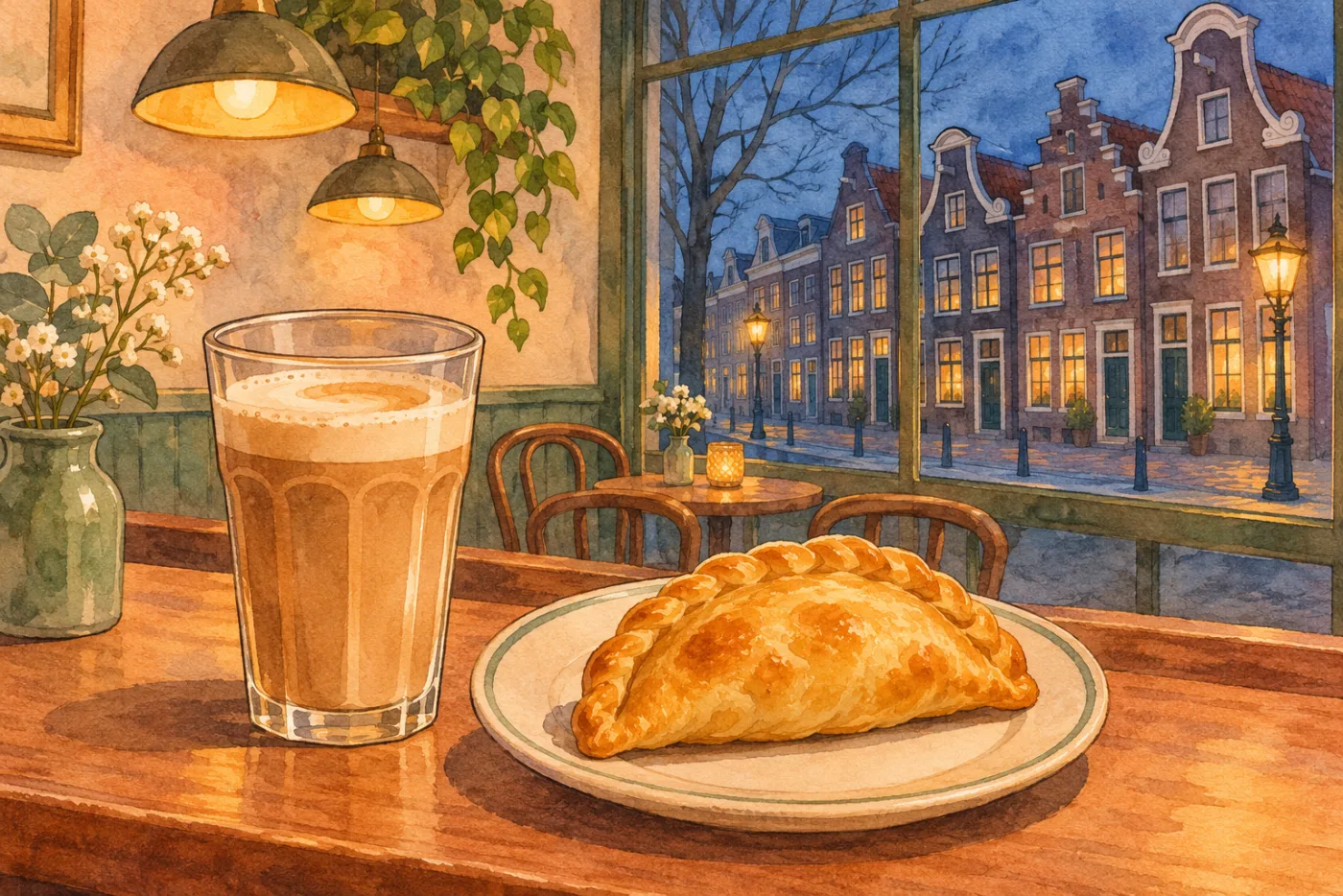
Text to type: At the Dutch Language Café, the Thursday ticket costs €11. The ticket pays for snacks and games. The snacks are things like popcorn and nuts. You ask the host: Are the snacks included? The host says yes. But drinks are not in the ticket, so you buy them at the bar. On the menu, you see a funny name: koffie verkeerd. In English, koffie verkeerd is wrong coffee. Why wrong? A normal Dutch coffee has only a little milk. Koffie verkeerd has more milk than coffee, so it is the wrong way around. At the bar, you order: Can I have a koffie verkeerd, please? Then you ask: How much is it? It costs €4.00. If you are hungry, you ask the waiter: What is an empanada? It is a small pastry, with cheese, meat or vegetables inside. An empanada costs €6.50.
Ready. The timer starts with your first key.
Complete
Great job!
Strong finish — your speed stayed steady.
Your rhythm
Speed over time- Time
- 0:00
- Raw speed
- 0 WPM
- Wrong keys
- 0
- Corrected
- 0
Check your understanding
Check: Part 2: Ordering at the Café
1. What does koffie verkeerd mean, and why?
Sample answer
Wrong coffee, because it has more milk than coffee.
Useful language
Useful phrases
- Can I have
- to order somethingCan I have a koffie verkeerd, please?
- What is an empanada?
- to ask about the menuWhat is an empanada?
- How much is it?
- to ask the priceThank you. How much is it?
- Are the snacks included?
- to ask about your ticketAre the snacks included?
 Part 3: Introducing Yourself
Reading
Part 3: Introducing Yourself
Typing practice
Type the text exactly. Timer starts with your first key.
Text to type: In the Netherlands, people shake hands when they meet someone new. At the same time, they say their name: Hi! I'm Sanne. Often they say only their first name. In Japan, many people bow, or bend forward, and say their family name. But for Dutch people, a hello without a name is rude, or not polite. Why? Dutch people like to be clear, so they start with a name. When you hear a new name, you say your name too. Then you say: Nice to meet you. The first time you meet a Dutch person, do not ask: How are you? Many Dutch people use this question only with people they already know. A stranger is a person you do not know. If a stranger asks this, a Dutch person may think you met before. They may think they forgot you! In a 3-minute speed exchange, you do not have much time. So say three things: your name, your city and why you study the language. Lucía from Spain says: Hi! I'm Lucía. I'm from Valencia. I study Dutch because I work in The Hague. The last part is the most useful. It gives people a question to ask, for example: Where do you work? Then Lucía asks: What about you?
Ready. The timer starts with your first key.
Complete
Great job!
Strong finish — your speed stayed steady.
Your rhythm
Speed over time- Time
- 0:00
- Raw speed
- 0 WPM
- Wrong keys
- 0
- Corrected
- 0
Check your understanding
Check: Part 3: Introducing Yourself
1. Why should you not ask a Dutch stranger: How are you?
Sample answer
They may think you met before.
Useful language
Useful phrases
- Nice to meet you
- after you hear a nameHi, Sanne! Nice to meet you.
- I'm from
- to say your cityI'm from Osaka.
- What about you?
- to ask the same question backI'm from Osaka. What about you?
 Part 4: Keeping the Conversation Going
Reading
Part 4: Keeping the Conversation Going
Typing practice
Type the text exactly. Timer starts with your first key.
Text to type: The best tool for a long conversation is the follow-up question. This is a question about what the other person just said. Lucía says: I work at a hotel. A new question jumps to a new idea: Do you like football? A follow-up question stays with her idea: What do you do at the hotel? Lucía also says: I moved here from Valencia. Each follow-up question uses one part of what she says. You ask about her reason: Really? Why did you move here? You ask about her city: What is Valencia like? You ask about time: How long have you lived here? In 2017, scientists at Harvard University studied how strangers talk. People who asked more questions were liked more by their partners. Follow-up questions worked best of all. Why? A follow-up question shows that you are really listening. At 21:30, the exchange ends. When you want to leave, end the conversation in a kind way. Do not just walk away. The other person gave you their time. So say thank you with kind words: It was nice to talk to you.
Ready. The timer starts with your first key.
Complete
Great job!
Strong finish — your speed stayed steady.
Your rhythm
Speed over time- Time
- 0:00
- Raw speed
- 0 WPM
- Wrong keys
- 0
- Corrected
- 0
Check your understanding
Check: Part 4: Keeping the Conversation Going
1. What is a follow-up question?
Sample answer
A question about what the other person just said.
Useful language
Useful phrases
- Why did you move here?
- to ask for a reasonReally? Why did you move here?
- What is Valencia like?
- to ask about a placeWhat is Valencia like?
- How long have you lived here?
- to ask about timeHow long have you lived here?
- It was nice to talk to you
- when you leaveBye! It was nice to talk to you.
Scene
Scene: Arriving and Ordering
Typing practice
Type the text exactly. Timer starts with your first key.
Text to type: It is Thursday, 19:30. You arrive at the Dutch Language Café, Herengracht 13A, in The Hague. You signed up online, and your ticket was €11. A host says hello to you. Your goal: get your sticker, then order a drink and some food.
Ready. The timer starts with your first key.
Complete
Great job!
Strong finish — your speed stayed steady.
Your rhythm
Speed over time- Time
- 0:00
- Raw speed
- 0 WPM
- Wrong keys
- 0
- Corrected
- 0
Roleplay
Conversation: Arriving and Ordering
Host
Good evening! Are you here for the language exchange?
You
Yes, I'm here for the language exchange. I signed up online.
Host
Great. Here is your sticker. Please write your languages on it.
You
OK. My native language is Japanese, and I study English.
Host
Perfect. Anything else?
You
Are the snacks included?
Host
Yes, the snacks are free. Drinks are not included. You buy them at the bar.
Waiter
Hi! What would you like?
You
Can I have a koffie verkeerd, please?
Waiter
Sure. Anything to eat?
You
What is an empanada?
Waiter
It's a small pastry, with cheese, meat or vegetables inside.
You
A cheese one, please. How much is it?
Waiter
The coffee is €4.00, and the empanada is €6.50. So €10.50, please.
You
Here you go. Thank you!
Scene
Scene: Meeting Your Table
Typing practice
Type the text exactly. Timer starts with your first key.
Text to type: You sit down at a table with your coffee. A Dutch woman sits next to you. Her sticker shows Dutch, English and Spanish. Your goal: shake hands, say your name and learn something about her.
Ready. The timer starts with your first key.
Complete
Great job!
Strong finish — your speed stayed steady.
Your rhythm
Speed over time- Time
- 0:00
- Raw speed
- 0 WPM
- Wrong keys
- 0
- Corrected
- 0
Roleplay
Conversation: Meeting Your Table
Sanne
Hi! I'm Sanne.
You
Hi! I'm (your name). Nice to meet you.
Sanne
Nice to meet you too. I see Japanese on your sticker!
You
Yes, I'm from Osaka. What about you?
Sanne
I'm from The Hague.
You
Which languages do you speak?
Sanne
Dutch and English. And I study Spanish.
You
Really? Why do you study Spanish?
Sanne
I go to Spain every summer. I want to order food in Spanish! Why do you study English?
You
I study English because I want to travel and make friends.
Scene
Scene: The Speed Exchange
Typing practice
Type the text exactly. Timer starts with your first key.
Text to type: It is 20:00. You talk with each person for 3 minutes. You and your partner take turns choosing the language. Your first partner is Daan. His sticker shows Dutch, English and a little Japanese. Your goal: practise English first, then help Daan with his Japanese.
Ready. The timer starts with your first key.
Complete
Great job!
Strong finish — your speed stayed steady.
Your rhythm
Speed over time- Time
- 0:00
- Raw speed
- 0 WPM
- Wrong keys
- 0
- Corrected
- 0
Roleplay
Conversation: The Speed Exchange
Daan
Hi! I'm Daan. Nice to meet you.
You
Hi! I'm (your name). Nice to meet you too.
Daan
You can choose first. Which language?
You
English, please. I'm from Japan. I study English because I want to work abroad. What about you?
Daan
I'm an engineer here in The Hague. I study Japanese because I'm going to Tokyo in April.
You
Really? How long have you studied Japanese?
Daan
Only six months. OK, now it's my turn. Japanese, please!
You
Sure. Say hajimemashite. It is Japanese for nice to meet you.
Daan
Hajimemashite! Is that right?
You
Yes, that's right! You learn fast.
Scene
Scene: The English Table
Typing practice
Type the text exactly. Timer starts with your first key.
Text to type: It is 20:30, and you sit at the English table. Sanne is there, and you meet Lucía from Spain. People can change tables at 21:10. The exchange ends at 21:30. Your goal: ask follow-up questions, then end the conversation in a kind way.
Ready. The timer starts with your first key.
Complete
Great job!
Strong finish — your speed stayed steady.
Your rhythm
Speed over time- Time
- 0:00
- Raw speed
- 0 WPM
- Wrong keys
- 0
- Corrected
- 0
Roleplay
Conversation: The English Table
Lucía
Hi! I'm Lucía. I'm from Valencia, in Spain.
You
Nice to meet you, Lucía. What is Valencia like?
Lucía
It's sunny, and the food is great. Paella comes from Valencia.
You
Really? Why did you move to The Hague?
Lucía
For work. I work at a hotel.
You
What do you do at the hotel?
Lucía
I work at the front desk.
You
How long have you lived here?
Lucía
Two years. I study Dutch, but it's hard!
Host
It's 21:30, everyone. The exchange is over.
You
It was nice to talk to you, Lucía. Bye, Sanne. See you next Thursday!
Sanne
See you next Thursday! Have fun with your English.
Speak
Speaking
What you can do now
Final Reflection
A language exchange is a trade, and follow-up questions keep it going.
Would you like to go to a language exchange? Why or why not?
What three things will you say when you introduce yourself?
Someone says, I just moved here. What follow-up question can you ask?
Learning cards
My cards
Meeting New People at a Language Exchange Café
0 due · 0 new · about 1 min
Learn the sense first · then retrieve it
No saved cards yet
Open a word or phrase in the article and choose Save to My Words.
Focused Reading Mode is open.
Listening
Lesson audio
Listen from the beginning, or choose “Play this part” as you read along.
Reading
Part 1: How a Language Exchange Works
Reading
Part 2: Ordering at the Café
Reading
Part 3: Introducing Yourself
Reading
Part 4: Keeping the Conversation Going
Finished listening?
Mark this listening practice complete when you have followed the lesson audio.
Listening complete
Listen Mode
Word-by-word syncPlay the audio and follow the highlighted word.
Article complete
Choose your next step
Open the next same-level lesson, replay the article, or save this page for later.
Listen Again
Replay the article once and notice how much more you understand.
One replay is enough. Then move on.
Lesson resources
Resources
Sources and fact review (9)
- Taalcafé Language Exchange, Dutch Language Café
Thursday 19:30–21:30; €11 ticket; snacks (popcorn, crisps, nuts) and games included, drinks at the bar and not in the ticket; at 19:30 get a language sticker and write the languages you speak and want to practise; 20:00 speed exchange, 3 minutes per person, taking turns choosing the language; 20:30 language tables; 21:10 change tables
- Dutch Language Café
Address Herengracht 13A, The Hague
- Dutch Language Cafe, NeoTaste
Koffie verkeerd €4.00; empanadas (cheese, meat, spinach) €6.50
- koffie verkeerd, Wiktionary
Means wrong coffee: more milk than a normal coffee, which has only a little milk
- Language Tandem, Montpellier-Haus
Each language is spoken for half the time
- Sprogcafé, Copenhagen Municipality
Half an hour in one language, then half an hour in the other
- Customs: Do as the Dutch do, Leiden International Centre
Handshake at first meeting and say your first name; not saying it is rude; do not ask How are you? at a first meeting; Dutch value open, clear talk
- Harvard research reveals a conversation trick to make you more likable, CNBC
2017 Harvard study: people who asked more questions, most of all follow-up questions, were liked more; follow-up questions show listening
- It Doesn't Hurt to Ask: Question-Asking Increases Liking, Harvard DASH
The study looked at conversations between strangers