Language Exchange Café: Meeting New People
Quality checked lesson
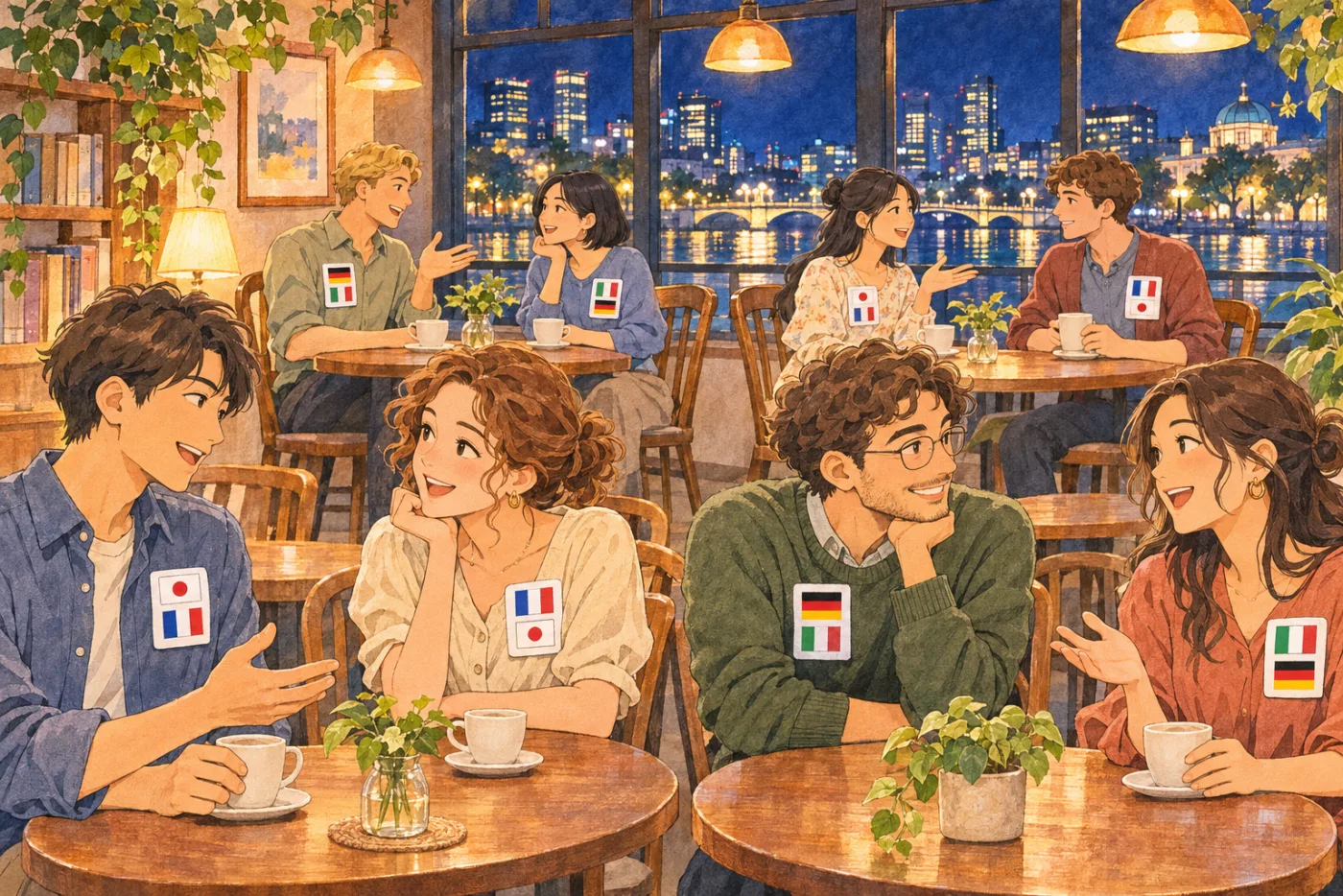
At a café language exchange, you trade languages with new people: you read their stickers, shake hands, say your first name, keep the talk going with follow-up questions and your own stories, and end in a kind way.
 English lesson

Article
Choose how to use this lesson
You can switch anytime.
Study mode
Introduction
Typing practice
Type the text exactly. Timer starts with your first key.
Text to type: Today we spend an evening at a language exchange in a café. We learn how the evening works, how to order and how to introduce ourselves. Then we practise long conversations and a kind goodbye.
Ready. The timer starts with your first key.
Complete
Great job!
Strong finish — your speed stayed steady.
Your rhythm
Speed over time- Time
- 0:00
- Raw speed
- 0 WPM
- Wrong keys
- 0
- Corrected
- 0
Before you begin
Warm-up
Do you like meeting new people? Why or why not?
What do you usually say first when you meet someone new?
Which language would you like to practise with a native speaker?
 Part 1: How a Language Exchange Works
Reading
Part 1: How a Language Exchange Works
Typing practice
Type the text exactly. Timer starts with your first key.
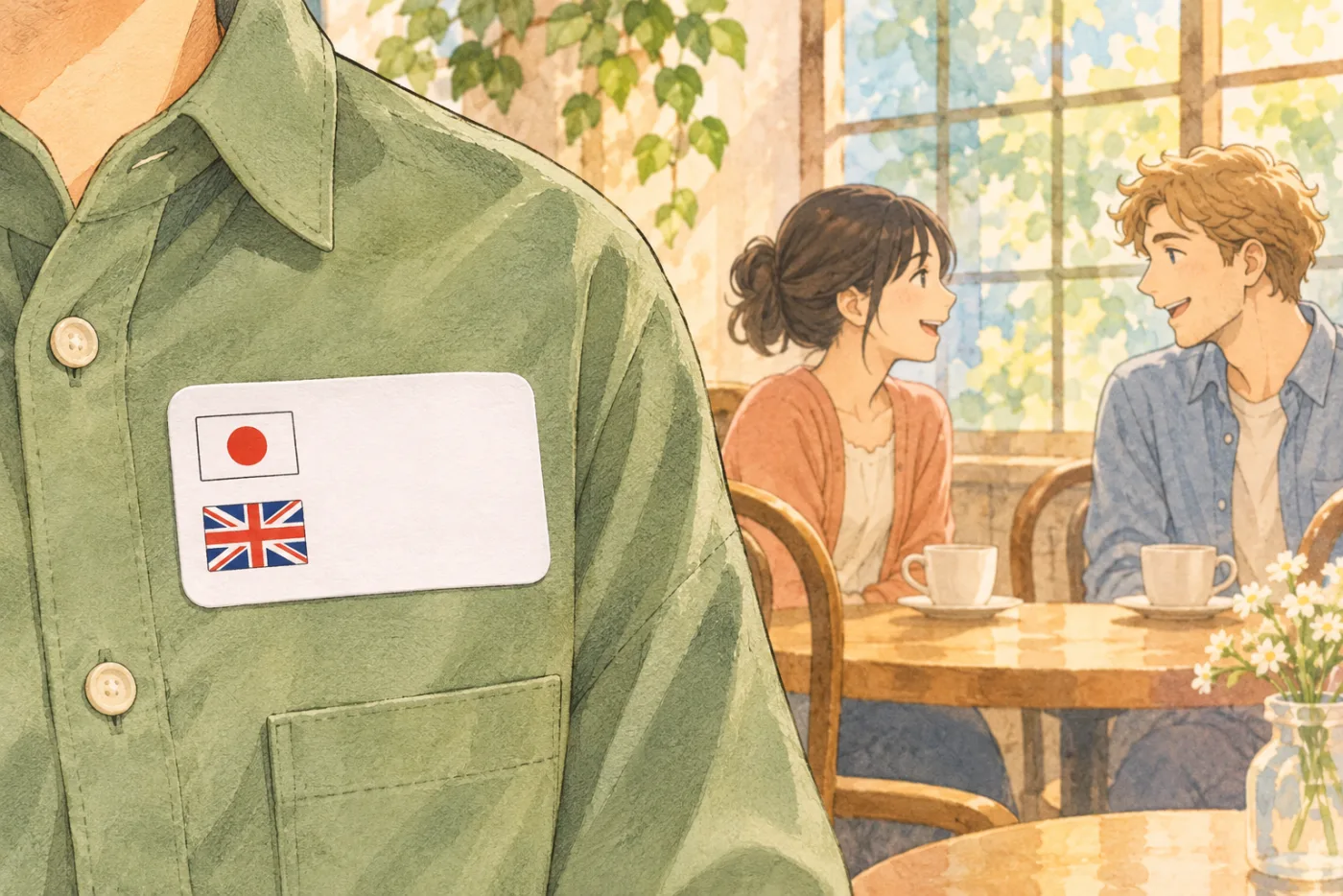
Text to type: A language exchange is a trade: you give something, and you get something back. You help someone with your language, and they help you with theirs. For example, you speak Japanese and want to practise English. So you look for an English speaker who wants to practise Japanese. Everyone is a teacher and a student at the same time. When you help with your language, you are the teacher. When the other person helps you, you are the student. In this lesson, you visit the Dutch Language Café in The Hague. The Hague is a city in the Netherlands. The café has a language exchange every Thursday evening. Every visitor gets a language sticker and wears it on their shirt. Write your languages on two lines, so people can see the difference. Your native language is the first language you learned as a child. It goes on the Speak line. For example: - Speak: Japanese - Practise: English A sticker shows you who can help you. The room is full of strangers, people you do not know. But with one look at a sticker, you know their languages. It also gives you your first question. Do you see Spanish on the Practise line? Ask: I see you study Spanish. Why? The evening has a clear plan: - 19:30: arrive and get your sticker. - 20:00: speed exchange, 3 minutes with each person. - 20:30: language tables, with one language at each table. - 21:10: change tables if you want. In the speed exchange, you take turns choosing the language. First one of you chooses, then the other, so both people practise. After 3 minutes, you move to the next person. Why so short? In a short time, you meet many new people.
Ready. The timer starts with your first key.
Complete
Great job!
Strong finish — your speed stayed steady.
Your rhythm
Speed over time- Time
- 0:00
- Raw speed
- 0 WPM
- Wrong keys
- 0
- Corrected
- 0
Check your understanding
Check: Part 1: How a Language Exchange Works
1. Why does every visitor wear a language sticker?
Sample answer
So other people see their languages and know who can help them.
Useful language
Useful phrases
- My native language is ...
- to say your first languageMy native language is Spanish, and I want to practise Dutch.
- I see you study ...
- when you read someone's stickerI see you study English. Why? – For my job.
- Which languages do you speak?
- when the person has no stickerWhich languages do you speak? – Dutch and a little Japanese.
 Part 2: Ordering at the Café
Reading
Part 2: Ordering at the Café
Typing practice
Type the text exactly. Timer starts with your first key.
Text to type: Your €11 ticket includes the snacks and the games. Included means they are in the price. The snacks are popcorn, crisps and nuts. You eat them at your table. Drinks are not included, so you buy them at the bar. You order from the bartender, the person who works behind the bar. You buy food there too. On the menu, you see a funny name: koffie verkeerd. In English, it means wrong coffee. Why wrong? A normal Dutch coffee has only a little milk. Koffie verkeerd has a lot of warm milk, often more than the coffee. So it is the wrong way around. If you are hungry, try an empanada. It is small and baked, with food inside. At this café, you choose cheese, meat or spinach. When you do not understand, do not just say yes. A bar is loud, and a menu has new words. Ask: Sorry, can you say that again? Or ask about one word: What does spinach mean? At a language café, everyone is a student, so questions are normal.
Ready. The timer starts with your first key.
Complete
Great job!
Strong finish — your speed stayed steady.
Your rhythm
Speed over time- Time
- 0:00
- Raw speed
- 0 WPM
- Wrong keys
- 0
- Corrected
- 0
Check your understanding
Check: Part 2: Ordering at the Café
1. What does koffie verkeerd mean, and why?
Sample answer
Wrong coffee, because it has much more milk than a normal Dutch coffee.
Useful language
Useful phrases
- Is ... included?
- to ask what a price pays for (for more than one thing, say Are ... included?)Is breakfast included? – Yes, it is.
- Can I have ...?
- to order somethingCan I have a koffie verkeerd, please? – Sure, that's €4.00.
- What does ... mean?
- when you hear a new wordWhat does verkeerd mean? – It means wrong.
- Sorry, can you say that again?
- when you did not hear or understandThat's ten fifty. – Sorry, can you say that again? – Ten euros fifty.
 Part 3: Introducing Yourself
Reading
Part 3: Introducing Yourself
Typing practice
Type the text exactly. Timer starts with your first key.
Text to type: In the Netherlands, people shake hands with someone new and say their name. Often it is only the first name: Hi! I'm Sanne. In Japan, many people bow, or bend forward, and say their family name. A hello without your name is rude, or not polite. Why? Your name tells people who you are. It also tells them what to call you all evening. So when you hear a new name, say your name too. At a first meeting, do not ask: How are you? For many Dutch people, it is a real question, not just a hello. They ask it when they really want to know the answer. So they usually ask people they already know. Save How are you? for next Thursday, when you meet again. At a first meeting, just say hello and your name. A speed exchange is short. So say three things: your name, your city and why you study the language. Daan says: Hi! I'm Daan. I live in The Hague. I study Japanese because I'm going to Tokyo. The reason is the most useful part. It gives the other person a question. For example: What do you want to see in Tokyo? When you finish, ask back: What about you?
Ready. The timer starts with your first key.
Complete
Great job!
Strong finish — your speed stayed steady.
Your rhythm
Speed over time- Time
- 0:00
- Raw speed
- 0 WPM
- Wrong keys
- 0
- Corrected
- 0
Check your understanding
Check: Part 3: Introducing Yourself
1. Why do Dutch people not ask How are you? at a first meeting?
Sample answer
For them it is a real question, so they ask people they already know.
Useful language
Useful phrases
- I'm a ... / I'm an ...
- to say your jobWhat do you do? – I'm an engineer. – Oh, I'm a teacher.
- I study ... because ...
- to say why you learn a languageWhy do you study Dutch? – I study Dutch because I work in The Hague.
- What about you?
- to ask the same question backI'm a teacher. What about you? – I work at a hotel.
 Part 4: Keeping the Conversation Going
Reading
Part 4: Keeping the Conversation Going
Typing practice
Type the text exactly. Timer starts with your first key.
Text to type: The best tool for a long conversation is the follow-up question. A follow-up question is a question about what the other person just said. It stays with their idea. A new question jumps to a new idea, for example: Do you like football? Each answer gives you the next follow-up question: - Lucía: I moved here from Valencia. - You: Really? Why did you move here? - Lucía: For work. I work at a hotel. - You: What do you do at the hotel? In 2017, scientists at Harvard University studied conversations between strangers. People who asked more questions were liked more by their partners. Follow-up questions worked best. Why? A follow-up question shows that you are really listening. But a good conversation goes both ways. If you never talk about yourself, people may think you are hiding something. So react to what you hear: Really? Me too! or That sounds fun! Then tell something about yourself, and ask back.
Ready. The timer starts with your first key.
Complete
Great job!
Strong finish — your speed stayed steady.
Your rhythm
Speed over time- Time
- 0:00
- Raw speed
- 0 WPM
- Wrong keys
- 0
- Corrected
- 0
Check your understanding
Check: Part 4: Keeping the Conversation Going
1. What is a follow-up question?
Sample answer
A question about what the other person just said.
Useful language
Useful phrases
- Why did you ...?
- to ask for the reason after someone tells you somethingI started Dutch last year. – Why did you start? – For my job.
- How long have you lived here?
- to ask about time in a placeHow long have you lived here? – About five years.
- Really? Me too!
- when the same is true for youI love koffie verkeerd. – Really? Me too!
- That sounds fun!
- when someone tells you a nice plan or hobbyI'm going to the beach this weekend. – That sounds fun!
 Part 5: Ending Well
Reading
Part 5: Ending Well
Typing practice
Type the text exactly. Timer starts with your first key.
Text to type: At 21:30, the exchange ends. Do not just walk away. The other person gave you their time. So thank them with kind words: It was nice to talk to you. Do you want to keep in touch? Ask for WhatsApp. Keep in touch means you talk or write again later. In the Netherlands, WhatsApp is by far the most used app for messages. So almost everyone you meet can say yes. The exchange is every Thursday, so say goodbye for one week: See you next Thursday! Next time, you can ask: How are you?
Ready. The timer starts with your first key.
Complete
Great job!
Strong finish — your speed stayed steady.
Your rhythm
Speed over time- Time
- 0:00
- Raw speed
- 0 WPM
- Wrong keys
- 0
- Corrected
- 0
Check your understanding
Check: Part 5: Ending Well
1. Why is it easy to keep in touch on WhatsApp in the Netherlands?
Sample answer
It is by far the most used app for messages there, so almost everyone has it.
Useful language
Useful phrases
- It was nice to talk to you
- when you leave a new personI have to go now. It was nice to talk to you! – You too. Bye!
- Can I add you on WhatsApp?
- to keep in touchCan I add you on WhatsApp? – Sure! Here's my number.
Scene
Scene: Arriving and Ordering
Typing practice
Type the text exactly. Timer starts with your first key.
Text to type: It is Thursday, 19:30. You walk into the Dutch Language Café, Herengracht 13A, The Hague. A host is at the door, and a bartender works at the bar. Phrases to use: My native language is ... / Is ... included? / Can I have ...? / What does ... mean? Your goal: get your sticker, then order a drink and food at the bar.
Ready. The timer starts with your first key.
Complete
Great job!
Strong finish — your speed stayed steady.
Your rhythm
Speed over time- Time
- 0:00
- Raw speed
- 0 WPM
- Wrong keys
- 0
- Corrected
- 0
Roleplay
Conversation: Arriving and Ordering
You
Hi, I'm here for the language exchange.
Host
Welcome! What's your name?
You
I'm (your name). I signed up online.
Host
Yes, here you are on my list. Is this your first time here?
You
Yes, it is.
Host
Great, welcome! Where are you from?
You
I'm from (your city), in Japan.
Host
Oh, nice! Here's your sticker. Please write the languages you speak and the languages you want to practise.
You
OK. My native language is Japanese, and I want to practise English.
Host
Perfect. The speed exchange starts at 20:00.
You
Thank you. Is the popcorn included?
Host
Yes, the popcorn, crisps and nuts are in your ticket, and the games too. Drinks are not included. You buy them at the bar.
Bartender
Hi! What would you like?
You
Can I have a koffie verkeerd, please?
Bartender
Sure. Anything to eat?
You
What is an empanada?
Bartender
It's small and baked, with food inside. We have cheese, meat or spinach.
You
Sorry, what does spinach mean?
Bartender
It's a green vegetable with soft leaves.
You
Ah, OK. A cheese one, please. How much is it?
Bartender
The koffie verkeerd is €4.00, and the empanada is €6.50. That's €10.50, please.
You
Here you go. Which languages do you speak?
Bartender
Dutch, English and some German. Enjoy the exchange!
You
Thank you! Have a nice evening.
Scene
Scene: Meeting Your Table
Typing practice
Type the text exactly. Timer starts with your first key.
Text to type: At 19:45, you sit down with your coffee and empanada. A Dutch woman sits next to you. Her sticker says she speaks Dutch and English. She practises Spanish. Phrases to use: I see you study ... / I study ... because ... / What about you? / That sounds fun! Your goal: shake hands, say your name and get to know her.
Ready. The timer starts with your first key.
Complete
Great job!
Strong finish — your speed stayed steady.
Your rhythm
Speed over time- Time
- 0:00
- Raw speed
- 0 WPM
- Wrong keys
- 0
- Corrected
- 0
Roleplay
Conversation: Meeting Your Table
Sanne
Hi! I'm Sanne.
You
Hi, Sanne! I'm (your name). Nice to meet you.
Sanne
Nice to meet you too. I see Japanese on your sticker. Where are you from?
You
I'm from (your city), in Japan. What about you?
Sanne
I'm from here, The Hague. I come to this café every Thursday.
You
Every Thursday? Wow! I see you study Spanish. Why?
Sanne
I go to Spain every summer. I want to order food and talk to people in Spanish, not English!
You
That sounds fun! Is Spanish hard?
Sanne
Some parts, yes. The verbs are hard for me! And you? Why do you study English?
You
I study English because (your reason for learning English).
Sanne
That's a great reason. What do you do?
You
I'm a/an (your job). What about you?
Sanne
I'm a teacher. I teach children at a primary school.
You
Really? Do you like it?
Sanne
Yes, I love it. But on the weekend, I want a quiet day! What do you do in your free time?
You
In my free time, I like (your hobby).
Sanne
Oh, nice! I play ping pong. There's a table here at the café. Do you play?
You
A little. But I'm not very good!
Sanne
Me neither! Let's play later.
Host
It's 20:00, everyone! The speed exchange starts now. Please find a partner.
Sanne
Oh, it's time! Good luck!
You
Thanks, Sanne. See you later!
Scene
Scene: The Speed Exchange
Typing practice
Type the text exactly. Timer starts with your first key.
Text to type: At 20:00, the speed exchange starts: 3 minutes with each person. Your first partner's sticker says he speaks Dutch and English and practises Japanese. Phrases to use: I'm a ... / I'm an ... / Sorry, can you say that again? / That sounds fun! Your goal: speak English, then teach Daan a Japanese phrase for his trip.
Ready. The timer starts with your first key.
Complete
Great job!
Strong finish — your speed stayed steady.
Your rhythm
Speed over time- Time
- 0:00
- Raw speed
- 0 WPM
- Wrong keys
- 0
- Corrected
- 0
Roleplay
Conversation: The Speed Exchange
Daan
Hi! I'm Daan.
You
Hi, Daan! I'm (your name). Nice to meet you.
Daan
Nice to meet you too. We take turns choosing the language. You can choose first.
You
English, please. I see Japanese on your sticker!
Daan
Yes, I study Japanese. I started six months ago, so I know only a little. What do you do?
You
I'm a/an (your job). What about you?
Daan
I'm an engineer. I make machines for factories.
You
Sorry, can you say that again? It's very loud in here.
Daan
I'm an engineer. I make machines.
You
Oh, cool! Why do you study Japanese?
Daan
I'm going to Tokyo in April, for two weeks!
You
That sounds fun! What do you want to do there?
Daan
Eat a lot of ramen and see old temples. And you? Why do you study English?
You
I study English because (your reason for learning English).
Daan
Good reason! OK, now it's my turn. Japanese, please. What can I say in a shop in Tokyo?
You
Say kore o hitotsu kudasai. It means this one, please.
Daan
Kore o... sorry, can you say that again?
You
Kore o hitotsu kudasai. Kore is this, hitotsu is one, and kudasai is please give me.
Daan
Kore o hitotsu kudasai! Is that right?
You
Yes, perfect! Point at the thing you want and say it.
Host
Time's up! Please move to the next person.
Daan
Thank you! That's really useful.
You
It was nice to talk to you, Daan. Have a great trip!
Scene
Scene: The English Table
Typing practice
Type the text exactly. Timer starts with your first key.
Text to type: At 20:30, you sit at the English table with Sanne. A new woman sits down. Her sticker says she speaks Spanish and English. She practises Dutch. Phrases to use: Why did you ...? / How long have you lived here? / Really? Me too! / Can I add you on WhatsApp? Your goal: ask follow-up questions, talk about yourself and keep in touch.
Ready. The timer starts with your first key.
Complete
Great job!
Strong finish — your speed stayed steady.
Your rhythm
Speed over time- Time
- 0:00
- Raw speed
- 0 WPM
- Wrong keys
- 0
- Corrected
- 0
Roleplay
Conversation: The English Table
Lucía
Hi! I'm Lucía.
You
Hi, Lucía! I'm (your name). Nice to meet you. Where are you from?
Lucía
Nice to meet you too. I'm from Valencia, in Spain, but I moved to The Hague.
You
Really? Why did you move here?
Lucía
For work. I work at a big hotel.
You
Oh, nice! What do you do at the hotel?
Lucía
I work at the front desk. I say hello to the guests and give them their room keys.
You
How long have you lived here?
Lucía
Two years. I study Dutch, but it's hard! And I miss the sun in Valencia.
You
What is Valencia like?
Lucía
It's warm and sunny, and the food is great. What about you? What do you do?
You
I'm a/an (your job). In my free time, I like (your hobby).
Lucía
Oh, nice! I see you study English. Why?
You
I study English because (your reason for learning English).
Lucía
That's a great reason. Oh, you have a koffie verkeerd! I really love coffee.
You
Really? Me too! I drink coffee every morning. But this is my first koffie verkeerd, and it's very good.
Lucía
I have one here every Thursday. Next week, try the empanadas too!
You
I had a cheese one tonight. It was great!
Host
It's 21:30, everyone. The exchange is over. Thank you for coming!
You
It was nice to talk to you, Lucía. Can I add you on WhatsApp?
Lucía
Sure! Here's my number. Let's practise again soon.
Sanne
Are you coming next Thursday?
You
Yes! See you next Thursday!
Sanne
See you next Thursday! Bye!
Speak
Speaking
What you can do now
Final Reflection
Follow-up questions and your own stories keep a language exchange going.
Would you like to go to a language exchange? Why or why not?
Someone says, I just started a new job. What follow-up question can you ask?
What three things will you say when you introduce yourself?
Learning cards
My cards
Language Exchange Café: Meeting New People
0 due · 0 new · about 1 min
Learn the sense first · then retrieve it
No saved cards yet
Open a word or phrase in the article and choose Save to My Words.
Focused Reading Mode is open.
Listening
Lesson audio
Listen from the beginning, or choose “Play this part” as you read along.
Reading
Part 1: How a Language Exchange Works
Reading
Part 2: Ordering at the Café
Reading
Part 3: Introducing Yourself
Reading
Part 4: Keeping the Conversation Going
Reading
Part 5: Ending Well
Finished listening?
Mark this listening practice complete when you have followed the lesson audio.
Listening complete
Listen Mode
Word-by-word syncPlay the audio and follow the highlighted word.
Article complete
Choose your next step
Open the next same-level lesson, replay the article, or save this page for later.
Listen Again
Replay the article once and notice how much more you understand.
One replay is enough. Then move on.
Lesson resources
Resources
Sources and fact review (11)
- Taalcafé: Language Exchange, Dutch Language Café
Thursday 19:30–21:30; €11 ticket; snacks (popcorn, crisps, nuts) and games included; drinks at the bar; language sticker with the languages you speak or practise; 20:00 speed exchange, 3 minutes, taking turns choosing the language; 20:30 language tables; 21:10 change tables
- Dutch Language Café
address Herengracht 13A, The Hague; Thursday language exchange
- Café, Dutch Language Café
ping pong and board games at the café
- Menu DLC oct 2026, Dutch Language Café
koffie verkeerd €4.00; empanadas €6.50 with cheese, meat or spinach (prices kept from the earlier sourced lesson; this PDF could not be read as text on 12 Nov 2026)
- Koffie verkeerd, The Dutch Table
wrong coffee, because normal Dutch coffee has only a little milk and koffie verkeerd has much more
- koffie verkeerd, Wiktionary
coffee made with a large amount of warm milk
- Customs (Do as the Dutch do), Leiden International Centre
shake hands at a first meeting; say your first name; not introducing yourself is rude; How are you? is not used at a first meeting
- Dutch Culture: Greetings, Cultural Atlas
first names; How are you? is asked only when the person really wants to know the answer
- Asking Questions Can Get You a Better Job or a Second Date, Harvard Business School Working Knowledge
2017 Harvard study: people who ask more questions, especially follow-up questions, are liked more; follow-ups show listening; Brooks's warning that asking many questions without telling anything about yourself may seem guarded
- It Doesn't Hurt to Ask: Question-Asking Increases Liking, Harvard DASH
the 2017 study by Harvard researchers
- Snapchat use in NL jumped 78% in 2.5 years, Telecompaper
WhatsApp is by far the most used messaging app in the Netherlands