A Food Trip Around Lithuania
Quality checked lesson
You travel to four famous places in Lithuania, try one special dish in each, and learn why each place and each dish is famous.
 English lesson

Article
Choose how to use this lesson
You can switch anytime.
Study mode
Introduction
Typing practice
Type the text exactly. Timer starts with your first key.
Text to type: Today you take a trip around Lithuania. You visit four famous places and try one special dish in each. You also learn how to order food, buy tickets and ask questions.
Ready. The timer starts with your first key.
Complete
Great job!
Strong finish — your speed stayed steady.
Your rhythm
Speed over time- Time
- 0:00
- Raw speed
- 0 WPM
- Wrong keys
- 0
- Corrected
- 0
Before you begin
Warm-up
Which famous places in your country do visitors love?
Which dish from your country do you want a visitor to try?
Do you like to eat new food when you travel?
 Part 1: Vilnius Old Town and Cepelinai
Reading
Part 1: Vilnius Old Town and Cepelinai
Typing practice
Type the text exactly. Timer starts with your first key.
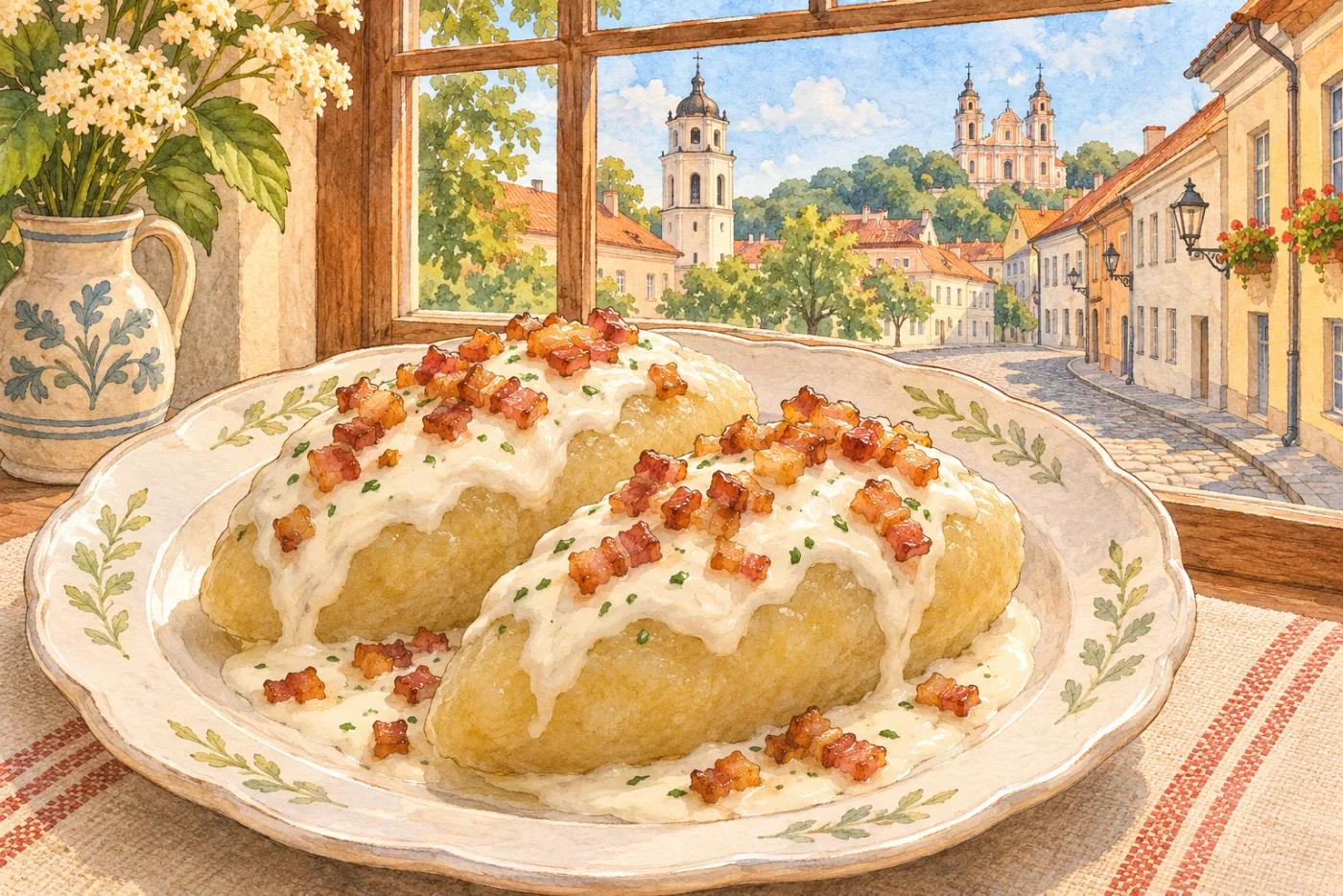
Text to type: Your trip starts in Vilnius, the capital of Lithuania. You walk through the Old Town. The streets are small, and there are old churches everywhere. This Old Town is very old, and it is also very big. Many of its buildings and streets are hundreds of years old. Because of this, UNESCO put it on its World Heritage list. UNESCO is a world group that takes care of very important places. At lunch, you go into Etno Dvaras, a restaurant with food from Lithuania. You order cepelinai, the national dish of Lithuania. Cepelinai are big potato dumplings. A dumpling is a soft ball of food with more food inside. Inside cepelinai, there is usually meat or curd cheese, a soft white cheese. On top, there is a sauce of sour cream with small pieces of bacon. Why the funny name? A zeppelin is a long, round flying ship. It carries people, like a plane. Cepelinai have the same long, round shape. So people named them after the zeppelin. At Etno Dvaras, one plate of cepelinai costs 9.55 euros.
Ready. The timer starts with your first key.
Complete
Great job!
Strong finish — your speed stayed steady.
Your rhythm
Speed over time- Time
- 0:00
- Raw speed
- 0 WPM
- Wrong keys
- 0
- Corrected
- 0
Check your understanding
Check: Part 1: Vilnius Old Town and Cepelinai
1. Why do people call this dish cepelinai?
Sample answer
It looks like a zeppelin: long and round.
Useful language
Useful phrases
- Can I see the menu
- when you sit downHello! Can I see the menu?
- I would like
- to order foodI would like cepelinai, please.
- What is inside
- to ask about a dishThese look good. What is inside?
- The bill, please
- when you want to payThank you! The bill, please.
 Part 2: Trakai Island Castle and Kibinai
Reading
Part 2: Trakai Island Castle and Kibinai
Typing practice
Type the text exactly. Timer starts with your first key.
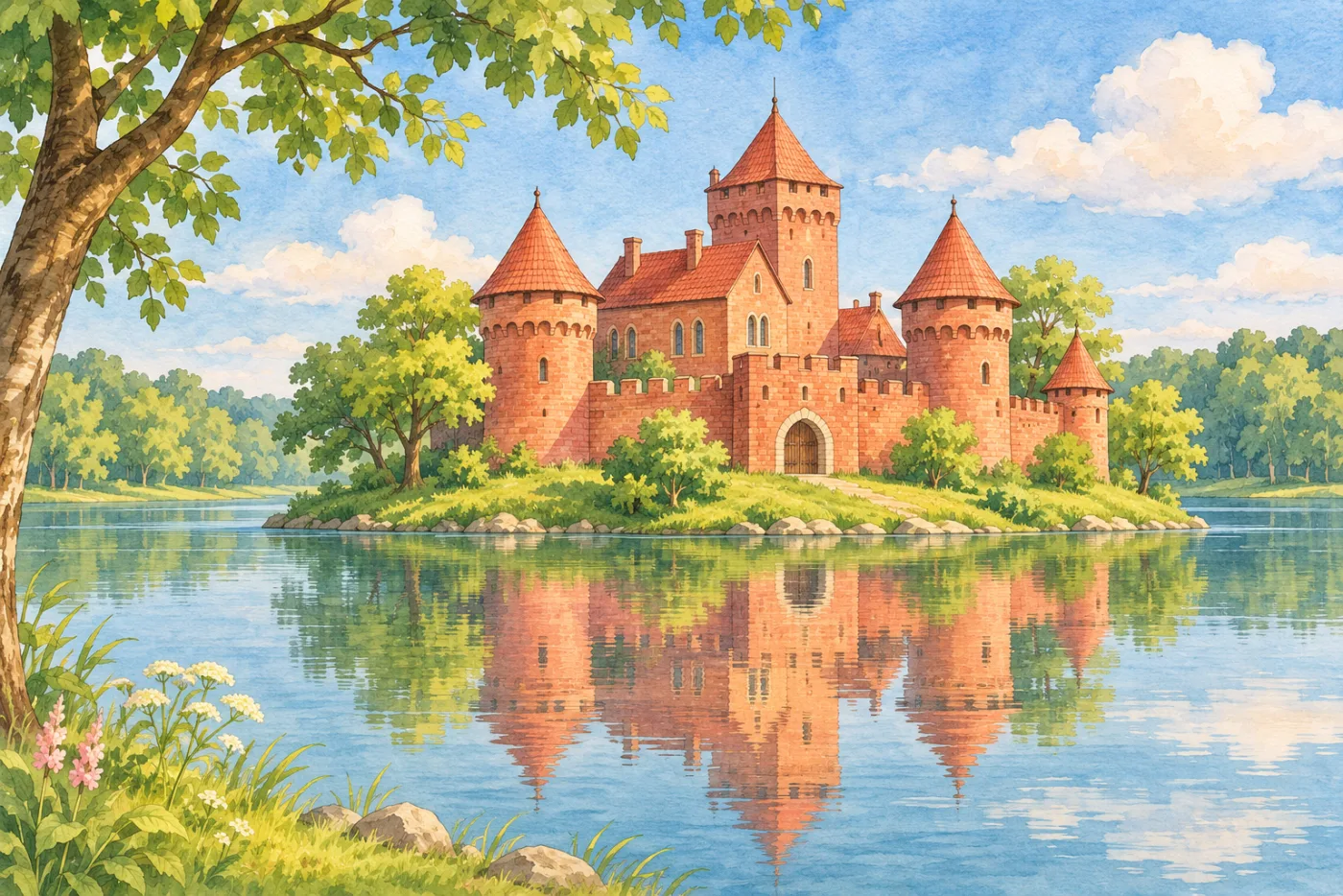
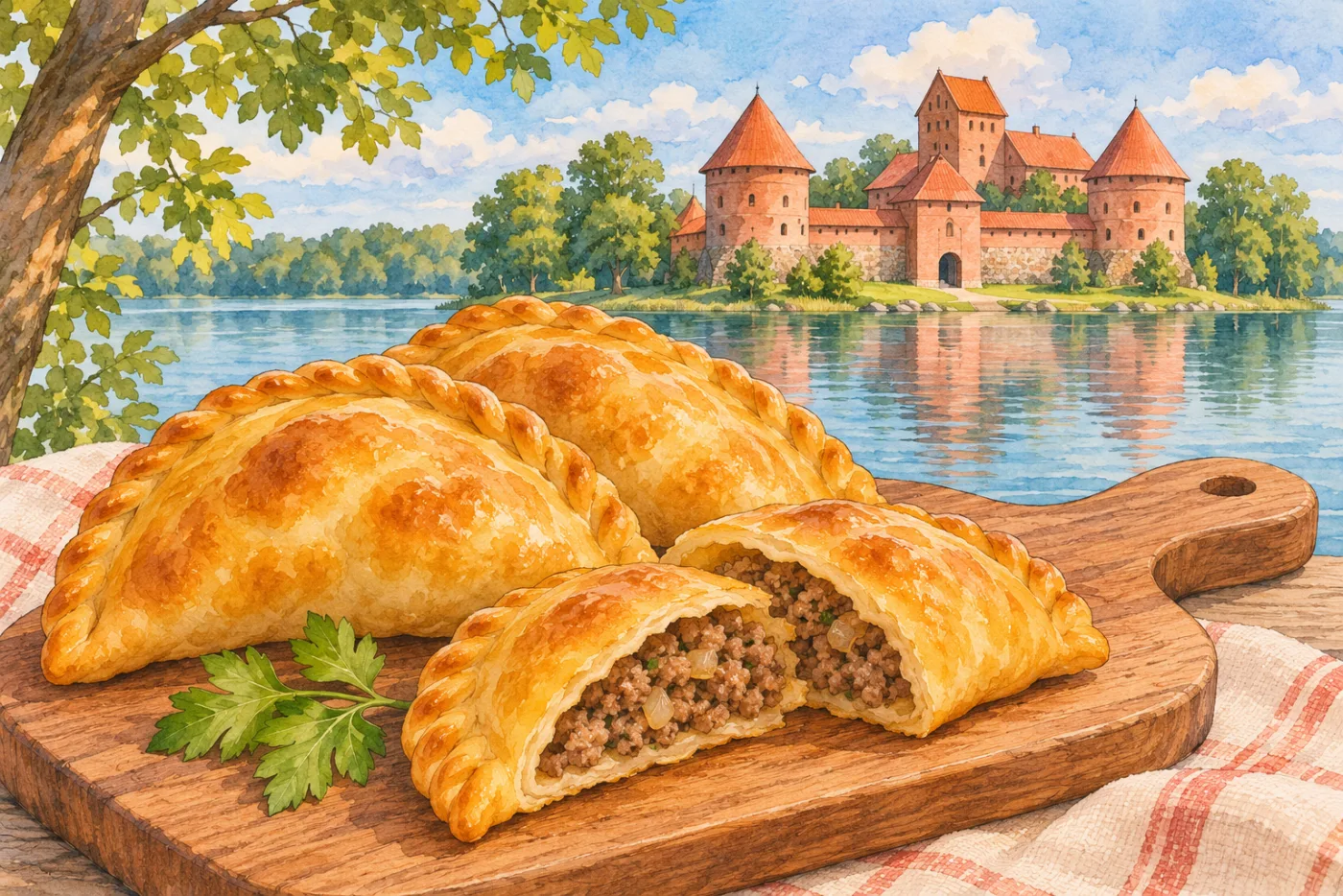
Text to type: The next day, you take a train from Vilnius to Trakai. Trakai Island Castle stands on a small island in a lake. You walk to it over a bridge. The castle is red and more than 600 years old. Inside, there is a museum about the history of Lithuania. After the castle, you go to Karaimų Street to try kibinai. Kibinai are small pastries. Inside, there is meat and onion. The traditional meat is mutton, the meat of an adult sheep. Kibinai are the food of the Karaim people. In English, Karaimų Street is Street of the Karaim. Who are the Karaim? More than 600 years ago, Vytautas was the ruler of Lithuania. He brought Karaim families to Trakai from Crimea, a place far in the south. Their job was to keep his castle safe. Vytautas gave them land here, and they lived on this street. That is why the street has their name. They brought their own food with them, and kibinai were part of it. A small group of Karaim people still lives in Trakai today.
Ready. The timer starts with your first key.
Complete
Great job!
Strong finish — your speed stayed steady.
Your rhythm
Speed over time- Time
- 0:00
- Raw speed
- 0 WPM
- Wrong keys
- 0
- Corrected
- 0
Check your understanding
Check: Part 2: Trakai Island Castle and Kibinai
1. Why did Vytautas bring the Karaim to Trakai?
Sample answer
To keep his castle safe.
Useful language
Useful phrases
- One adult ticket, please
- to buy a ticketHello! One adult ticket, please.
- How much is it
- to ask the priceHello! How much is it for a student?
- What time do you close
- before you goThank you! What time do you close today?
- Where can I buy
- to find foodExcuse me! Where can I buy kibinai?
 Part 3: The Hill of Crosses and Šaltibarščiai
Reading
Part 3: The Hill of Crosses and Šaltibarščiai
Typing practice
Type the text exactly. Timer starts with your first key.
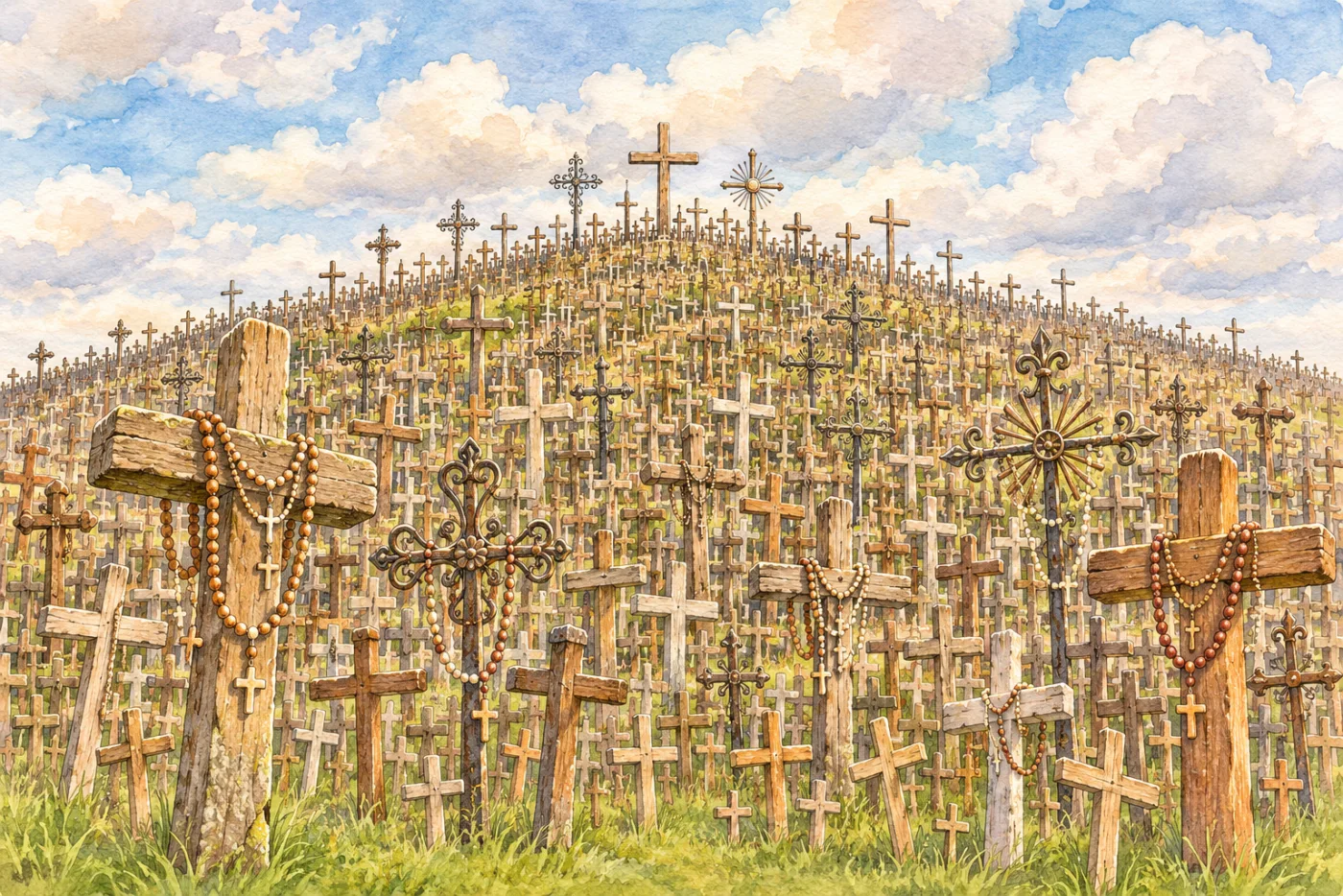
Text to type: On day three, you go north to the city of Šiauliai. The Hill of Crosses is a short drive from the city. From far away, it looks like a small hill. Up close, you see crosses everywhere, big and small, wooden and metal. Today, there are more than 100,000 crosses on the hill. Why are they here? In the 1800s, many people in Lithuania died in fights against Russia. They wanted their country to be free. Their families never found the bodies. So the families had no place to visit and remember them. Instead, they put crosses on this hill. Later, Lithuania was part of the Soviet Union. The Soviet leaders did not want people to pray. So they did not want the crosses. Again and again, they destroyed the crosses on the hill. The first time, in 1961, they destroyed all the crosses in one day. Crosses on the hill were against the law, and people were punished for them. But people came back at night and put up new crosses. In the dark, it was harder to see them, but it was still dangerous. They came anyway. So the hill became a sign that the people did not give up. After your visit, you eat lunch in Šiauliai. It is a hot July day, so you order šaltibarščiai. This is a famous cold pink soup. It is made with beetroot and kefir. Beetroot is a dark red vegetable, and it makes the soup pink. Kefir is a thick milk drink, a little like yogurt. People eat this soup on hot summer days, with boiled potatoes on the side.
Ready. The timer starts with your first key.
Complete
Great job!
Strong finish — your speed stayed steady.
Your rhythm
Speed over time- Time
- 0:00
- Raw speed
- 0 WPM
- Wrong keys
- 0
- Corrected
- 0
Check your understanding
Check: Part 3: The Hill of Crosses and Šaltibarščiai
1. Why did people put up new crosses at night?
Sample answer
In the dark, it was harder to see them. It was still dangerous, but they did not give up.
Useful language
Useful phrases
- Excuse me
- to start talking to someoneExcuse me! Can I ask you something?
- Why do people
- to ask for a reasonHello! Why do people bring crosses here?
- Is it OK to
- to ask if you canSorry! Is it OK to take photos?
 Part 4: The Curonian Spit and Smoked Fish
Reading
Part 4: The Curonian Spit and Smoked Fish
Typing practice
Type the text exactly. Timer starts with your first key.
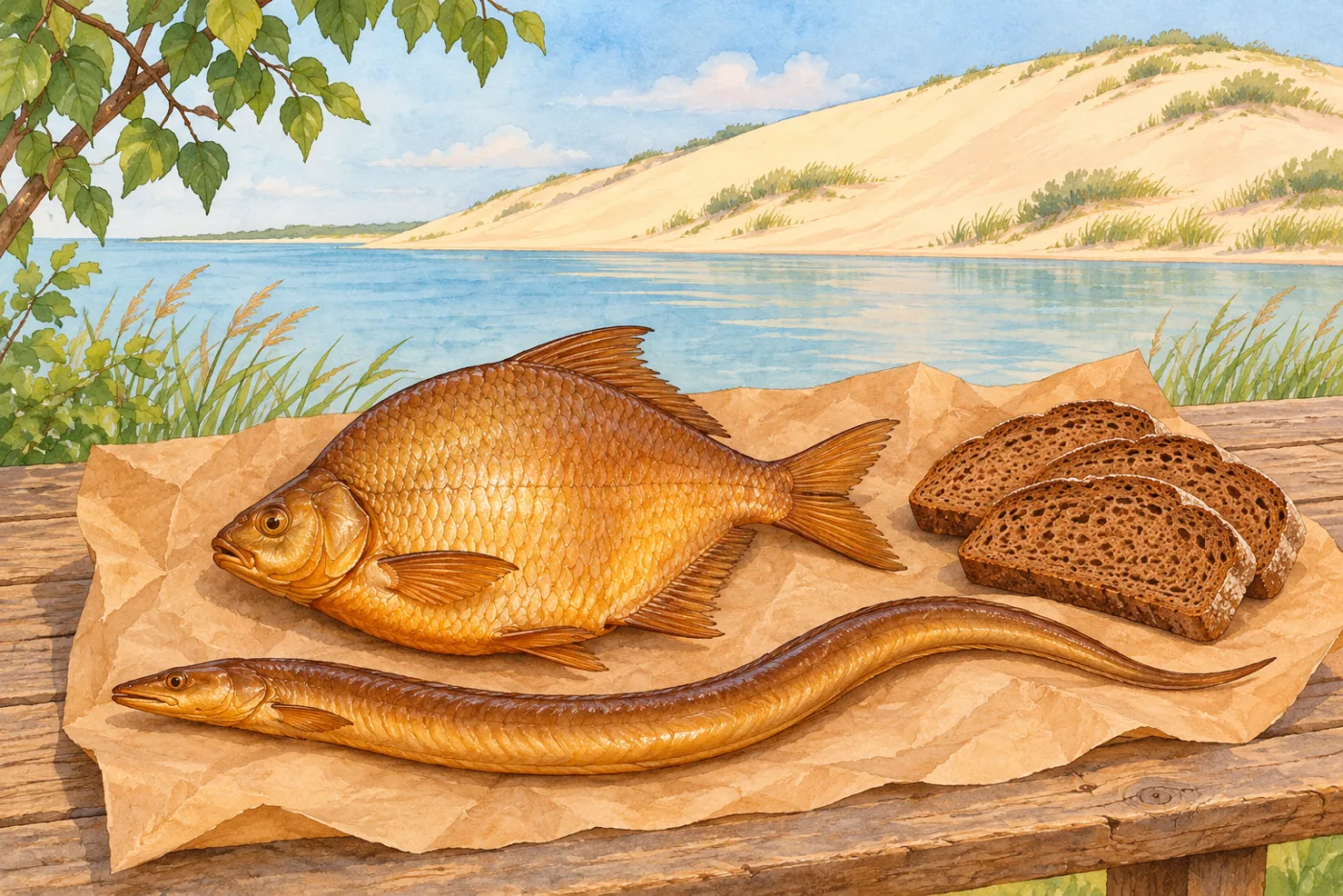
Text to type: Your last stop is the Curonian Spit. A spit is a long, thin piece of land in the sea. On one side is the Baltic Sea. On the other is the Curonian Lagoon. A lagoon is a big, quiet area of water next to the sea. There is land in between. To get there, you take a short ferry from the city of Klaipėda. It goes to Smiltynė, at the north end of the spit. Then you take a bus to Nida. The ride is about one hour. In the village of Nida, you climb the Parnidis Dune. A dune is a hill of sand that the wind makes. It is 52 metres high. From the top, you see sand, forest and water on both sides. In the 1800s, fishing was the most important work in Nida. People caught fish in the lagoon. But there were no fridges then, and fish goes bad fast. So they smoked the fish over a fire. Smoke dries the fish, so it stays OK to eat for longer. They often used the wood of the alder tree. Its smoke is soft and sweet, and it makes the fish golden. Today, small shops all over the spit sell smoked fish. In Nida, you go to a café called Tik pas Joną. In English, the name is Only at Jonas's Place. This café smokes its own fish. You choose bream, a fish from the lagoon, or eel. An eel is a long fish that looks like a snake. The fish is still warm, and you eat it with bread and your hands.
Ready. The timer starts with your first key.
Complete
Great job!
Strong finish — your speed stayed steady.
Your rhythm
Speed over time- Time
- 0:00
- Raw speed
- 0 WPM
- Wrong keys
- 0
- Corrected
- 0
Check your understanding
Check: Part 4: The Curonian Spit and Smoked Fish
1. Why did people in Nida smoke their fish?
Sample answer
They had no fridges, and smoke helps fish stay OK to eat for longer.
Useful language
Useful phrases
- What is good here
- to choose foodHello! What is good here today?
- Is it from here
- to ask about local foodNice fish! Is it from here?
- How do you eat it
- to ask about new foodEel? How do you eat it?
- It is delicious
- to say you love the foodThank you! It is delicious.
Scene
Scene: Lunch at Etno Dvaras
Typing practice
Type the text exactly. Timer starts with your first key.
Text to type: You walk around the Old Town all morning. Now you are hungry. You sit down at Etno Dvaras, and a waiter comes to your table. Your goal: order cepelinai, ask what is inside, and pay the bill.
Ready. The timer starts with your first key.
Complete
Great job!
Strong finish — your speed stayed steady.
Your rhythm
Speed over time- Time
- 0:00
- Raw speed
- 0 WPM
- Wrong keys
- 0
- Corrected
- 0
Roleplay
Conversation: Lunch at Etno Dvaras
You
Hello! Can I see the menu, please?
Waiter
Of course. Here you are.
You
Thank you. I would like cepelinai, please.
Waiter
Great choice. They are our most famous dish.
You
What is inside?
Waiter
Meat or curd cheese. Which one do you want?
You
Meat, please. How much is it?
Waiter
9.55 euros. It comes with sour cream on top.
You
Great, thank you.
Waiter
Here are your cepelinai. Enjoy!
You
That was delicious. The bill, please.
Waiter
Here you are. That is 9.55 euros.
Scene
Scene: A Ticket for Trakai Castle
Typing practice
Type the text exactly. Timer starts with your first key.
Text to type: It is a sunny afternoon in July. You walk over the bridge to Trakai Island Castle. Ona sells tickets at the ticket office. Your goal: buy a ticket. Then ask when the castle closes and where to eat kibinai.
Ready. The timer starts with your first key.
Complete
Great job!
Strong finish — your speed stayed steady.
Your rhythm
Speed over time- Time
- 0:00
- Raw speed
- 0 WPM
- Wrong keys
- 0
- Corrected
- 0
Roleplay
Conversation: A Ticket for Trakai Castle
You
Hello. One adult ticket, please.
Ona
Hello! That is 14 euros.
You
How much is it for a student?
Ona
Students pay 7 euros.
You
OK, one adult ticket. Here you are. What time do you close?
Ona
In July, we close at 7 p.m.
You
Great. Where can I buy kibinai after my visit?
Ona
Go to Kybynlar. It is at number 29 on Karaimų Street.
You
Thank you very much!
Scene
Scene: Asking a Local at the Hill of Crosses
Typing practice
Type the text exactly. Timer starts with your first key.
Text to type: You walk between thousands of crosses. Rūta, a woman from Šiauliai, is putting a small cross on the hill. Your goal: ask about the crosses, and ask if you can add one.
Ready. The timer starts with your first key.
Complete
Great job!
Strong finish — your speed stayed steady.
Your rhythm
Speed over time- Time
- 0:00
- Raw speed
- 0 WPM
- Wrong keys
- 0
- Corrected
- 0
Roleplay
Conversation: Asking a Local at the Hill of Crosses
You
Hi! Excuse me. Can I ask you something?
Rūta
Yes, of course.
You
How many crosses are there?
Rūta
Nobody can count them all. There are more than 100,000.
You
Why do people bring crosses here?
Rūta
To remember someone, or to pray.
You
Is it OK to put up my own cross?
Rūta
Yes. A wooden cross up to 2 metres tall is fine.
You
Do I need to ask anyone first?
Rūta
Not for a small cross. For a taller one, you ask first.
You
Thank you so much!
Scene
Scene: Smoked Fish in Nida
Typing practice
Type the text exactly. Timer starts with your first key.
Text to type: After the dune, you walk to Tik pas Joną. It is midday, and the fish is still warm. You meet the cook. Your goal: choose a fish. Then ask where it is from and how to eat it.
Ready. The timer starts with your first key.
Complete
Great job!
Strong finish — your speed stayed steady.
Your rhythm
Speed over time- Time
- 0:00
- Raw speed
- 0 WPM
- Wrong keys
- 0
- Corrected
- 0
Roleplay
Conversation: Smoked Fish in Nida
You
Hello! What is good here today?
Cook
Today we have bream and eel. Try the bream first.
You
OK. Is it from here?
Cook
Yes. It is from the Curonian Lagoon, right next to Nida.
You
Do you smoke it here?
Cook
Yes, we smoke all our own fish here.
You
How do you eat it?
Cook
With bread, and with your hands. No fork.
You
Mmm! It is delicious!
Cook
Thank you! At midday, the fish is still warm.
Speak
Speaking
What you can do now
Final Reflection
You saw four places in four days, and every dish had a story.
Which place do you want to visit first, and why?
Which dish do you want to try most?
Which place or dish reminds you of something in Japan?
Learning cards
My cards
A Food Trip Around Lithuania
0 due · 0 new · about 1 min
Learn the sense first · then retrieve it
No saved cards yet
Open a word or phrase in the article and choose Save to My Words.
Focused Reading Mode is open.
Listening
Lesson audio
Listen from the beginning, or choose “Play this part” as you read along.
Reading
Part 1: Vilnius Old Town and Cepelinai
Reading
Part 2: Trakai Island Castle and Kibinai
Reading
Part 3: The Hill of Crosses and Šaltibarščiai
Reading
Part 4: The Curonian Spit and Smoked Fish
Finished listening?
Mark this listening practice complete when you have followed the lesson audio.
Listening complete
Listen Mode
Word-by-word syncPlay the audio and follow the highlighted word.
Article complete
Choose your next step
Open the next same-level lesson, replay the article, or save this page for later.
Listen Again
Replay the article once and notice how much more you understand.
One replay is enough. Then move on.
Lesson resources
Resources
Sources and fact review (31)
- Vilnius Old Town – Wikipedia
UNESCO World Heritage Site; one of the largest surviving medieval old towns in Northern Europe
- Etno Dvaras – menu
cepelinai with meat or curd 9.55 euros
- Cepelinai – Wikipedia
potato dumplings with meat or curd cheese, sour cream sauce and bacon, named after the zeppelin, national dish
- Trakai Island Castle Museum – Ticket prices
adults 14 euros and students 7 euros from April to September; open 10:00–19:00 from May to September; history museum in the castle
- Love Vilnius – Day trips by train
train from Vilnius to Trakai
- Photo: Trakai Island Castle
the castle on Lake Galvė
- Kibinai – Wikipedia
Karaim pastry with mutton and onion, linked to Trakai; Vytautas brought Karaim families from Crimea as guards
- Trakai Visit – 6 ways to experience Karaim culture in Lithuania
Vytautas brought Karaim families from Crimea in 1397 and gave them land in Trakai; Karaim Street is named for the Karaim community, and many people on the street are still Karaim
- The Irish Times – Dwindling minority treasures memory of grand duke
Vytautas brought Karaim families from Crimea to Trakai as defenders; small community today
- Go Vilnius – Kybynlar Restaurant
address Karaimų g. 29, Trakai; Karaim food and kibinai
- Hill of Crosses – Wikipedia
12 km north of Šiauliai; crosses for rebels of the 1800s whose bodies families could not find; Soviet leaders against the crosses; people came back at night; over 100,000 crosses
- Šiauliai District Municipality – Hill of Crosses
in Soviet times putting crosses on the hill was strictly forbidden and pilgrims were punished; people brought crosses under the cover of night
- Šiauliai District Tourism – The Hill of Crosses
in Soviet times pilgrims were chased and punished; people still put up crosses at night, despite the ban and the danger
- Kryžių kalnas – Naikinimai (Hill of Crosses site history)
five Soviet destruction campaigns (1961, 1973, November 1974, Christmas 1974, 1976) and a last attack in 1985; on 5 April 1961 all the crosses on the hill were destroyed in one day
- Šiauliai District Municipality – Rules of the Hill of Crosses
wooden crosses up to 2 metres may be put up without approval; taller crosses need approval first
- Šaltibarščiai – Wikipedia
cold summer soup of beetroot and kefir, boiled potatoes served on the side
- Curonian Spit – Wikipedia
between the Baltic Sea and the Curonian Lagoon; Parnidis Dune 52 m; ferry
- Curonian Lagoon – Wikipedia
freshwater lagoon cut off from the Baltic Sea by the spit
- Visit Neringa – Arrival by bus
ferry from Klaipėda to Smiltynė, then a local bus from Smiltynė to Nida, about one hour
- Nida, Lithuania – Wikipedia
fishing was the main work in the 1800s
- Visit Neringa – Dive into Neringa's sea of tastes
Tik pas Joną sells locally caught smoked fish, still warm around midday
- Falstaff – Smoked fish: Lithuania's most aromatic seaside tradition
alder wood gives a soft, sweet smoke and a golden colour
- Waymarking – Tik Pas Jona, Nida
smoked fish eaten with bread, often by hand
- Rolling Grace – Things to do on the Curonian Spit
bream and eel smoked over alder; smoked fish sold at huts along the spit
- Photo: Vilnius Old Town
view of the Old Town from Gediminas Tower
- Photo: cepelinai
cepelinai in a Vilnius restaurant
- Photo: kibinai
kibinai at Kybynlar in Trakai
- Photo: Hill of Crosses
the Hill of Crosses
- Photo: šaltibarščiai
a bowl of cold pink beet soup
- Photo: Curonian Spit, Parnidis Dune
the Parnidis Dune near Nida
- Photo: smoked fish
smoked fish dinner in Nida