Food Markets in Europe: Buy, Eat, Pay and Tip
Quality checked lesson
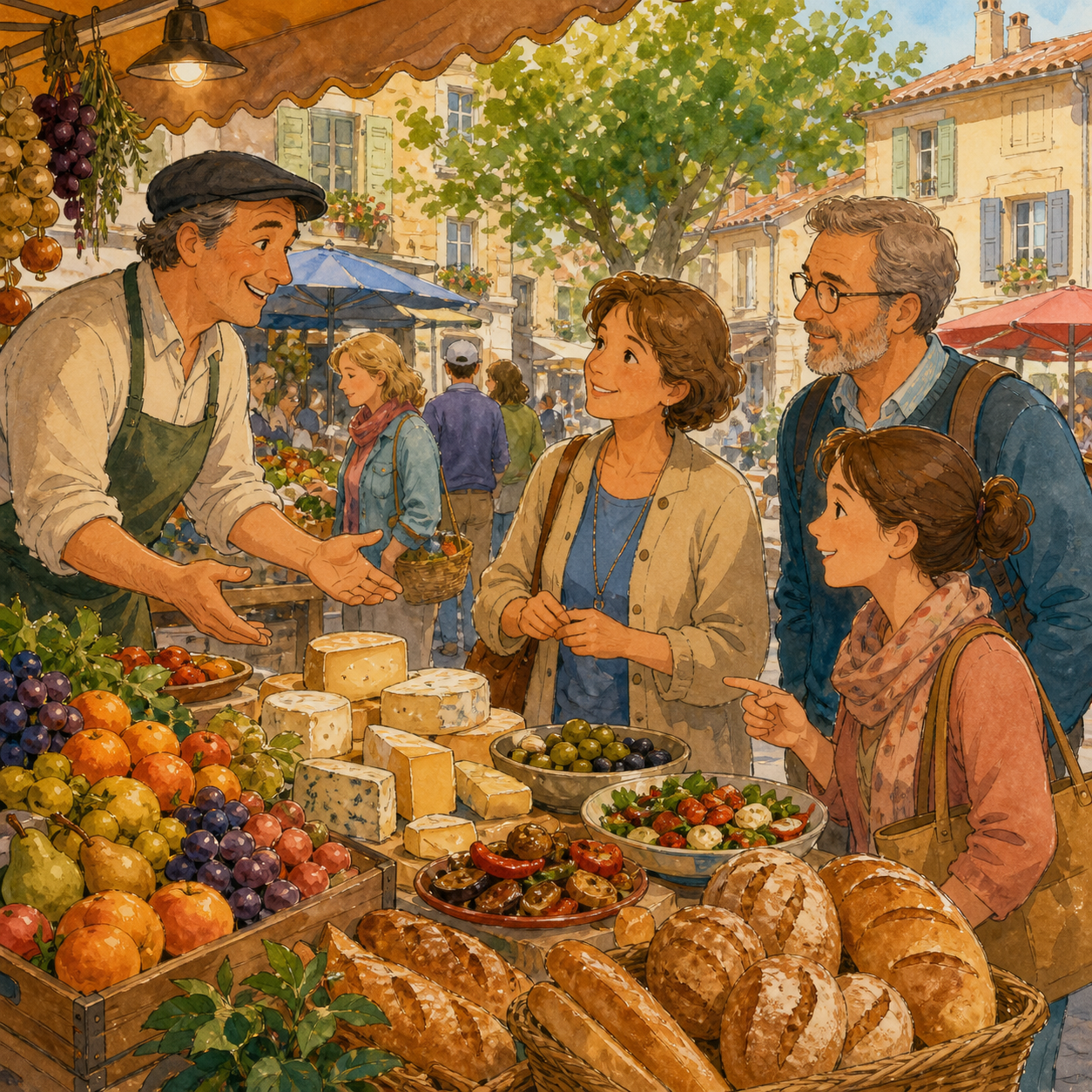
Food markets can be open-air, covered, or inside food halls. A few clear questions help you choose food, check allergens, pay, and handle tips.
 English lesson
Article
Choose how to use this lesson
You can switch anytime.
Study mode
Introduction
A Simple Plan for the Market
Typing practice
Type the text exactly. Timer starts with your first key.
Text to type: Food markets can be open-air, covered, or inside food halls. A few clear questions help you choose food, check allergens, pay, and handle tips.
Ready. The timer starts with your first key.
Complete
Great job!
Strong finish — your speed stayed steady.
Your rhythm
Speed over time- Time
- 0:00
- Raw speed
- 0 WPM
- Wrong keys
- 0
- Corrected
- 0
Before you begin
Before You Start
Think about these questions.
What food do you like to buy at a market?
Need a starting line?
Helpful clue: You can name fruit, bread, cheese, a snack, or another food.
Do you prefer to pay by card or in cash? Why?
Need a starting line?
Helpful clue: There is no single correct answer. Think about what is easy for you.
When do you usually leave a tip?
Need a starting line?
Helpful clue: Think about cafés, restaurants, counters, and table service.
Reading
Three Kinds of Food Market
Typing practice
Type the text exactly. Timer starts with your first key.
Text to type: Buying food at European food markets becomes easier when you know the basic layout. An open-air market has stalls outside. A covered market puts the stalls under one roof. A food hall is usually inside and often has places to sit. Any of these places may sell ingredients, ready-to-eat dishes, or both. Picture fruit in Barcelona, a warm lunch in Paris, and bread in London. First, walk around and look at the displayed price. Notice whether people order at a counter or sit at a table. These details help you know how to buy, eat, and pay. Local market cultures differ, so watch first and ask politely when you are unsure.
Ready. The timer starts with your first key.
Complete
Great job!
Strong finish — your speed stayed steady.
Your rhythm
Speed over time- Time
- 0:00
- Raw speed
- 0 WPM
- Wrong keys
- 0
- Corrected
- 0
Check your understanding
Check: Read the Market
1. What two details can help you understand how to use a new food market?
Sample answer
These details help you understand how people buy, eat, and pay there.
Reading
Choose an Amount and Ask How to Pay
Typing practice
Type the text exactly. Timer starts with your first key.
Text to type: Food may be sold by piece or by weight. For one bread roll, say, “Two of these, please,” and point. For a practice cheese order, say, “Half a kilo, please,” or ask for a smaller amount. The seller can stop when you say, “That’s enough, thank you.” You can also ask what is local or popular. Ask for a small sample only when it seems possible; the seller may say yes or no. Before the seller prepares the order, check payment with “Do you take cards?” or “Is it cash only?” This avoids a problem after the food is ready.
Ready. The timer starts with your first key.
Complete
Great job!
Strong finish — your speed stayed steady.
Your rhythm
Speed over time- Time
- 0:00
- Raw speed
- 0 WPM
- Wrong keys
- 0
- Corrected
- 0
Check your understanding
Check: Order Clearly
1. What can you ask before a seller prepares your order?
Sample answer
Checking first helps you avoid a payment problem after the food is ready.
Useful language
Phrases: Choosing, Amounts, and Payment
- What is popular here?
- Ask the seller for a popular choice.What is popular here today?
- Is this local?
- Ask whether the food comes from the area.Is this local cheese?
- Half a kilo, please.
- Order food by weight.Half a kilo of tomatoes, please.
- Two of these, please.
- Order two items while pointing.Two of these, please.
- Do you take cards?
- Ask whether you can pay by card.Do you take cards, or is it cash only?
Reading
Ask Clearly About Allergens
Typing practice
Type the text exactly. Timer starts with your first key.
Text to type: Allergies need clear questions. In the European Union, fourteen allergens are regulated. Sellers of non-prepacked food, including food at restaurant and deli counters, must provide allergen information. They may explain it aloud, and written information must be available on request. This helps, but it is not a promise that cross-contact cannot happen. A little of another food may touch the dish during preparation. Say exactly what you cannot eat, ask to see the written information, and listen to the answer. If the answer is not safe or clear enough for you, choose something else. Never guess about a serious allergy.
Ready. The timer starts with your first key.
Complete
Great job!
Strong finish — your speed stayed steady.
Your rhythm
Speed over time- Time
- 0:00
- Raw speed
- 0 WPM
- Wrong keys
- 0
- Corrected
- 0
Check your understanding
Check: Allergens
1. Why should a traveller still ask clearly after reading allergen information?
Sample answer
The traveller should explain the allergy and choose another item if the answer is not safe or clear enough.
Useful language
Phrases: Ingredients and Allergies
- What is in this?
- Ask about the ingredients.What is in this salad?
- Does this contain nuts?
- Ask whether nuts are an ingredient.Does this contain nuts or sesame?
- I am allergic to nuts.
- State an allergy clearly.I am allergic to nuts, so I need to be careful.
- Can I see the written information?
- Ask to read the allergen details.Can I see the written information, please?
Reading
Tips Depend on the Country and Service
Typing practice
Type the text exactly. Timer starts with your first key.
Text to type: Tipping is not one European rule. In Spain, restaurant tips are discretionary. At a tapas bar, a customer may round up the bill; at a higher-end restaurant, about 10% can be used. In France, service compris means that service is included, so an extra tip is optional. In Britain, a bill can name a discretionary or compulsory service charge. Read the words on the bill before you decide. Also ask what kind of service you received. At a simple counter, pay the stated price unless local information suggests something different. At a table, check the bill and the local custom before adding more money.
Ready. The timer starts with your first key.
Complete
Great job!
Strong finish — your speed stayed steady.
Your rhythm
Speed over time- Time
- 0:00
- Raw speed
- 0 WPM
- Wrong keys
- 0
- Corrected
- 0
Check your understanding
Check: Decide About a Tip
1. What should you check before adding a tip at a table?
Sample answer
Tipping rules differ, and the bill may already name a service charge.
Useful language
Phrases: Bills and Tips
- Is service included?
- Ask whether service is already in the price.Excuse me, is service included?
- Is there a service charge?
- Ask whether the bill adds money for service.Is there a service charge on this bill?
- Do I need to leave a tip?
- Ask whether an extra tip is normal.Do I need to leave a tip as well?
- I will pay the stated price.
- Say that you will pay the shown amount.Thank you. I will pay the stated price.
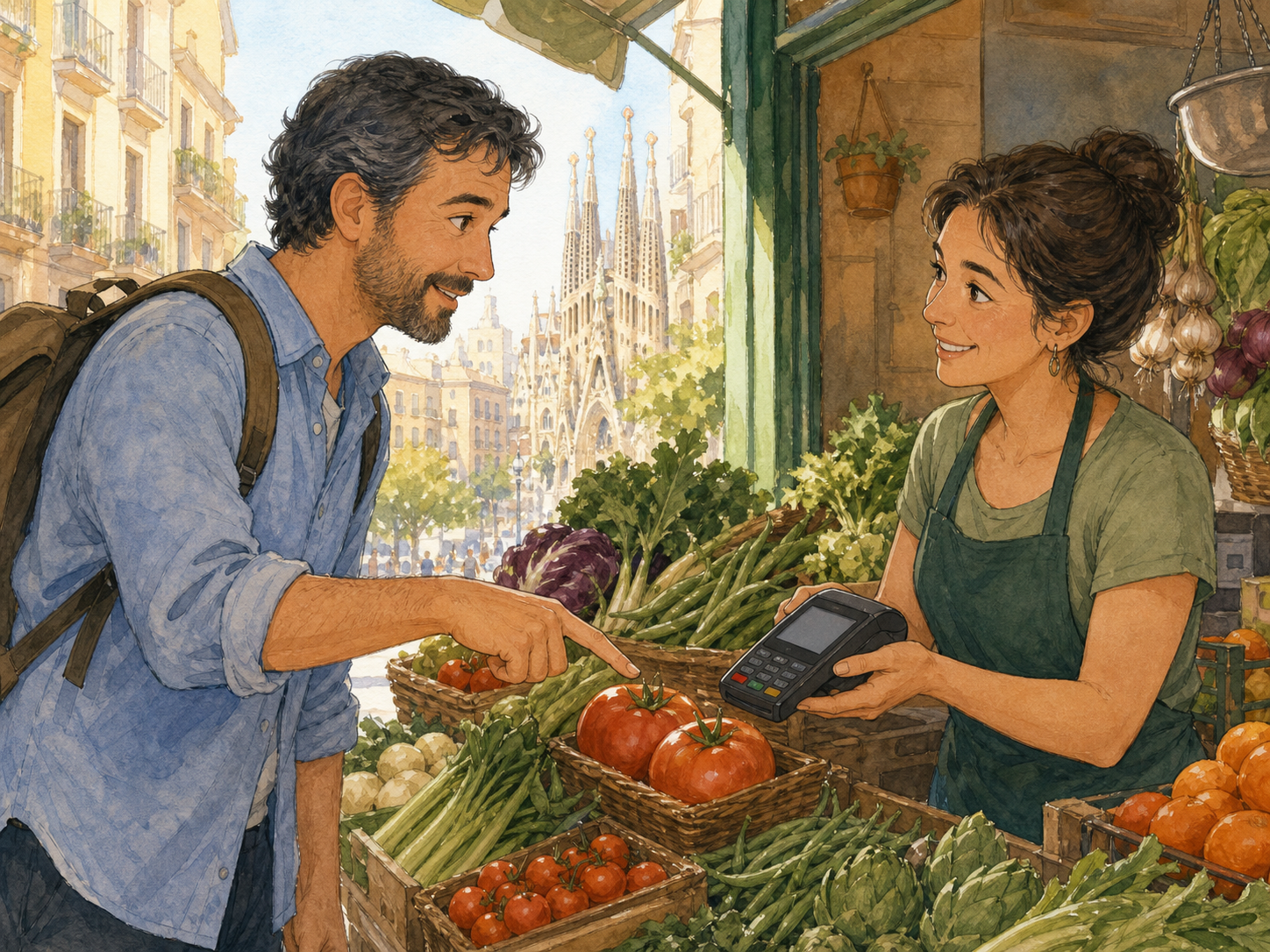 Scene 1: A Market Stall in Barcelona
Scene
Scene 1: A Market Stall in Barcelona
Typing practice
Type the text exactly. Timer starts with your first key.
Text to type: This is a fictional practice stall in Barcelona, Spain. The seller has local tomatoes and accepts card payment in this exercise. In Spain, restaurant tips are discretionary, and a customer at a tapas bar may round up the bill. Your goal is to ask what is local, order two items, check card payment, and decide whether to tip.
Ready. The timer starts with your first key.
Complete
Great job!
Strong finish — your speed stayed steady.
Your rhythm
Speed over time- Time
- 0:00
- Raw speed
- 0 WPM
- Wrong keys
- 0
- Corrected
- 0
Roleplay
Roleplay: Choose and Pay in Barcelona
Seller
Hello! What would you like?
You
What is local and popular here?
Seller
The tomatoes are local and popular in this practice stall.
You
Great. Two of these, please. Do you take cards?
Seller
Yes, this fictional stall takes cards.
You
Do I need to leave a tip?
Seller
In Spain, a tip is your choice. At a casual tapas bar, some customers simply round up.
You
I will pay the stated price today. Thank you.
Seller
Thank you. Your two tomatoes are ready.
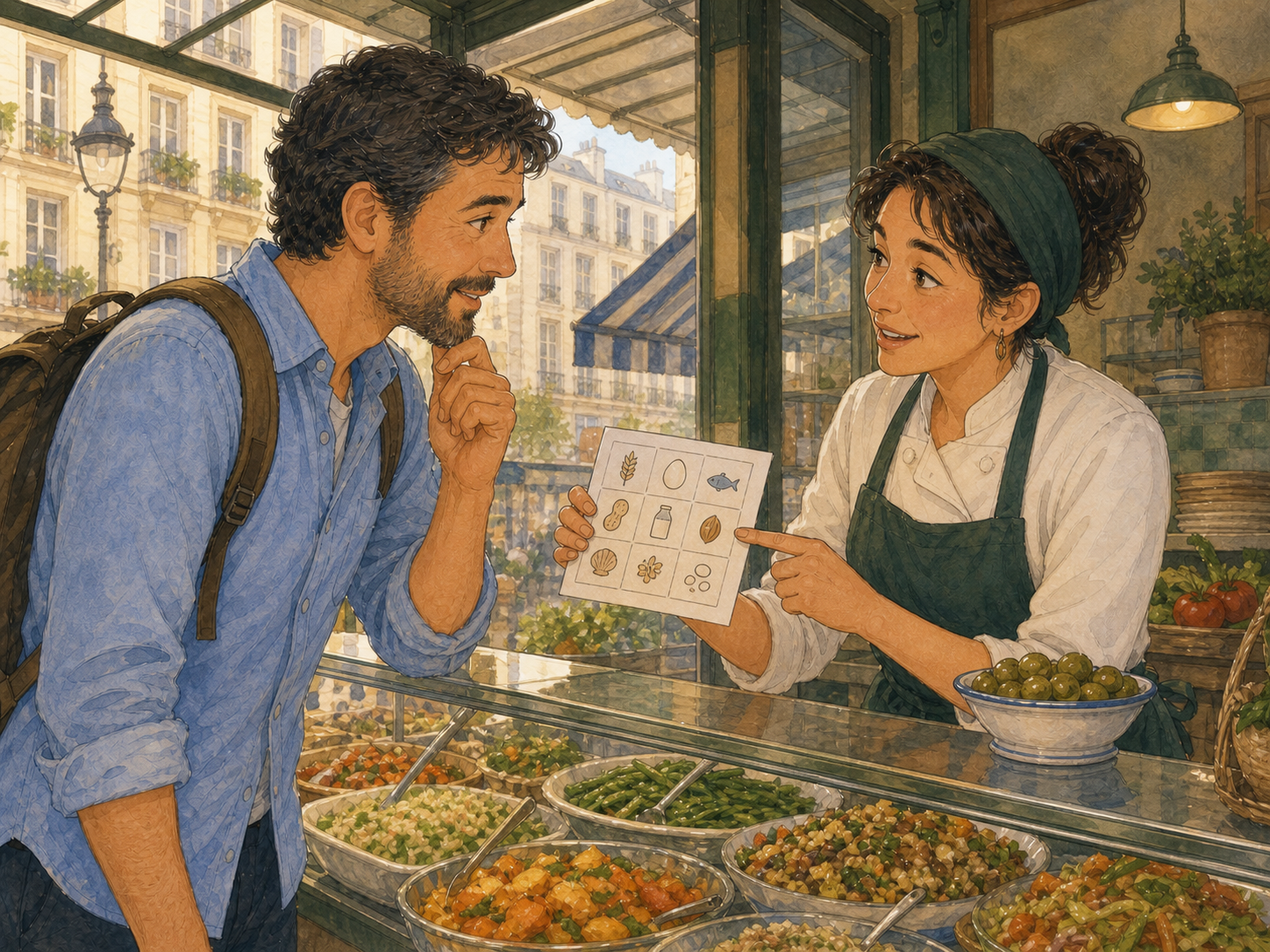 Scene 2: A Food Counter in Paris
Scene
Scene 2: A Food Counter in Paris
Typing practice
Type the text exactly. Timer starts with your first key.
Text to type: This is a fictional prepared-food counter in a covered market in Paris, France. An allergen card is available for the non-prepacked dishes. Under European Union rules, the seller may also explain the information aloud, but the card cannot promise that cross-contact never happens. Your goal is to ask about nuts, read the allergen information, and make a safe personal choice.
Ready. The timer starts with your first key.
Complete
Great job!
Strong finish — your speed stayed steady.
Your rhythm
Speed over time- Time
- 0:00
- Raw speed
- 0 WPM
- Wrong keys
- 0
- Corrected
- 0
Roleplay
Roleplay: Ask About Allergens in Paris
Cook
Hello. Would you like the lentil salad?
You
What is in it? I am allergic to nuts.
Cook
The written allergen card says it contains almonds. Cross-contact is also possible.
You
Thank you for telling me. Can I see the written information?
Cook
Yes. European Union rules allow a spoken answer, and written information is available on request. Here is the card.
You
The salad is not safe for me, so I will choose a sealed bottle of water instead.
Cook
Of course. Here is the sealed water.
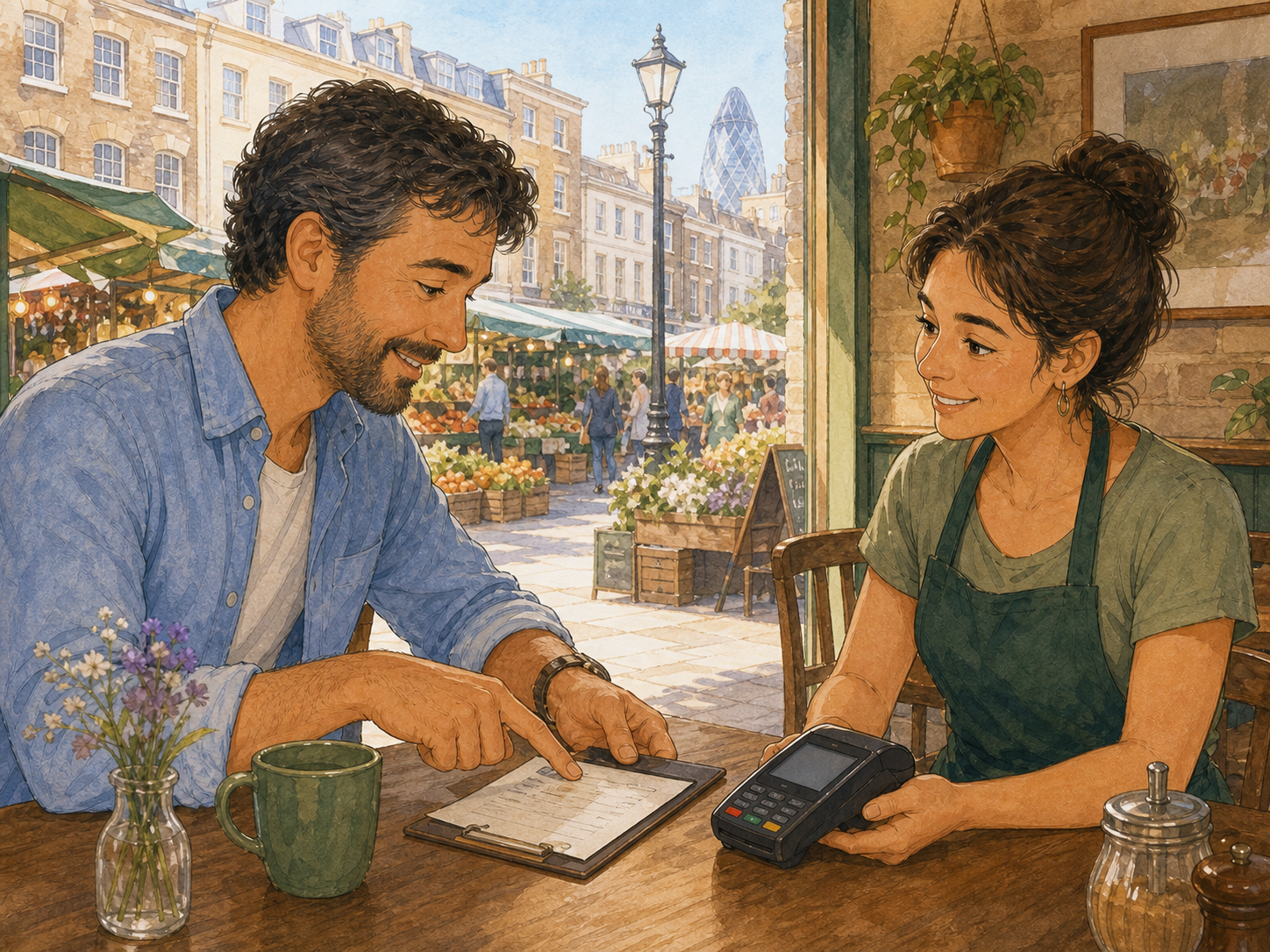 Scene 3: The Bill in London
Scene
Scene 3: The Bill in London
Typing practice
Type the text exactly. Timer starts with your first key.
Text to type: This is a fictional sit-down café beside a food market in London, Britain. The practice bill says “discretionary service charge.” In Britain, bills may use two different labels: discretionary service charge or compulsory service charge. Your goal is to identify the charge, ask whether another tip is needed, and complete the payment.
Ready. The timer starts with your first key.
Complete
Great job!
Strong finish — your speed stayed steady.
Your rhythm
Speed over time- Time
- 0:00
- Raw speed
- 0 WPM
- Wrong keys
- 0
- Corrected
- 0
Roleplay
Roleplay: Check the Bill in London
Server
Here is your bill.
You
Thank you. Is this service charge discretionary or compulsory?
Server
For this practice bill, it is discretionary, not compulsory.
You
Is it already included, and do I need to leave another tip?
Server
Yes, the discretionary charge is already on this bill. You do not need to add another tip in this exercise.
You
I understand. I will keep the charge and pay by card.
Server
Thank you. Your payment is complete.
Speak
Your Turn: Choose the Right Words
Speak through each situation. Change one detail and try again.
You want fruit by weight, but you do not know whether the stall takes cards. What do you say?
Need a starting line?
Start with: Half a kilo of ...
Helpful clue: Order the amount, then ask about card payment before the seller prepares it.
You have an allergy and want a ready-to-eat dish. What three questions or statements do you use?
Need a starting line?
Start with: What is in ...?
Helpful clue: State the allergy, ask about the ingredient, and request written allergen information.
A restaurant bill includes a service charge. What do you ask before adding more money?
Need a starting line?
Start with: Is this service charge ...?
Helpful clue: Check whether the charge is included and whether another tip is needed.
What you can do now
Final Reflection
Choose the useful rule you most want to remember.
Which market question will be most useful on your next trip, and why?
Need a starting line?
Helpful clue: Choose one phrase and explain the situation where you will use it.
What will you check before you leave a tip in another country?
Need a starting line?
Helpful clue: Think about counter or table service, the bill, and the local custom.
Learning cards
My cards
Food Markets in Europe: Buy, Eat, Pay and Tip
0 due · 0 new · about 1 min
Learn the sense first · then retrieve it
No saved cards yet
Open a word or phrase in the article and choose Save to My Words.
Focused Reading Mode is open.
Listening
Lesson audio
Listen from the beginning, or choose “Play this part” as you read along.
Reading
Three Kinds of Food Market
Reading
Choose an Amount and Ask How to Pay
Reading
Ask Clearly About Allergens
Reading
Tips Depend on the Country and Service
Finished listening?
Mark this listening practice complete when you have followed the lesson audio.
Listening complete
Listen Mode
Word-by-word syncPlay the audio and follow the highlighted word.
Article complete
Choose your next step
Open the next same-level lesson, replay the article, or save this page for later.
Listen Again
Replay the article once and notice how much more you understand.
One replay is enough. Then move on.