B1: Bulgaria's Wine Regions
Source topic: Bulgaria's Wine Regions: Climate, Grapes, and How Style Changes
Quality checked lesson
How Bulgaria's coast, inland valleys, and cellar choices create fresher whites, firmer reds, and more elegant spicy styles.
Transcript
Choose how to use this lesson
You can switch anytime.
Current mode
Study mode: full transcript with word help and inline checks.
Study Layout
Experience
Key Concepts
terroir
Terroir is the local mix of soil, weather, and landscape that shapes a wine.
It helps a learner connect place with style instead of treating wine taste as random.
acidity
Acidity is the fresh, sharp feeling that makes a wine feel lively and clean.
It explains why slower-ripening coastal wines can taste brighter and more refreshing.
tannin
Tannin is the dry, gripping feeling that can make red wine feel firmer and more structured.
It helps learners describe why Mavrud often feels stronger than a light coastal white.
microclimate
A microclimate is the climate of one small area, such as a coast, valley, or hillside.
It shows why two vineyards in one country can still produce different wine styles.
indigenous grape
An indigenous grape is a local grape that has a long history in one place.
It explains why grapes such as Mavrud and local Bulgarian varieties are tied to regional identity.
oak ageing
Oak ageing means keeping wine in oak barrels so the wine gains texture and extra aromas.
It helps learners separate the effect of cellar technique from the effect of geography.
lees ageing
Lees ageing means leaving wine on dead yeast cells after fermentation to build more texture.
It gives a second example of how winemaking can change style after the grapes are picked.
ageing potential
Ageing potential is a wine's ability to improve or stay stable over time in the bottle.
It connects structure, acidity, and tannin to a practical tasting decision.
Black Sea freshness chain
Black Sea influence -> slower ripening -> higher acidity -> fresher white wine style
This chain explains why coastal conditions often help white wines stay bright and energetic.
Mavrud inland structure chain
warmer inland climate -> fuller grape ripening -> deeper color and firmer tannin -> stronger ageing potential
This chain shows how inland heat can produce a darker, more structured red wine.
Cellar texture chain
oak ageing or lees ageing -> texture and aroma change -> rounder or softer final style
This chain helps learners separate winemaking choices from regional climate effects.
Technical Concepts
Core Concepts
- terroir: Terroir is the local mix of soil, weather, and landscape that shapes a wine. (It helps a learner connect place with style instead of treating wine taste as random.)
- acidity: Acidity is the fresh, sharp feeling that makes a wine feel lively and clean. (It explains why slower-ripening coastal wines can taste brighter and more refreshing.)
- tannin: Tannin is the dry, gripping feeling that can make red wine feel firmer and more structured. (It helps learners describe why Mavrud often feels stronger than a light coastal white.)
- microclimate: A microclimate is the climate of one small area, such as a coast, valley, or hillside. (It shows why two vineyards in one country can still produce different wine styles.)
- indigenous grape: An indigenous grape is a local grape that has a long history in one place. (It explains why grapes such as Mavrud and local Bulgarian varieties are tied to regional identity.)
- oak ageing: Oak ageing means keeping wine in oak barrels so the wine gains texture and extra aromas. (It helps learners separate the effect of cellar technique from the effect of geography.)
- lees ageing: Lees ageing means leaving wine on dead yeast cells after fermentation to build more texture. (It gives a second example of how winemaking can change style after the grapes are picked.)
- ageing potential: Ageing potential is a wine's ability to improve or stay stable over time in the bottle. (It connects structure, acidity, and tannin to a practical tasting decision.)
Connection Map
- Black Sea freshness chain: Black Sea influence -> slower ripening -> higher acidity -> fresher white wine style (This chain explains why coastal conditions often help white wines stay bright and energetic.)
- Mavrud inland structure chain: warmer inland climate -> fuller grape ripening -> deeper color and firmer tannin -> stronger ageing potential (This chain shows how inland heat can produce a darker, more structured red wine.)
- Cellar texture chain: oak ageing or lees ageing -> texture and aroma change -> rounder or softer final style (This chain helps learners separate winemaking choices from regional climate effects.)
Mini Case Study
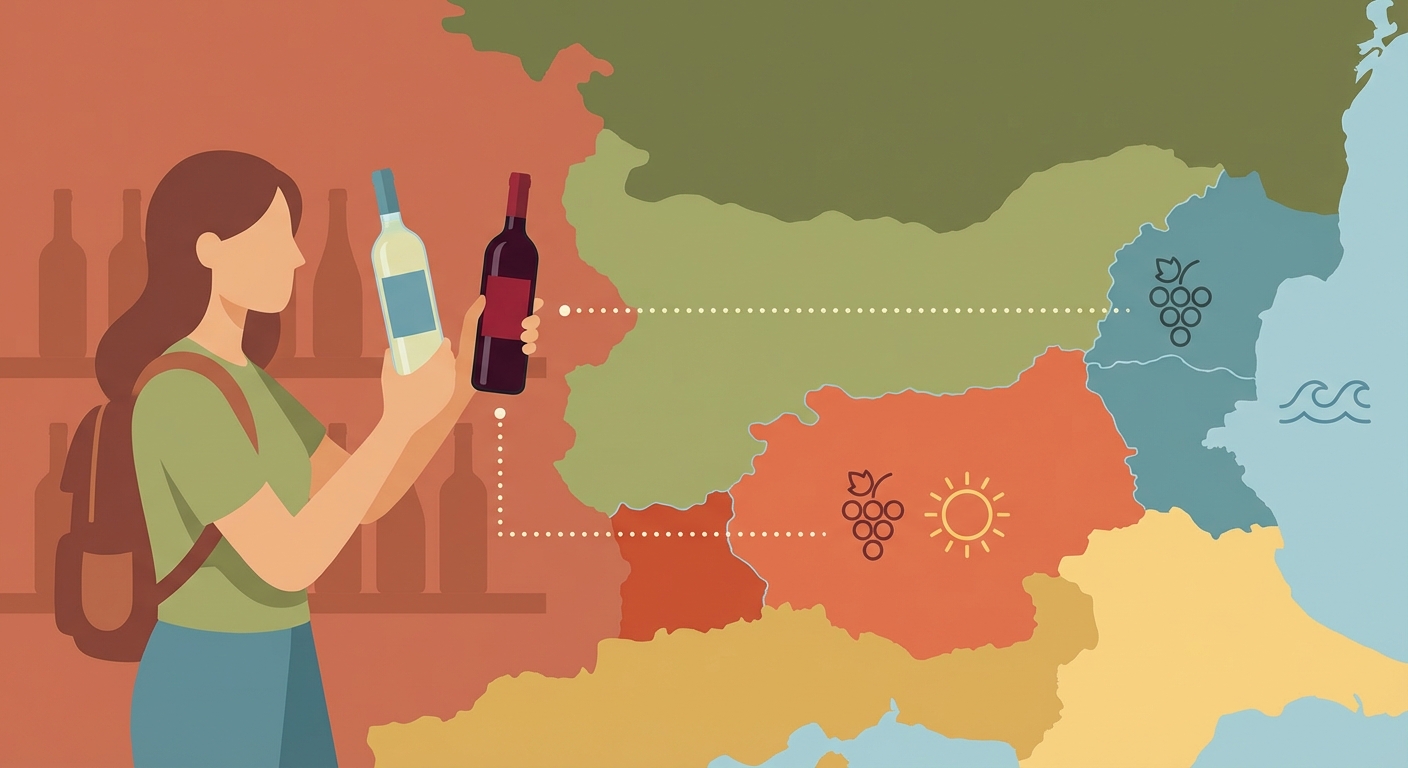
Scenario: Elena is choosing between a Black Sea white wine and a Thracian Valley Mavrud for dinner in Sofia.
Analysis: The coastal white fits seafood or salad because it keeps freshness and higher acidity. The Mavrud fits roast meat or hard cheese because warmer inland ripening gives more tannin, color, and structure.
Takeaway: A learner can use region, climate, and grape style together to predict the wine before tasting it.
7-Day Tracking Checklist
- Day 1: Map the three main regions - Write one short line on the Black Sea coast, Thracian Valley, and Struma Valley.
- Day 2: Acidity and freshness - Explain why slower ripening can keep acidity higher.
- Day 3: Tannin and structure - Describe how Mavrud feels different from a coastal white wine.
- Day 4: Microclimate - Give one example of how coast and inland valley conditions change style.
- Day 5: Local grapes - Review Dimyat, Red Misket, Mavrud, Melnik 55, and Gamza in one simple comparison.
- Day 6: Cellar technique - Write one sentence on oak ageing and one sentence on lees ageing.
- Day 7: Food pairing decision - Choose one Bulgarian wine for a meal and explain your logic in clear English.
Technical Practice
Comprehension
- Why can slower ripening near the Black Sea help white wines stay fresh?
- What does terroir include in this lesson?
- Why does Mavrud usually feel more structured than a coastal white wine?
- How is Melnik 55 different from a heavier red style?
- What is one way oak ageing or lees ageing can change wine texture?
Discussion
- Which factor is stronger in your opinion: climate, grape variety, or cellar technique?
- Would you rather taste a coastal white or a Thracian red first? Why?
- Do local grapes make a wine region easier to remember for learners?
- How much can winemaking change a style before place stops being the main story?
Speaking
- Explain the Black Sea freshness chain in your own words.
- Compare Mavrud and Melnik 55 in two or three sentences.
- Recommend one Bulgarian wine for a meal and justify the choice clearly.
Read-along works with this web player.
Introduction
The Explanation
a a a a a
Check your understanding
Read the sentence again. Where is Elena standing at the start of the story?
You can start like this: Elena is standing in...
a A a
Check your understanding
According to the text, what happens to the wine when the place changes?
You can start like this: When the place changes...
a
A a
Check your understanding
How can coastal white wines feel, according to the story?
You can start like this: They can feel...
a a
A a a
Think about it
Why do red wines feel stronger in the warmer inland valley?
You can start like this: They feel stronger because...
55. a
a a a 55
Check your understanding
Which red wine may have energy and spice?
You can start like this: ...may have energy and spice.
a a
A A A
Check your understanding
What may a coastal white from Dimyat or Red Misket promise?
You can start like this: It may promise...
Key Takeaways
a a a a a
Practice
Check your understanding
Why do many white wines from the Black Sea coast taste fresh?
Check your understanding
What does terroir mean?
Check your understanding
Why is Mavrud often stronger than a coastal white wine?
Discussion
Open question 1 · opinion
Do you think place is the most important factor in how wine tastes? Why or why not?
Open question 2 · personal experience
Have you ever tasted two drinks or foods from the same country that were very different? What happened?
Open question 3 · comparison
How are wines from the Black Sea coast different from wines from the Thracian Valley?
Open question 4 · opinion
Why does slower ripening near the sea help white wines taste fresh and bright?
Open question 5 · opinion
Which type of Bulgarian wine would you choose for a meal: coastal white, Mavrud, or Melnik 55? Why?
Open question 6 · opinion
How do winemakers’ choices like oak ageing or lees ageing change a wine, and why do these choices not erase the influence of place?
Lesson summary
How Bulgaria's coast, inland valleys, and cellar choices create fresher whites, firmer reds, and more elegant spicy styles.
Simple Meaning
Word
No context sentence available.
Simple Meaning
Loading simple meaning...
In this sentence
No context meaning available yet.
Simple version
Example sentence
Language assist
Loading assist...
Beta: extra help is still being prepared for this lesson.
Question
Lesson vocabulary
Vocabulary
Save words from this lesson, then use flashcards and quiz here.
Practice your saved words. We'll bring back the ones you need to review.
Flashcards
No saved words yet
Tap words in the transcript to start your lesson vocabulary.
Context Guesser
Guess the Word
Read the sentence and pick the missing word. All words come from this lesson.
Spelling Challenge
Spell the Word
Read the meaning and type the correct word. Use hints if you need help.
Listen Again
You listened, read, and studied the lesson. Now listen one more time and notice how much more you understand.
Re-listening after studying helps you remember new words better.
Quick feedback
If something felt confusing, broken, or especially helpful, send one short note before you move on.