B1: Use AI Safely at Work: Tax Office English
Quality checked lesson
Practice safe AI at work: protect data, write prompts, check facts, use human review.

Transcript
Choose how to use this lesson
You can switch anytime.
Today's path
One clear way through the lesson
Start with Listen, then move forward when you feel ready.
- 1 Listen
- 2 Read core
- 3 Check understanding
- 4 Speak and apply
- 5 Grammar review
- 6 Go deeper
Today: Review the key idea in Using AI safely and usefully in a tax office.
Next: Explain Using AI safely and usefully in a tax office in your own words next time.
Selected
Study mode: full transcript with word help and inline checks.
Study Layout
Experience
Listen and follow the highlighted text.
Setting the Scene
Welcome to Ovi English School.
Today, we are in a busy tax office with Maya.
It is late afternoon, and the clock is moving fast.
A client keeps calling because an important form is missing.
Maya wants to answer before 4 p.
m.
, but she also has to protect private data and follow office rules.
So she asks a very modern question: can AI help her write the email, or is that too risky?
In this episode, you will hear a natural office conversation, useful phrases, and one clear safe process.
Listen for Maya’s choices, because the pressure is real.
The client is worried, Maya is under a deadline, and one small mistake could create a bigger problem.
Setting the Scene
Welcome to Ovi English School. Today, we are in a office with It is late and the is A calling because an important is to answer before 4 p.m., but she also has to data and follow office So she a very question: can help her the or is that too In this episode, you will a natural office and one clear process. Listen for because the pressure is The is worried, is under a deadline, and one small mistake could a bigger problem.
The Conversation
Situation 1
Decide if AI is safe
Decide if AI is safe
A: I need help.
Decide whether the task can use AI and remove any private taxpayer or client details.
tax office staff checking a safe-use list before opening an AI tool
I need help. The has called twice today, and it is almost 3:30. I need to draft a before 4 p.m. Can I use
Yes, but be Use only public or fake details. Do not enter names, phone or records.
Right. The already sounds upset, and I do not to make things
You can A” and X. ” That the
Okay, that safer. I just need a starting point, because my is full and my manager is in a
Then can help with the first When you say “draft a you a first not the final
Yes, that is what I need. A first I can fix. The is so I the tone to be
Good thinking. Keep your simple. Say the task, the tone, and the general
I a for A. Explain that X is still and we need it soon. ”
That is clear. Now, before we read the what do you expect? Will the sound too direct, or maybe too
Maybe too Or too often sounds correct, but not very human.
Let’s see.
Oh no. It “Send the papers now, or your file may fail. ” That sounds hard and a bit
I agree. It is direct, but not The is already If they read that line, they may panic.
Yes, and then they will probably call again. That would no at all.
So this is the to stop and Do you send it quickly because of the deadline, or do you fix it first?
Continue The Conversation
Decide if AI is safe
Continue as Tax Office Staff.
Main question: Decide whether the task can use AI and remove any private taxpayer or client details.
Follow-up questions
- Which details should stay out of the AI tool first?
- What part of the task could AI help with safely?
- What would you check before you paste anything into the prompt?
Answer help
First, I would remove names, tax numbers, and private records.
AI could help me draft a first version, but not the final decision.
Before I use it, I would check that the task does not include private data.
Useful phrases
I can use fake labels like Client A and Form X.
AI can help with a draft, but not the final decision.
One model reply
First, I would remove private details and use AI only for a first draft.
Focus: workplace rules
Tip: Let the learner explain choices and solve small problems without flattening the language into textbook dialogue.
Quick Grammar Check
I _____ draft a reply before 4 p.m.
Which phrase shows the action is necessary in this situation?
Check answer
Show answer
need to
Tip: Look for the phrase that means this is necessary, not just a good idea.
Use need to when the step is necessary, not optional.
- "should" is advice, so it sounds softer.
- "must" and "need to" show stronger necessity.
Check your understanding
Why does the speaker say AI can help with the first version? Answer with the reason from the conversation.
You can start like this: AI can help because...
Situation 2
Write a clean prompt

Write a clean prompt
A: I fix it first.
Write a prompt with public, fake, or approved information only.
office worker writing a prompt beside a clean checklist and no private records
I fix it first. A bad is still a bad
Good
I remember one office but I to check it. We must follow official What does that here?
“Official means the approved from your office. It is the source. If one thing and the office another, follow the
So can support the work, but it cannot replace the
is a It is but it is not the decision-maker.
That makes sense. And there is another my manager uses all the “human review. ”
Yes. “Human review” means a person the final answer before it goes out. Not a two-second look, but a check.
So the order is: remove details, a draft, then do human review.
Yes. That is the three-step order.
Wait. I found a bigger problem. The wrote that the has 10 days to but our office 14 days.
Good catch. That is why human review matters.
If I send the wrong deadline, the might rush for no reason. Or they might lose trust in us.
Right. In office work, the tone matters, but the matter even more.
Continue The Conversation
Write a clean prompt
Continue as Tax Office Staff.
Main question: Write a prompt with public, fake, or approved information only.
Follow-up questions
- What should the prompt explain clearly to the AI?
- How can you ask for a calm and polite tone?
- Which detail would you keep general instead of specific?
Answer help
I would tell the AI the task, the tone, and the general situation.
I would ask for a polite draft, not a final decision.
I would keep the case anonymous and use fake labels like Client A or Form X.
Useful phrases
Do not make the final decision for me.
One model reply
I need a polite draft for Client A about Form X. Please use general details only.
Focus: workplace rules
Tip: Let the learner explain choices and solve small problems without flattening the language into textbook dialogue.
Quick Grammar Check
We _____ follow official guidance.
Which phrase sounds like a strong office rule?
Check answer
Show answer
must
Tip: Look for the phrase that sounds stronger than simple advice.
Use must for a strong rule or requirement.
- "should" is advice, so it sounds softer.
- "must" and "need to" show stronger necessity.
Check your understanding
What problem did the speaker notice in the AI message about the client’s reply time?
You can start like this: The problem was that...
Situation 3
Check the answer
Check the answer
A: I am changing it now.
Compare the AI answer with office rules, official sources, and human judgment.
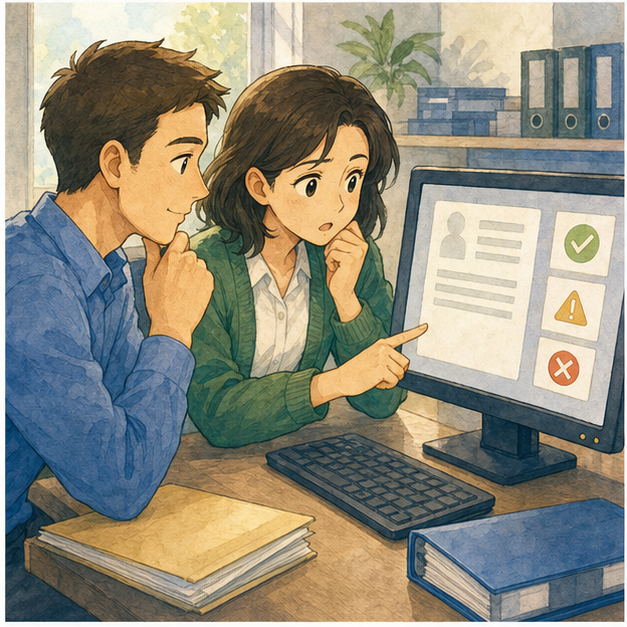
staff member comparing an AI draft with official guidance and a review checklist
I am changing it now. How about this: send X by Friday so we can continue your
Better. It is clear and But check one more thing. Does “by Friday” match the deadline?
Good point. Friday is fine in this because Friday is still inside the 14-day limit.
Great. Then it gives the a simple next step breaking the
I to add one line because the asked if we lost the Maybe: “At the we cannot see X in your file. ”
That sounds natural. It answers the question anyone.
Yes, because maybe they it, and maybe it was I do not know yet.
In customer it is often better to be when the are incomplete.
The just another They wrote, “I already everything last week. ” Oh, now I for them.
I understand. They are probably frustrated, and maybe even scared. letters can make nervous.
True. If I were in that I would a answer, not a warning.
So what is your next move? Predict it before you act.
First, I will not send the draft. Second, I will check the file again. Third, I will ask my manager to review my new
That sounds professional.
Continue The Conversation
Check the answer
Continue as Tax Office Staff.
Main question: Compare the AI answer with office rules, official sources, and human judgment.
Follow-up questions
- Which fact would you verify before sending this message?
- What part of the AI draft sounds risky or too strong?
- Which office rule or source should you compare it with?
Answer help
I would compare the deadline with the official rule first.
The risky part is the sentence that sounds too hard or inaccurate.
I would check the office checklist and the file notes before I send anything.
Useful phrases
We must follow official guidance.
One model reply
I would compare the deadline with the office rule and check the tone before sending it.
Focus: workplace rules
Tip: Let the learner explain choices and solve small problems without flattening the language into textbook dialogue.
Quick Grammar Check
Predict it _____ you act.
Which word shows the earlier step in the process?
Check answer
Show answer
before
Tip: Look for the word that tells you what happens first.
Use before to show the earlier step in a process.
- "before" shows the earlier step.
- "after" shows the later step.
Check your understanding
What new message does the speaker suggest sending to the client?
You can start like this: The new message is...
Situation 4
Rewrite politely

Rewrite politely
A: I checked the file notes.
Turn a rough AI draft into a clear, polite message for a taxpayer, client, or coworker.
before and after message draft on a desk in a professional tax office
I checked the file notes. There is no record of X So I will “At the we cannot of X. ”
Very good. That is and
Here is my full draft: “Dear A, at the we cannot of X. send it by Friday so we can continue your If you already it, with the date Thank you. ”
That well. It is clear, and It also gives the a simple action.
And it sounds more human. Not but better.
Better is enough when it is and kind.
My manager is back. I’ll ask for human review now.
Good A quick check now can prevent a bigger problem later.
She it. She changed only one and approved it.
Great. So you met the deadline?
Yes. I it at 3:52. The got a clear answer today, and I the
Well done. What did you from this?
helped me start faster, but I still had to think. I had to data, check official and use human review.
can but only when stay responsible.
Continue The Conversation
Rewrite politely
Continue as Tax Office Staff.
Main question: Turn a rough AI draft into a clear, polite message for a taxpayer, client, or coworker.
Follow-up questions
- Which sentence sounds careful enough for the client?
- How would you explain the human review to your manager?
- What action should the client take after reading your message?
Answer help
I would use careful language like At the moment, we cannot confirm receipt.
I would tell my manager that AI helped with the draft, but I checked the facts.
The client should know the next step and the deadline clearly.
Useful phrases
At the moment, we cannot confirm receipt.
Please send Form X by Friday so we can continue your case.
If you already sent it, please reply with the date.
One model reply
At the moment, we cannot confirm receipt of Form X. Please send it by Friday so we can continue your case.
Focus: workplace rules | clarification repair
Tip: Let the learner explain choices and solve small problems without flattening the language into textbook dialogue.
Quick Speaking Check
Which answer starter can help with "Turn a rough AI draft into a clear, polite message for a taxpayer, client, or coworker."?
Use the answer help as a speaking starter, then add your own detail.
Check answer
Show answer
I would use careful language like At the moment, we cannot confirm receipt.
Tip: Choose a starter that directly answers the main question.
This starter directly answers the main question.
Continue The Conversation
Full practical role-play
Continue as You.
Role-play the full goal once as Tax Office Staff, then switch and listen as Manager.
Starter help
Check whether the task is safe for AI first.
Ask AI for a draft, not the final decision.
Compare the answer with the office rule.
Explain the human review before you send it.
One model reply
I removed the private details, asked for a calm draft with fake labels, checked the office rule, and asked for human review before sending it.
Focus: workplace rules | clarification repair
Tip: Use the scenario cards as the path, but do not read them like a script.
Continue The Conversation
Explain the safe process
Continue as You.
Explain the full safe process in order and say what a human still needs to check before the message is sent.
Useful phrases
Use fake labels like Client A and Form X.
AI can draft the message, but it cannot make the final decision.
Human review still matters before the message goes out.
Starter help
First, I would remove private details and use fake labels.
Then I would ask AI for a calm first draft only.
Before sending anything, I would compare the facts with the office rule and ask for human review.
One model reply
First, I would remove private details and replace them with fake labels. Then I would ask AI for a polite draft, compare it with the office rule, and ask for human review before I send it.
Focus: workplace rules | clarification repair
Tip: Keep the order clear: remove private data, write a clean prompt, check the facts, then ask for human review.
Think about it
Why is the phrase "at the moment, we cannot confirm receipt of Form X" careful and accurate?
You can start like this: This phrase is careful because...
Wrap-Up
Nice work today. had pressure, a worried and a deadline, but she did not let speed control her She used for a draft, not for the final answer. She official the and asked for human review. That is smart office English, and it is also smart office Now here is your challenge: can you remember the three-step order looking? Say it if you can. Remove details, make a draft, then do human review. If you more practical English like this, ovi english dot com. Keep going. You are building English step by step.
Practice
Why did Maya use “Client A” and “Form X” in her prompt?
Because fake details protect private data in the AI tool.
What does “draft a reply” mean in this story?
It means writing a first version that Maya can change later.
The AI gave 10 days, but the office rule said 14.
What should Maya trust, and why?
She should trust the official guidance, because office rules are the approved source.
Maya stopped before sending the first AI email.
Why was that a smart decision?
The tone was too hard, and one fact was wrong.
Can you say the safe three-step order from memory?
Remove private details, make a draft, then do human review.
Wrap-Up
Nice work today.
Maya had pressure, a worried client, and a deadline, but she did not let speed control her decision.
She used AI for a draft, not for the final answer.
She followed official guidance, corrected the facts, and asked for human review.
That is smart office English, and it is also smart office behavior.
Now here is your challenge: can you remember the safe three-step order without looking?
Say it aloud if you can.
Remove private details, make a draft, then do human review.
If you want more practical English like this, visit ovi english dot com.
Keep going.
You are building real workplace English step by step.
Go deeper
Study Mode
Grammar
Start with a mini diagnostic, notice the pattern, answer checks, review results, and say your own sentences.
Start
Mini diagnosticNotice
Short examplesCheck
Grammar questionsReview
Results and retrySpeak
Own sentencesChoose a Focus
Practice one grammar idea at a time
Grammar Focus
Choose one target when you want to focus the cards and highlights.
All grammar targets are visible.
Workplace Rules With Should / Must 3 checks
Workplace Rules With Should / Must
Use should, must, and need to for rules, and before and after for the order of steps.
should | must | need to | before | after
I need to draft a reply before 4 p.m.
Why: Here, "need to" shows a necessary step in the work process.
Transcript lineNow, before we read the result, what do you expect?
Why: Here, "before" shows the earlier step in the process.
Transcript lineWe must follow official guidance.
Why: Here, "must" shows a strong office rule.
Transcript linePractice quiz 3 questions
Choose
I _____ draft a reply before 4 p.m.
Which phrase shows the action is necessary in this situation?
Show answer
need to
Tip: Look for the phrase that means this is necessary, not just a good idea.
Which phrase shows the action is necessary in this situation?
- "should" is advice, so it sounds softer.
- "must" and "need to" show stronger necessity.
Fill in
Now, _____ we read the result, what do you expect?
This line is about the order of steps.
Show answer
before
Tip: Look for the word that shows the earlier step.
This line is about the order of steps.
Jump to transcriptRebuild
must / follow / official / guidance / We
This sentence gives a rule or necessary step.
Show answer
We must follow official guidance.
Also okay: We must follow official guidance
Tip: Start with "We" and put "must" before the main verb.
This sentence gives a rule or necessary step.
Jump to transcriptSay It Yourself
- Explain the office rule in this line: "I need to draft a reply before 4 p.m."
- Ask one short checking question before you send the message.
Lesson summary
Practice at work: data, write check facts, use human review.
Simple Meaning
Word
This word has no saved lesson sentence yet.
Simple Meaning
Preparing word help...
In this sentence
No context meaning available yet.
Simple version
Example sentence
Language assist
Loading assist...
Extra language help is not ready for this word yet.
Scenes
Question
Lesson vocabulary
Vocabulary
Save words from this lesson, then use flashcards and quiz here.
Practice your saved words. We'll bring back the ones you need to review.
Flashcards
No saved words yet
Tap words in the transcript to start your lesson vocabulary.
Lesson complete
Choose your next step
Open the next lesson, review once more, or save this page for later.
Listen Again
Replay the lesson once after studying and notice how much more you understand.
One replay is enough. Then move on.
Save, rate, or report an issue
Quick issue note
Mark one confusing or broken spot on the page, then send a short note.
Resources
Save, share, or contact support from one place.