Back to Archive
Beginner (A2) Conversation Lesson Public

A2: Transportation English for Travel

Quality checked lesson

A practical English lesson for traveling abroad
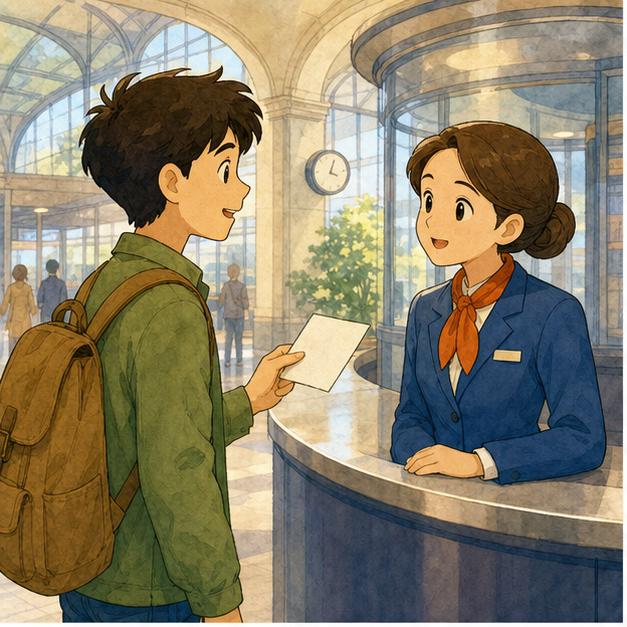
Illustration 1: Asking Where to Go: Risa is in a new city.

Transcript

Choose how to use this lesson

You can switch anytime.

Today's path

One clear way through the lesson

Start with Read core, then move forward when you feel ready.

  1. 1 Read core
  2. 2 Check understanding
  3. 3 Speak and apply

Current mode

Study mode: full transcript with word help and inline checks.

Lesson Goal

In this lesson, you will learn how to use simple English when traveling by train, bus, subway, or metro. You will practice how to ask for help, understand schedules, buy tickets, change lines, and arrive at your destination.

Why Transportation English Is Useful

When you travel abroad, transportation can feel confusing. Stations are busy, signs are sometimes difficult, and people may speak quickly. But most travel English is simple and repeated many times. You often need to ask:

  • “Where is the station?”
  • “Which train should I take?”
  • “Where do I get off?”
  • “How much is the ticket?”
  • “Does this bus go to this place?”

Setting the Scene

In this you will to when by or You will to for and at your

Introduction: Why Transportation Is Useful

When you can Stations are are and But is and You to

“Where is the “Which I “Where do I is the “Does this to this

The Conversation

Situation 1

Part 1: Asking Where to Go

Risa is in a new city. She wants to go to the city center, but the station is large. There are many signs, platforms, and people walking quickly. She decides to ask a station worker for help.

Turn 1

Risa

Excuse me, do I to the

Turn 2

Station Staff

the Blue Central

Turn 3

Risa

Which I to?

Turn 4

Station Staff

3.

Turn 5

Risa

Thank you. is it?

Turn 6

Station Staff

Turn 7

Risa

Great. Thank you

Check your understanding

?

Which line does Risa need to take?

You can start like this: I think

Useful Phrases

  • Excuse me, how do I get to ___?
  • Which platform should I go to?
  • How many stops is it?
  • Does this train go to ___?

Situation 2

Part 2: Buying a Ticket

Before Risa can ride the train, she needs a ticket. Some countries use ticket machines. Some stations have staff at a ticket counter. If the machine is confusing, it is okay to ask for help.

Turn 1

Risa

Hi, I’d a to Central

Turn 2

Station Staff

or

Turn 3

Risa

Turn 4

Station Staff

That’s $3. 50.

Turn 5

Risa

Can I by

Turn 6

Station Staff

Yes, your

Turn 7

Risa

Thank you.

Check your understanding

?

Does Risa buy a one-way ticket or a round-trip ticket?

You can start like this: I think

Useful Phrases

  • I’d like a ticket to ___, please.
  • One-way, please.
  • Round trip, please.
  • Can I pay by card?
  • Where do I tap my card?

Simple Explanation

One-way means you only go to the place.

Round trip means you go and come back.

Situation 3

Part 3: Finding the Right Train

Risa goes to Platform 3. She sees two trains. She is not sure which one is correct. It is better to ask before getting on the wrong train.

Turn 1

Risa

Excuse me, does this to Central

Turn 2

Station Staff

Yes, it does.

Turn 3

Risa

Great. Do I to

Turn 4

Station Staff

No, it’s

Turn 5

Risa

Thank you.

Turn 6

Station Staff

No

Check your understanding

?

Does Risa need to change trains?

You can start like this: I think

Useful Phrases

  • Does this train go to ___?
  • Do I need to change trains?
  • Is it direct?
  • Which direction is this train going?

Simple Explanation

Direct means you do not need to change trains.

Change trains means you get off one train and get on another train.

Situation 4

Part 4: On the Train

Risa gets on the train. It is busy, but she finds a place to stand. She wants to make sure she gets off at the right station, so she asks someone nearby.

Turn 1

Risa

Excuse me, to Central

Turn 2

Station Staff

Turn 3

Risa

Thank you. Could you me when we there?

Turn 4

Station Staff

Sure. I’m there

Turn 5

Risa

Thank you so

Check your understanding

?

How many more stops are there to Central Station?

You can start like this: I think

Useful Phrases

  • How many stops to ___?
  • Is this the right train for ___?
  • Could you tell me when we get there?
  • I’m getting off at ___.

Situation 5

Part 5: Changing Lines on the Metro

In many cities, the subway or metro has many colored lines. Sometimes you need to transfer. A transfer means changing from one line to another.

Turn 1

Risa

Excuse me, I to to Riverside Museum.

Turn 2

Station Staff

the Blue then to the Green at Central

Turn 3

Risa

to the Green at Central

Turn 4

Station Staff

Yes, that’s Then at Riverside.

Turn 5

Risa

Thank you. Is it the

Turn 6

Station Staff

No, on

Check your understanding

?

Where does Risa need to transfer?

You can start like this: I think

Useful Phrases

  • Where do I transfer?
  • Which line should I take?
  • Get off at ___.
  • Is it far from the station?
  • About five minutes on foot.

Simple Explanation

Transfer = change from one train or line to another.

On foot = walking.

Situation 6

Part 6: Taking a Bus

Buses are useful, but they can be more confusing than trains. Bus stops can be small, and sometimes the driver is busy. The best question is: “Does this bus go to ___?”

Turn 1

Risa

Excuse me, does this to Riverside Museum?

Turn 2

Station Staff

Yes, it does.

Turn 3

Risa

Where I

Turn 4

Station Staff

at River Street. It’s the the

Turn 5

Risa

Thank you. Can I by

Turn 6

Station Staff

Yes, your when you on.

Turn 7

Risa

Okay, you.

Check your understanding

?

Where should Risa get off the bus?

You can start like this: I think

Useful Phrases

  • Does this bus go to ___?
  • Where should I get off?
  • Is this the right bus?
  • Can I pay by card?
  • Please tell me when to get off.

Situation 7

Part 7: Asking for Directions After Getting Off

Risa gets off the bus at River Street. She can see some shops, but she cannot see the museum. She asks a local person for directions.

Turn 1

Risa

Excuse me, do I to Riverside Museum?

Turn 2

Station Staff

for then

Turn 3

Risa

Is it the

Turn 4

Station Staff

Yes, it’s to the

Turn 5

Risa

Thank you.

Turn 6

Station Staff

You’re

Check your understanding

?

Where is the museum?

You can start like this: I think

Useful Phrases

  • Go straight.
  • Turn left / turn right.
  • It’s next to ___.
  • It’s across from ___.
  • Is it near ___?

Situation 8

Part 8: When Something Goes Wrong

Sometimes travel does not go perfectly. You might miss a train, take the wrong bus, or lose your ticket. Stay calm and ask for help.

Turn 1

Risa

Excuse me, I I the

Turn 2

Station Staff

Where are you to

Turn 3

Risa

I’m to to Central

Turn 4

Station Staff

No at the and the

Turn 5

Risa

Do I a

Turn 6

Station Staff

No, your is

Turn 7

Risa

That’s a Thank you.

Check your understanding

?

Does Risa need a new ticket?

You can start like this: I think

Useful Phrases

  • I think I took the wrong train.
  • I missed my stop.
  • What should I do?
  • Do I need a new ticket?
  • Is my ticket still valid?
  • That’s a relief.

Simple Explanation

Valid means still okay to use.

That’s a relief means “I feel better now.”

Situation 9

Part 9: Small Talk While Traveling

Sometimes people speak to you on a train, bus, or at a station. Small talk is usually short and friendly.

Turn 1

Station Staff

Is this

Turn 2

Risa

Yes,

Turn 3

Station Staff

Thanks. Are you

Turn 4

Risa

Yes, it’s my

Turn 5

Station Staff

Nice! Enjoy your

Turn 6

Risa

Thank you.

Check your understanding

?

What does the traveler ask first?

You can start like this: I think

Useful Phrases

  • Is this seat free?
  • Go ahead.
  • Are you visiting?
  • It’s my first time here.
  • Enjoy your trip.

Wrap-Up

You 43 and 10 for Transportation for Travel. with "Excuse me," the and the

Final Review: Important Travel Words

WordSimple MeaningFlashcards
place where trains or buses stop
place where you wait for a train
train or metro route, often by color
place where you get on or off
Change from one train or bus to another
No change to another train or bus
Travel in only one direction
Going somewhere and coming back
still okay to use
The city center

Speaking Practice

  • What transportation do you usually use when traveling?
  • Do you prefer trains, buses, taxis, or walking?
  • What is difficult about using transportation abroad?
  • What phrase do you want to remember most?

Lesson vocabulary

Vocabulary

Save words from this lesson, then use flashcards and quiz here.

0 saved0 due0 mastered

Practice your saved words. We'll bring back the ones you need to review.

Flashcards

No saved words yet

Tap words in the transcript to start your lesson vocabulary.

Quick feedback

If something felt confusing, broken, or especially helpful, send one short note before you move on.

Resources

Next A2 lesson

This keeps you inside A2 by default. Browse all lessons if you want a stretch.