B1: The Piano Stairs: Can Fun Change Behavior?
Quality checked lesson
Understand how one playful public space experiment used music to change a small daily habit, then practice explaining how design can make better choices feel easier in clear B1 English.

Article
Choose how to use this lesson
You can switch anytime.
Today's path
One clear way through the lesson
Start with Read core, then move forward when you feel ready.
- 1 Read core
- 2 Check understanding
Selected
Study mode: article with word help and quick checks.
Study Layout
Experience
Listen and follow the highlighted text.
Introduction
Understand how one playful public space experiment used music to change a small daily habit, then practice explaining how design can make better choices feel easier in clear B1 English.
When you see stairs next to an escalator, which one do you usually choose?
What boring daily action could become easier if it felt more fun?
Have you ever changed your behavior because something was designed in a clever way?
Should public places try to teach people, guide people, or simply help people choose?
Reading
In many people face a small take the or take the The are but the is Most people do not stop and think They follow the
In 2009, a public in Stockholm, Sweden, asked a question. What if the did not feel like exercise? What if they felt like a At Odenplan a was into large black and white When people on a it made a note.
Check your understanding
What normal choice did the experiment focus on?
You can start like this: I think...
The were not a long about health. They did not tell people, "You should exercise." they the feeling of the place. A something people wanted to try.
Check your understanding
How did the piano stairs guide people without giving a lecture?
You can start like this: I think...
Some people up at first. Others played with the notes, or watched friends the The a small public People were still going to work, school, or home, but for a few seconds their felt
The reported that 66 more people the after they That number is but the idea is more important. People often know what is good for them, but is not always enough.
Check your understanding
What result did the project report?
You can start like this: I think...
can change the of If the better feels or many people it. If the better feels simple, and more people may try it. For example, a who to on the might take because the first feels The showed this idea in a and way.
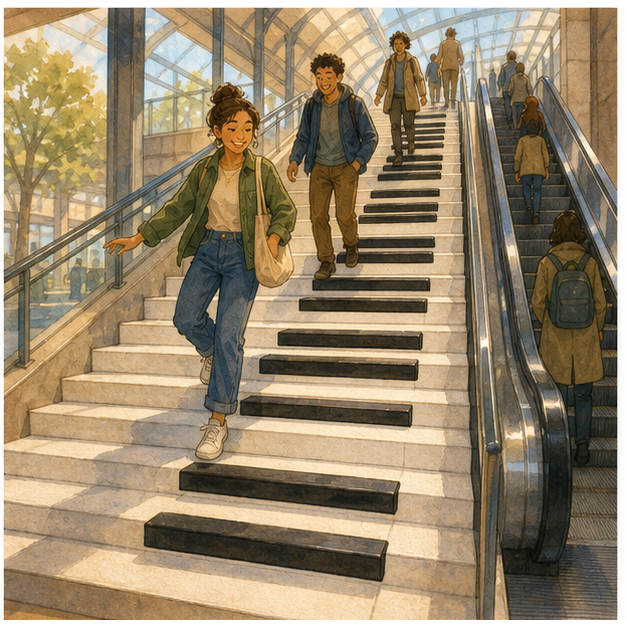
A is not only a It is also to the world around us. For example, in a the may be in of the while the are behind a Most people follow the they see first. If the are open, and close to the the before anyone says a word.
Check your understanding
Why are habits connected to the world around us?
You can start like this: Because...
This does not mean people are People still But good can a better at the right The did not anyone to They made feel like a small game.
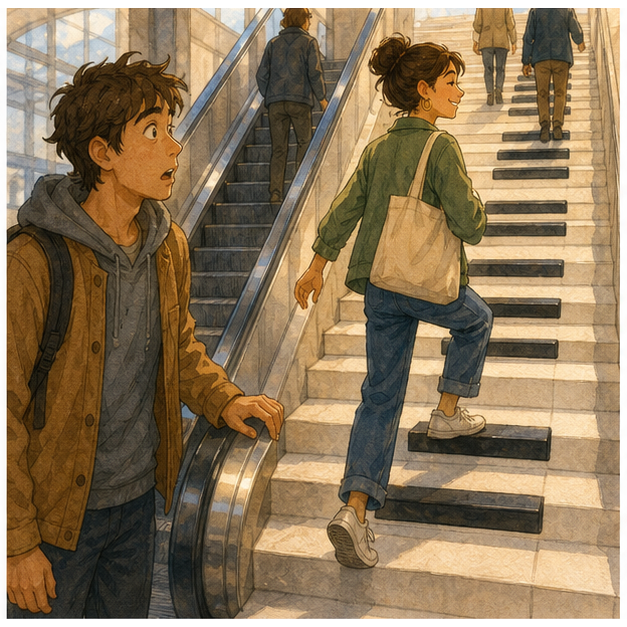
The are but they also questions. Would people keep using the after the Would the some people? Would the idea work in a a or a school?
Fun can open a but it cannot every problem. A good public must also be to and of different people. For example, a after a night may need a more than a one. The lesson is not "make everything into a game." The lesson is "make the better to and to
Check your understanding
Why is fun not a complete solution by itself?
You can start like this: Because...
you can change one small place in your school, home, or office. You cannot give people a long You can only change the of the What would you change?
Check your understanding
What is the goal of a tiny design experiment?
You can start like this: I think...
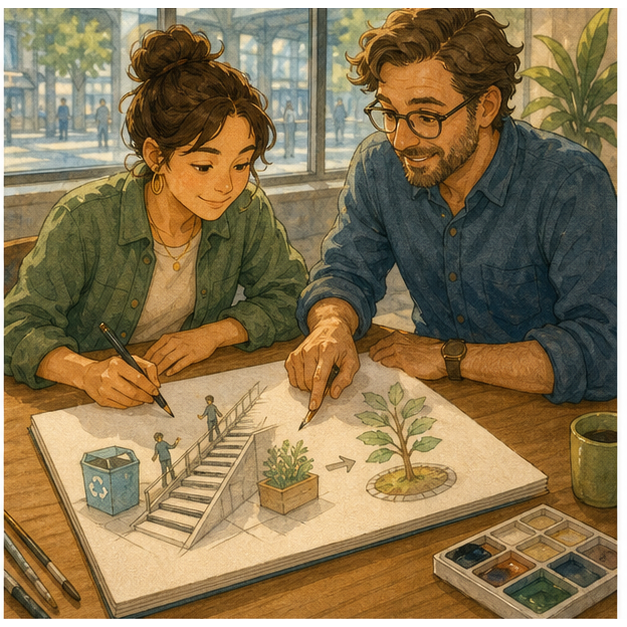
Maybe a could make a when someone uses it. Maybe a could show a Maybe a could show a simple line. The best idea is not always the biggest idea. the best idea is the one that makes a good feel
Practice
What normal choice did the experiment focus on?
It focused on the choice between taking the stairs and taking the escalator.
What would make you choose stairs more often?
How did the piano stairs guide people without giving a lecture?
They made the healthier choice feel fun, surprising, and worth trying.
Is it better to guide people with rules or with enjoyable design?
What result did the project report?
It reported that 66 percent more people chose the stairs.
Why is knowing the better choice sometimes not enough?
Why are habits connected to the world around us?
The design of places and tools can make some actions easier, clearer, or more enjoyable.
What small design change could help people build a better habit?
Why is fun not a complete solution by itself?
Fun can help people start, but public design also needs safety, fairness, maintenance, and respect.
When could fun design become annoying or unfair?
What is the goal of a tiny design experiment?
The goal is to make a good action feel easier, clearer, or more natural at the moment of choice.
What tiny experiment would you like to test in real life?
Summary
The piano stairs show that behavior can change when the environment changes.
People do not always need more information.
Sometimes they need a better moment: a clearer path, a lighter feeling, or a reason to smile.
For English students, this topic is useful because it gives us a simple way to discuss design, habits, public spaces, and human behavior.
We can ask a practical question: how can we make good choices feel easier without forcing people?
Final Reflection
The show that can change when the environment People do not always need more information.
they need a better a a lighter feeling, or a reason to
For English students, this topic is because it us a simple way to discuss public spaces, and human We can ask a practical question: how can we make good feel without forcing people?
Simple Meaning
Word
This word has no saved lesson sentence yet.
Simple Meaning
Preparing word help...
In this sentence
No context meaning available yet.
Simple version
Example sentence
Language assist
Loading assist...
Extra language help is not ready for this word yet.
Question
Lesson vocabulary
Vocabulary
Save words from this lesson, then use flashcards and quiz here.
Practice your saved words. We'll bring back the ones you need to review.
Flashcards
No saved words yet
Tap words in the transcript to start your lesson vocabulary.
Article complete
Choose your next step
Open the next same-level lesson, replay the article, or save this page for later.
Listen Again
Replay the lesson once after studying and notice how much more you understand.
One replay is enough. Then move on.
Save, rate, or report an issue
Quick issue note
Mark one confusing or broken spot on the page, then send a short note.
Resources
Save, share, or contact support from one place.