Why the Moon Looks Bigger Near the Horizon
Quality checked lesson
 English lesson
Article
Choose how to use this lesson
You can switch anytime.
Study mode
Introduction
Typing practice
Type the text exactly. Timer starts with your first key.
Text to type: The Moon does not change size as it crosses the sky. Its distance from Earth stays nearly the same from moonrise to midnight. Yet near the horizon it looks dramatically larger than it does overhead. Scientists call this the Moon illusion, and its true cause has been debated for centuries.
Ready. The timer starts with your first key.
Complete
Great job!
Strong finish — your speed stayed steady.
Your rhythm
Speed over time- Time
- 0:00
- Raw speed
- 0 WPM
- Wrong keys
- 0
- Corrected
- 0
Before you begin
Before You Read
Think about what you have noticed in the night sky.
Have you ever noticed the Moon looking larger near the horizon?
Need a starting line?
Helpful clue: Think about where you were and what you could see around the Moon.
What nearby objects might change how large the Moon seems?
Need a starting line?
Helpful clue: For example: buildings, trees, hills, or an empty sky.
 What the Moon Illusion Is
Reading
What the Moon Illusion Is
Typing practice
Type the text exactly. Timer starts with your first key.
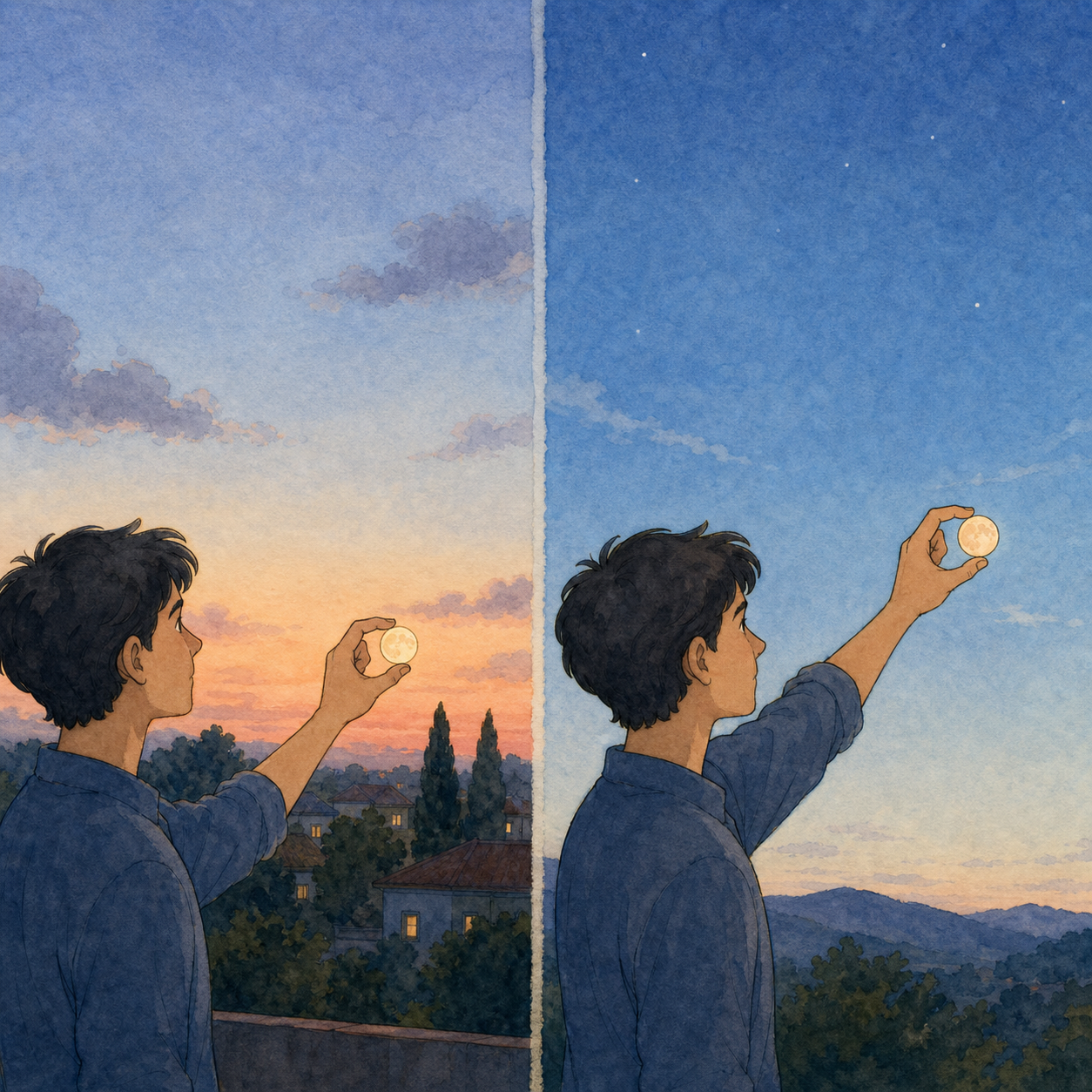
Text to type: When the Moon sits low on the horizon, most people judge it to be noticeably larger than when it sits high overhead. Photographs tell a different story. If you photograph the Moon at moonrise and again at its highest point, both images show a disc of identical angular size: roughly half a degree across, or about the width of your thumbnail held at arm's length. NASA confirms that the Moon's actual distance from Earth changes only slightly over a single night — far too little to explain the dramatic size difference people report seeing. The effect is entirely inside the observer's mind, not in the sky. The illusion is strong enough that most people find it hard to believe. One simple test: form a small circle with your finger and thumb, hold it at arm's length, and use it to frame the Moon near the horizon. Later that night, use the same circle to frame the Moon overhead. The framed Moon fits the circle both times.
Ready. The timer starts with your first key.
Complete
Great job!
Strong finish — your speed stayed steady.
Your rhythm
Speed over time- Time
- 0:00
- Raw speed
- 0 WPM
- Wrong keys
- 0
- Corrected
- 0
Check your understanding
Quick Check
1. What do photographs of the Moon at moonrise and at its highest point show about its size?
Sample answer
Photographs reveal that the Moon's angular size — roughly half a degree — does not change between moonrise and its highest point. The perceived size difference exists only in the observer's mind.
Think one step further
Have you ever noticed the Moon looking unusually large near the horizon? Where were you, and what did the landscape look like around it?
Reading
Why the Illusion Happens
Typing practice
Type the text exactly. Timer starts with your first key.
Text to type: Researchers have proposed many explanations over the centuries, but modern science points to two complementary mechanisms: the flattened-sky theory and the apparent-distance theory. **The flattened-sky theory** holds that people unconsciously perceive the sky as a flattened dome rather than a perfect hemisphere. The horizon feels farther away than the overhead point. When the brain judges an object as being far away but occupying the same angle in the eye as a closer object, it automatically scales that object up — it concludes the distant object must be physically larger. The Moon near the horizon triggers this upward scaling. **The apparent-distance theory** is closely related. In a landmark study published in the Proceedings of the National Academy of Sciences in 2000, Lloyd Kaufman and James Kaufman tested observers using adjustable artificial moons. Participants consistently set the horizon moon larger when they believed it was farther away. Kaufman and Kaufman concluded that the brain uses perceived distance — not retinal image size — to compute apparent size, and that the filled landscape between the observer and the horizon makes the horizon feel more distant than the empty sky above. A third factor can reinforce the illusion: nearby objects. Trees, buildings, and hills at the horizon give the brain real-world scale cues. The Moon appears beside objects whose sizes the brain knows well, so it recalculates upward. Overhead, there are no such reference objects.
Ready. The timer starts with your first key.
Complete
Great job!
Strong finish — your speed stayed steady.
Your rhythm
Speed over time- Time
- 0:00
- Raw speed
- 0 WPM
- Wrong keys
- 0
- Corrected
- 0
Check your understanding
Quick Check
1. According to Kaufman and Kaufman's 2000 study, what does the brain use to compute apparent size?
Sample answer
Kaufman and Kaufman found that when observers believed the horizon moon was farther away, they judged it as larger. The brain scales perceived size using distance estimates, not the actual size of the image on the retina.
Think one step further
The Kaufman study used artificial moons in a lab. Do you think laboratory results like this are a reliable way to study something people normally see outdoors? Why or why not?
 Photographing the Moon Illusion
Reading
Photographing the Moon Illusion
Typing practice
Type the text exactly. Timer starts with your first key.
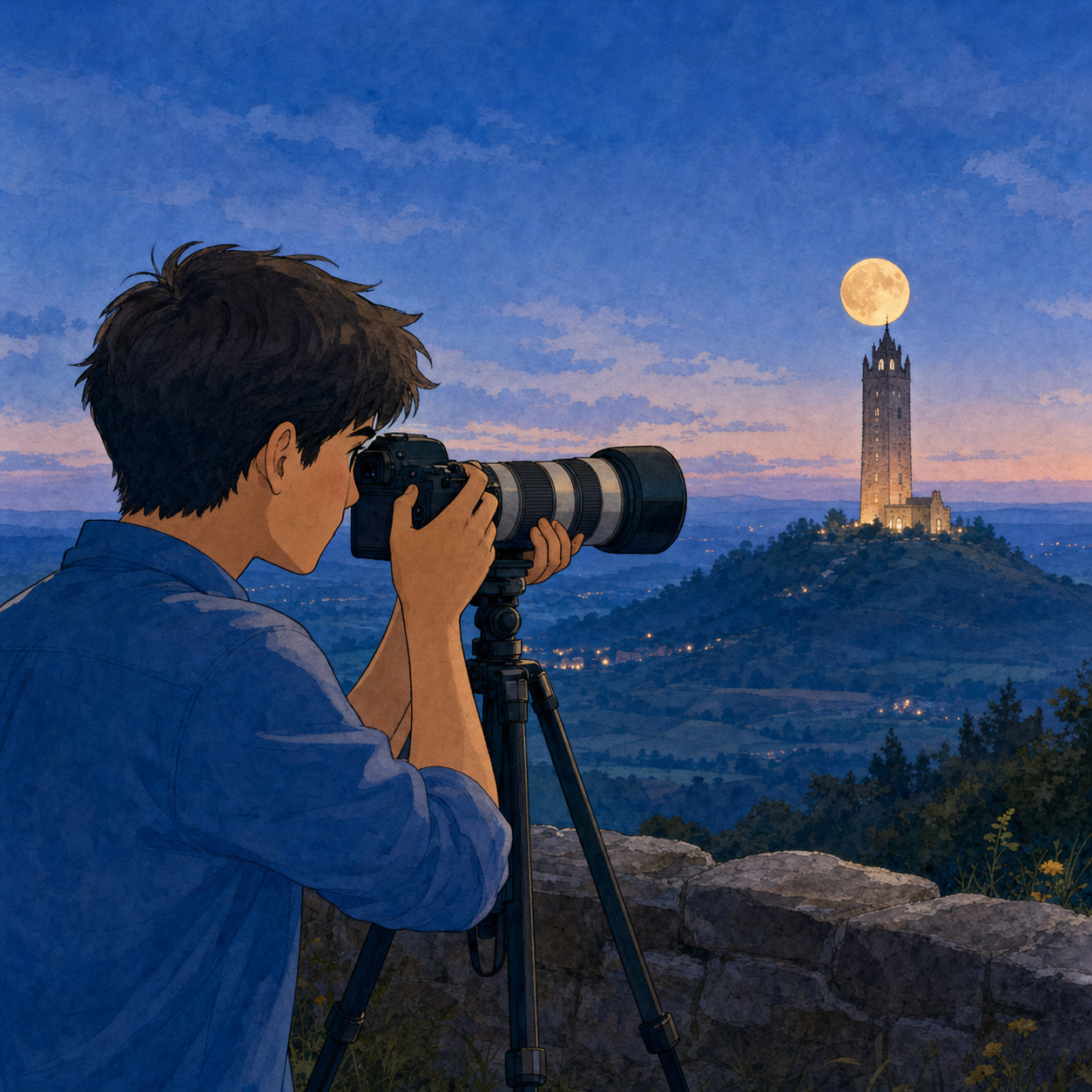
Text to type: Because a camera lens measures light physically rather than through a human perceptual system, a standard wide-angle photo of the Moon near the horizon captures it at its true angular size — small, often disappointingly so. Photographers who want to recreate the illusion as the eye perceives it use a different approach. NASA's guidance on photographing the Moon illusion explains that a telephoto lens compresses the scene: it makes both the Moon and the distant landscape appear larger relative to the frame. When a photographer positions themselves far from a recognisable landmark — a skyline, a mountain ridge, or a famous monument — and shoots with a long lens, the Moon and the landmark appear side by side at comparable scales. The resulting image matches what the brain constructs when standing at the horizon. This technique does not enlarge the Moon. It reproduces the perceptual relationship between the Moon and familiar objects that the brain creates naturally. The photograph and the illusion share the same root cause: the presence of a known reference.
Ready. The timer starts with your first key.
Complete
Great job!
Strong finish — your speed stayed steady.
Your rhythm
Speed over time- Time
- 0:00
- Raw speed
- 0 WPM
- Wrong keys
- 0
- Corrected
- 0
Check your understanding
Quick Check
1. Why does a standard wide-angle photograph of the Moon near the horizon not show the illusion?
Sample answer
A camera has no perceptual system to scale up distant objects. It records the Moon at its real angular size of about half a degree, so the illusion does not appear in a wide-angle shot the way it does to the human eye.
Think one step further
If you were planning to photograph the Moon rising behind a city skyline, what landmark and what kind of lens would you choose, and why?
What you can do now
Final Reflection
Think about what you have learned and consider these questions.
The Moon illusion works because the brain uses context — landscape, distance, familiar objects — to judge size. Can you think of another everyday situation where your brain scales or adjusts what you see based on surrounding context?
Need a starting line?
Helpful clue: Examples might include: a car appearing tiny at the end of a long straight road, a person looking small when standing at the base of a tall building, or two identical circles appearing different sizes when surrounded by larger or smaller circles (the Ebbinghaus illusion).
- Does knowing the scientific explanation change the way you experience the Moon illusion? Or does it still look just as big near the horizon even now that you understand why?
Kaufman and Kaufman published their findings in a peer-reviewed journal in 2000, yet the Moon illusion had been discussed since ancient Greece. What does this timeline suggest about how scientific understanding of perception develops?
Need a starting line?
Helpful clue: Consider: observation alone is not enough; controlled experiments that isolate one variable (perceived distance) are needed. It can take a very long time to move from noticing a phenomenon to explaining its mechanism rigorously.
Learning cards
My cards
Why the Moon Looks Bigger Near the Horizon
0 due · 12 new · about 3 min
Learn the sense first · then retrieve it
Focused Reading Mode is open.
Listening
Lesson audio
Listen from the beginning, or choose “Play this part” as you read along.
Reading
What the Moon Illusion Is
Reading
Why the Illusion Happens
Reading
Photographing the Moon Illusion
Finished listening?
Mark this listening practice complete when you have followed the lesson audio.
Listening complete
Listen Mode
Word-by-word syncPlay the audio and follow the highlighted word.
Article complete
Choose your next step
Open the next same-level lesson, replay the article, or save this page for later.
Listen Again
Replay the article once and notice how much more you understand.
One replay is enough. Then move on.