Memory Chips: Why AI Demand Is Raising Prices
Quality checked lesson
Memory chips help phones, computers, and AI systems work. Strong demand from AI data centers is leaving less memory for other devices and pushing prices higher.
 English lesson
Article
Choose how to use this lesson
You can switch anytime.
Study mode
Introduction
Typing practice
Type the text exactly. Timer starts with your first key.
Text to type: Memory chips help phones, computers, and AI systems work. Strong demand from AI data centers is leaving less memory for other devices and pushing prices higher.
Ready. The timer starts with your first key.
Complete
Great job!
Strong finish — your speed stayed steady.
Your rhythm
Speed over time- Time
- 0:00
- Raw speed
- 0 WPM
- Wrong keys
- 0
- Corrected
- 0
Before you begin
Warm-up
What do you mainly use your phone or computer for?
Do you usually check memory and storage before buying a device?
What would make you keep an old device for another year?
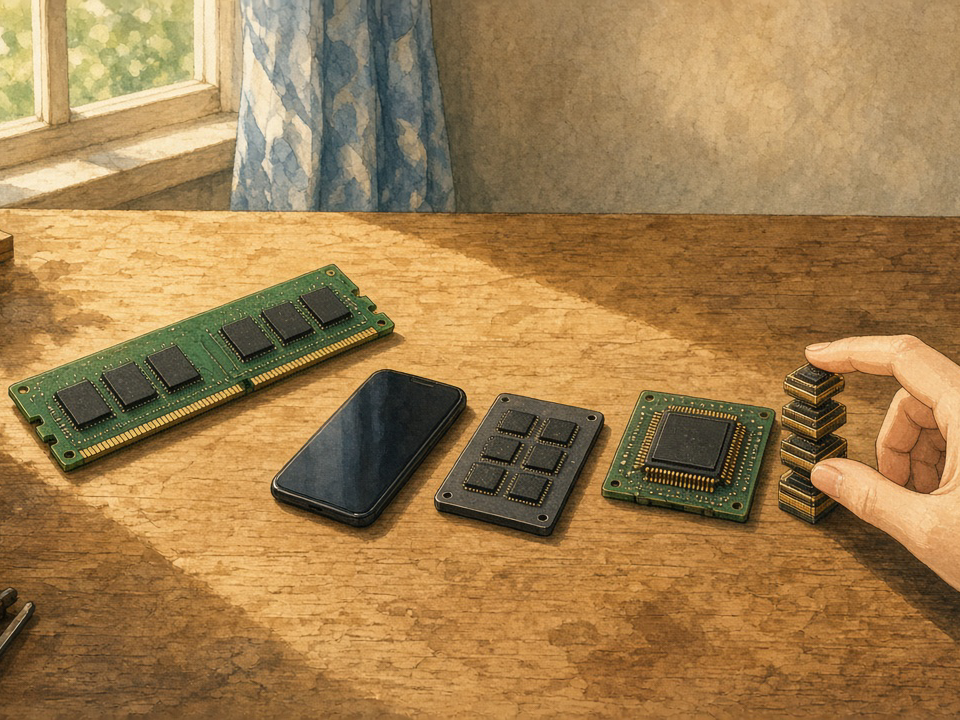 Part 1: Three kinds of memory
Reading
Part 1: Three kinds of memory
Typing practice
Type the text exactly. Timer starts with your first key.
Text to type: Memory chips hold information inside electronic devices. Three important types are DRAM, NAND, and HBM. They do different jobs. DRAM is short-term working memory, often called RAM. It holds information that a device is using now. Think of it as a kitchen work surface, with everything ready for the current job. NAND is long-term storage. It keeps photos, apps, and files even when the power is off. Phones and solid-state drives, or SSDs, use NAND. HBM means high-bandwidth memory. It stacks DRAM chips on top of each other and moves information very quickly. AI systems use it to keep their powerful processing chips supplied with information.
Ready. The timer starts with your first key.
Complete
Great job!
Strong finish — your speed stayed steady.
Your rhythm
Speed over time- Time
- 0:00
- Raw speed
- 0 WPM
- Wrong keys
- 0
- Corrected
- 0
Check your understanding
Check: Part 1: Three kinds of memory
1. How are DRAM, NAND, and HBM different?
Sample answer
DRAM holds information for current work, NAND keeps information for long-term storage, and HBM is very fast stacked DRAM used by AI systems.
Think one step further
What information on your phone would you most want to keep safe?
Do you think working memory or storage matters more for your daily use, and why?
What everyday comparison would help you remember the difference between working memory and storage?
Reading
Part 2: Why AI needs so much memory
Typing practice
Type the text exactly. Timer starts with your first key.
Text to type: An AI data center is a building full of server computers that run AI services. These computers need memory for larger AI models, longer conversations, and many users at the same time. AI agents, which carry out tasks, add more demand. Fast processing chips also need information to arrive quickly. HBM helps meet that need. As AI server demand grows, factories put more effort into making HBM. A wafer is a thin, round piece of material on which chips are made. HBM needs more wafer space than ordinary DRAM. Samsung says HBM uses about 20% of global DRAM wafer capacity now. That share could reach close to 30% in 2027, leaving less capacity for other memory.
Ready. The timer starts with your first key.
Complete
Great job!
Strong finish — your speed stayed steady.
Your rhythm
Speed over time- Time
- 0:00
- Raw speed
- 0 WPM
- Wrong keys
- 0
- Corrected
- 0
Check your understanding
Check: Part 2: Why AI needs so much memory
1. Why can growing HBM production reduce the supply of ordinary DRAM?
Sample answer
HBM and ordinary DRAM use the same limited wafer capacity, so making more HBM leaves less capacity for ordinary DRAM.
Think one step further
Do you use any AI apps or AI chat tools every day?
Do you think factories should give AI memory first place, and why?
Why do you think factories want to make more HBM now?
 Part 3: The shortage and rising prices
Reading
Part 3: The shortage and rising prices
Typing practice
Type the text exactly. Timer starts with your first key.
Text to type: The pressure was already clear in late 2025. PC and phone makers shipped devices early to avoid later memory price rises. In 2026, memory became more expensive. A contract price is a price agreed between a supplier and a buyer. The contract price of a 16-gigabit DDR5 DRAM chip reached $48 in September 2026, up from $45 in July. Further increases are forecasts, not completed changes. TrendForce expects ordinary DRAM contract prices to rise another 10–15% in late 2026, and NAND prices by 15–20%. For 2027, it forecasts a 121% rise in HBM’s average selling price. Separately, industry estimates suggest a 12-high, 36GB HBM4 stack could rise from about $600 in 2026 to about $1,300 in 2027.
Ready. The timer starts with your first key.
Complete
Great job!
Strong finish — your speed stayed steady.
Your rhythm
Speed over time- Time
- 0:00
- Raw speed
- 0 WPM
- Wrong keys
- 0
- Corrected
- 0
Check your understanding
Check: Part 3: The shortage and rising prices
1. Which price changes have already happened, and which are forecasts?
Sample answer
The DDR5 contract price reached $48 in September 2026. The late-2026 DRAM and NAND increases and the 2027 HBM increases are forecasts.
Think one step further
How would a large memory price rise affect your plans to buy a computer?
Why is it useful to separate a recorded price from a price forecast?
Do you think buyers should hurry to buy before a predicted price rise, and why?
Reading
Part 4: The companies making the memory
Typing practice
Type the text exactly. Timer starts with your first key.
Text to type: Three companies effectively share the HBM market: SK hynix, Samsung Electronics, and Micron Technology. SK hynix remains the leader. In the second quarter of 2026, it had about 50% of HBM revenue. Samsung is catching up fast. Its share rose from 21% to 33% in the comparison reported by Counterpoint Research. Both Samsung and SK hynix began mass-production shipments of HBM4 in 2026. Micron already has contracts for most of its 2027 HBM output. That means much of next year’s supply already has buyers. The shortage also reaches NAND. Japan’s Kioxia said in January that its whole 2026 NAND flash production was already sold out. AI demand affects storage as well as working memory.
Ready. The timer starts with your first key.
Complete
Great job!
Strong finish — your speed stayed steady.
Your rhythm
Speed over time- Time
- 0:00
- Raw speed
- 0 WPM
- Wrong keys
- 0
- Corrected
- 0
Check your understanding
Check: Part 4: The companies making the memory
1. What do Micron’s contracts and Kioxia’s sold-out production show?
Sample answer
They show that buyers have already taken much of the available supply, including future HBM output and Kioxia’s 2026 NAND production.
Think one step further
Why might a buyer want to reserve memory a year early?
Do you think having only three main HBM makers creates risks, and why?
Do you have an SSD in your computer at home?
Reading
Part 5: Why the shortage may last
Typing practice
Type the text exactly. Timer starts with your first key.
Text to type: More factories sound like a simple answer, but building them takes years. Memory production needs special buildings, equipment, and carefully controlled conditions. Even after a factory is ready, production grows slowly. Micron CEO Sanjay Mehrotra says the balance between supply and demand is getting tighter. Micron and Samsung executives expect the shortage to continue into 2028. Micron plans new clean rooms in 2028, but those rooms will not immediately produce memory at full speed. Meanwhile, the business is growing sharply. South Korea’s memory chip exports rose 358.6% in September 2026 compared with a year earlier. Strong export growth can happen alongside a shortage. Suppliers can earn more while buyers struggle with higher prices and limited supply.
Ready. The timer starts with your first key.
Complete
Great job!
Strong finish — your speed stayed steady.
Your rhythm
Speed over time- Time
- 0:00
- Raw speed
- 0 WPM
- Wrong keys
- 0
- Corrected
- 0
Check your understanding
Check: Part 5: Why the shortage may last
1. Why will new factories not end the shortage immediately?
Sample answer
Factories take years to build, and memory production increases slowly after the new facilities are ready.
Think one step further
What would you do if the computer you wanted was sold out?
Why might rising exports be good for suppliers but difficult for buyers?
Do you think companies should build more factories even if future demand is uncertain, and why?
 Part 6: What this means for everyday buyers
Reading
Part 6: What this means for everyday buyers
Typing practice
Type the text exactly. Timer starts with your first key.
Text to type: The shortage reaches ordinary shops through higher prices and smaller memory amounts. PCs and phones may cost more, or offer less at the same price. IDC gives a clear example. A phone that previously offered 12GB of RAM and 256GB of storage may offer only 8GB and 128GB at the same price. PCs may also come with less RAM and smaller SSDs. Cheaper devices are especially affected. There are fewer consumer choices, too. Micron announced in December 2025 that its Crucial brand would stop selling RAM to consumers. These changes make replacement less attractive. Many people may keep old devices longer or buy used phones. The important comparison is now both price and what that price includes.
Ready. The timer starts with your first key.
Complete
Great job!
Strong finish — your speed stayed steady.
Your rhythm
Speed over time- Time
- 0:00
- Raw speed
- 0 WPM
- Wrong keys
- 0
- Corrected
- 0
Check your understanding
Check: Part 6: What this means for everyday buyers
1. How can a phone become worse value without its price changing?
Sample answer
It can offer less RAM and storage at the same price, such as changing from 12GB and 256GB to 8GB and 128GB.
Think one step further
What would you check most carefully before buying your next device?
Do you prefer paying more for enough memory or keeping your current device longer, and why?
How could buying a used phone help you, and what risks would you consider?
What you can do now
Final Reflection
Discuss: What buying decision would you make differently after learning about the memory shortage?
How would you explain the link between AI demand, factory capacity, and device prices to a friend?
Learning cards
My cards
Memory Chips: Why AI Demand Is Raising Prices
0 due · 0 new · about 1 min
Learn the sense first · then retrieve it
No saved cards yet
Open a word or phrase in the article and choose Save to My Words.
Focused Reading Mode is open.
Listening
Lesson audio
Listen from the beginning, or choose “Play this part” as you read along.
Reading
Part 1: Three kinds of memory
Reading
Part 2: Why AI needs so much memory
Reading
Part 3: The shortage and rising prices
Reading
Part 4: The companies making the memory
Reading
Part 5: Why the shortage may last
Reading
Part 6: What this means for everyday buyers
Finished listening?
Mark this listening practice complete when you have followed the lesson audio.
Listening complete
Listen Mode
Word-by-word syncPlay the audio and follow the highlighted word.
Article complete
Choose your next step
Open the next same-level lesson, replay the article, or save this page for later.
Listen Again
Replay the article once and notice how much more you understand.
One replay is enough. Then move on.