Newest AI Research For Robotics: Means, Move, and Real
Quality checked lesson
Newest AI research for robotics is moving from chatbots toward models that see, plan, and act. Real systems like JEPA, V-JEPA 2, and Vision-Language-Action models help explain the change, and a simple robot-arm example shows what robots actually use today.
 English lesson
Article
Choose how to use this lesson
You can switch anytime.
Study mode
Introduction
Typing practice
Type the text exactly. Timer starts with your first key.
Text to type: Newest AI research for robotics is moving from chatbots toward models that see, plan, and act. Real systems like JEPA, V-JEPA 2, and Vision-Language-Action models help explain the change, and a simple robot-arm example shows what robots actually use today.
Ready. The timer starts with your first key.
Complete
Great job!
Strong finish — your speed stayed steady.
Your rhythm
Speed over time- Time
- 0:00
- Raw speed
- 0 WPM
- Wrong keys
- 0
- Corrected
- 0
Before you begin
Warm-up
Do you use any AI tools in your daily life, and what do you use them for?
What do you think is the hardest job for a robot in a normal kitchen?
Why do you think we can talk to computers easily now but still do not have robots washing our dishes?
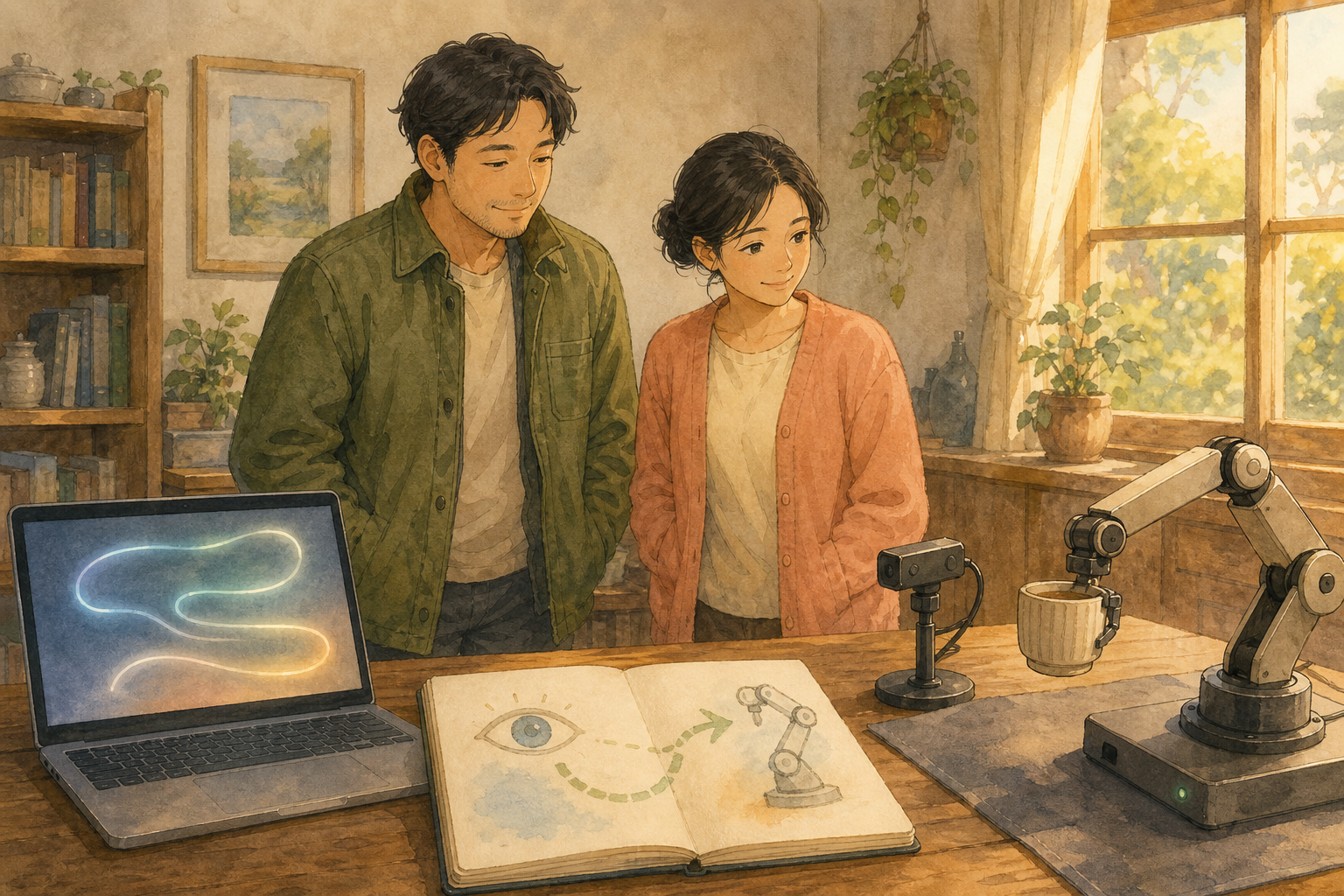 Part 1: What is changing in AI now
Reading
Part 1: What is changing in AI now
Typing practice
Type the text exactly. Timer starts with your first key.
Text to type: For the last few years, most people met AI through chatbots. You type a question, and a large language model, or LLM, writes an answer. It is good with words. But words are only one part of the world. Newest AI research for robotics points in a clearer direction. Models need to see, plan, and act. Seeing means using images and video, not only text. Planning means predicting what will probably happen next. Acting means controlling something real, like a robot arm. People often use three words for this direction. Multimodal means many kinds of input. Agents means models that take steps toward a goal. World models means models that learn how the physical world usually behaves. Keep this simple lens in mind. See, plan, act. We will use it in every part below.
Ready. The timer starts with your first key.
Complete
Great job!
Strong finish — your speed stayed steady.
Your rhythm
Speed over time- Time
- 0:00
- Raw speed
- 0 WPM
- Wrong keys
- 0
- Corrected
- 0
Check your understanding
Check: Part 1: What is changing in AI now
1. What are the three things the newest AI research wants models to do together?
Sample answer
The newest research wants models to see (use images and video), plan (predict what happens next), and act (control something real, like a robot arm).
Think one step further
Do you think a chatbot really understands the world, or only words?
Reading
Part 2: Why robots need more than a text LLM
Typing practice
Type the text exactly. Timer starts with your first key.
Text to type: Imagine you tell a robot in a Japanese kitchen, "Put the rice bowl on the tray." A text LLM can read that sentence perfectly. But it has no eyes, so it does not know where the bowl is. It has no hands, so it cannot move anything. And it has no sense of timing, so it does not know how fast to close the fingers before the bowl slides. This is the gap. A robot needs vision to find the bowl and see if it is full or empty. It needs actions, which are small commands like "move the arm 2 centimeters left" or "close the gripper." And it needs timing, because the real world does not wait. If the arm moves too late, the bowl is already falling. Language is still useful. It tells the robot the goal. But the goal is only the start. The see-plan-act loop must run many times every second.
Ready. The timer starts with your first key.
Complete
Great job!
Strong finish — your speed stayed steady.
Your rhythm
Speed over time- Time
- 0:00
- Raw speed
- 0 WPM
- Wrong keys
- 0
- Corrected
- 0
Check your understanding
Check: Part 2: Why robots need more than a text LLM
1. Name the three things a robot needs that a text LLM does not have.
Sample answer
A robot needs vision to find objects, actions to move its arm and gripper, and timing so it can act fast enough in the real world.
Think one step further
Do you think a robot could work in your kitchen, and what would be difficult for it?
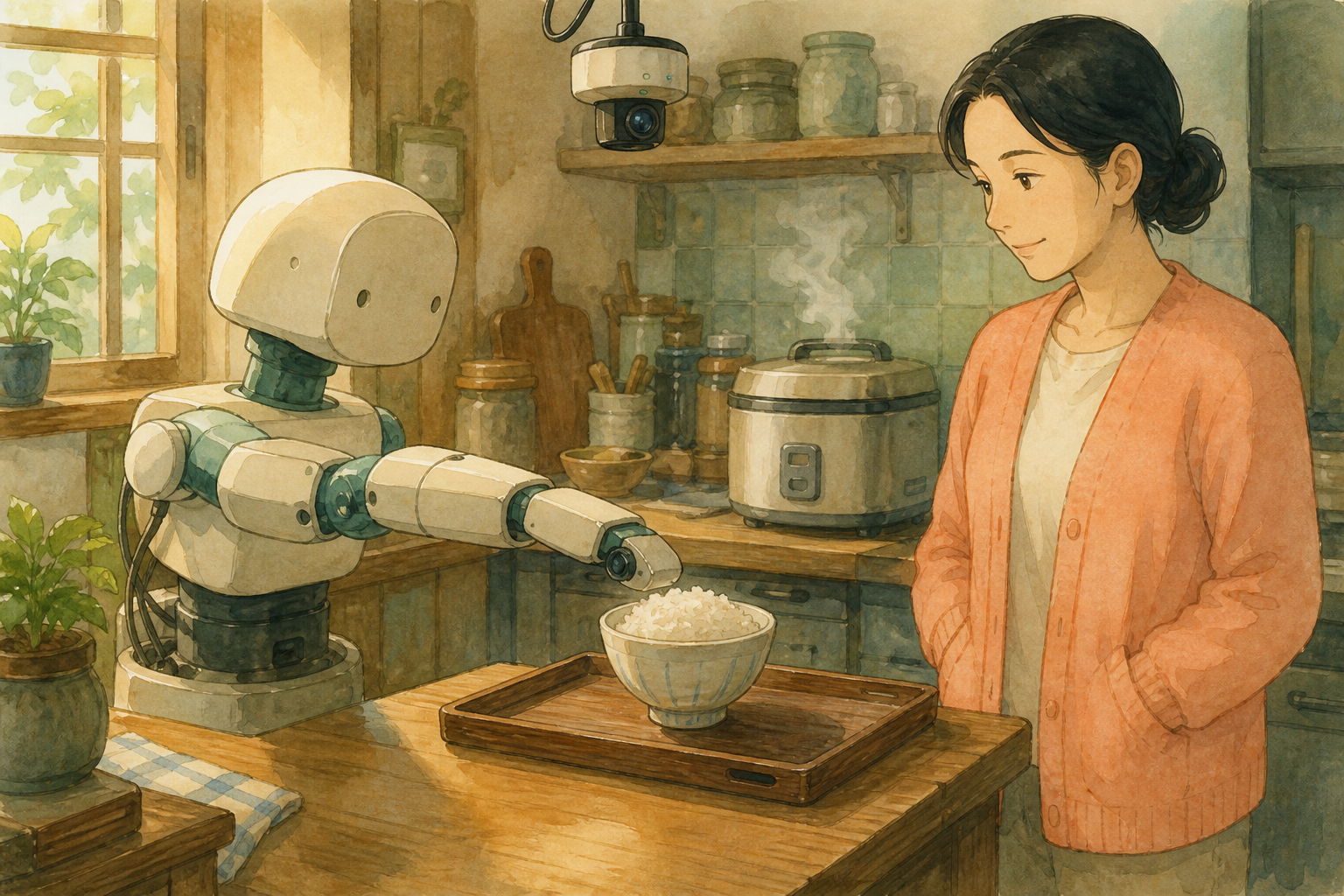 Part 3: Vision-Language-Action models
Reading
Part 3: Vision-Language-Action models
Typing practice
Type the text exactly. Timer starts with your first key.
Text to type: The first big answer to this gap is the Vision-Language-Action model, or VLA. A VLA takes an image from the robot's camera and a text instruction, and it gives out robot actions directly. Vision, language, and action are joined in one model. Two real projects show how this works. Open X-Embodiment is a shared dataset built by many research labs together. It collected data from 22 different types of robots across 21 institutions, with more than one million robot episodes. The team also trained RT-X models on this shared data. The key idea is that a robot can learn from other robots' experience, not only its own. OpenVLA is an open-source VLA with about 7 billion parameters. It was trained on about 970,000 robot episodes from the Open X-Embodiment dataset. Anyone can download it and try it on their own robot. In our lens, a VLA does see and act very directly, and the planning is mostly hidden inside the model.
Ready. The timer starts with your first key.
Complete
Great job!
Strong finish — your speed stayed steady.
Your rhythm
Speed over time- Time
- 0:00
- Raw speed
- 0 WPM
- Wrong keys
- 0
- Corrected
- 0
Check your understanding
Check: Part 3: Vision-Language-Action models
1. What does a VLA take in, and what does it give out?
Sample answer
A VLA takes in a camera image and a text instruction, and it gives out robot actions directly.
Think one step further
Do you think it is a good idea for robots to learn from other robots' data?
Reading
Part 4: What JEPA is
Typing practice
Type the text exactly. Timer starts with your first key.
Text to type: Now we come to a different idea. JEPA stands for Joint Embedding Predictive Architecture. It comes from Yann LeCun, a French-American computer scientist, one of the founders of deep learning, and for many years the chief AI scientist at Meta. In 2023, Meta published the first model based on this idea, called I-JEPA, for images. Here is the problem JEPA tries to solve. Many models learn by predicting every pixel of a missing part of an image or the next frame of a video. But pixels are full of details that do not matter. The exact position of every leaf on a tree is noise, not meaning. JEPA does something different. It looks at part of an image, turns it into an abstract representation, and predicts the representation of the missing part. It predicts the meaning of what is missing, not the picture itself. This helps learning because the model spends its effort on what matters, like objects and shapes, and ignores tiny details. In our lens, JEPA is mainly about the plan step, learning to predict well.
Ready. The timer starts with your first key.
Complete
Great job!
Strong finish — your speed stayed steady.
Your rhythm
Speed over time- Time
- 0:00
- Raw speed
- 0 WPM
- Wrong keys
- 0
- Corrected
- 0
Check your understanding
Check: Part 4: What JEPA is
1. What does a JEPA model predict, and what does it not predict?
Sample answer
A JEPA model predicts the abstract representation, or meaning, of the missing part, and it does not predict every pixel.
Think one step further
Do you remember every detail of your street, or only the important things?
Reading
Part 5: V-JEPA 2 from Meta
Typing practice
Type the text exactly. Timer starts with your first key.
Text to type: In June 2025, Meta released V-JEPA 2. It is a JEPA model for video, and Meta calls it a world model. The idea is the same as before, but now in time. The model watches video and learns to predict what comes next in abstract space, not pixel by pixel. The main model has about 1.2 billion parameters and was trained on more than one million hours of video, with no labels from people. Meta says V-JEPA 2 supports understanding/predicting video, including physical events like how objects move and what people do with them. Then comes the robot part, and here we must be careful. Meta trained a second version with a small amount of robot data, less than 62 hours. Meta says this video world model is helping zero-shot robot control in research settings, including cases with little robot data, by using what it learned from ordinary video. We should treat that carefully as a research claim, not as a finished home robot. In our lens, V-JEPA 2 is strong at the plan step. It builds an inner picture of how the world moves, and then robot training can sit on top of that picture.
Ready. The timer starts with your first key.
Complete
Great job!
Strong finish — your speed stayed steady.
Your rhythm
Speed over time- Time
- 0:00
- Raw speed
- 0 WPM
- Wrong keys
- 0
- Corrected
- 0
Check your understanding
Check: Part 5: V-JEPA 2 from Meta
1. What kind of model is V-JEPA 2, and what does Meta say it can help with?
Sample answer
V-JEPA 2 is a video world model from Meta, and Meta says it can help with robot control, including cases with little robot data.
Think one step further
Do you think learning from ordinary video is enough for a robot to work in a kitchen?
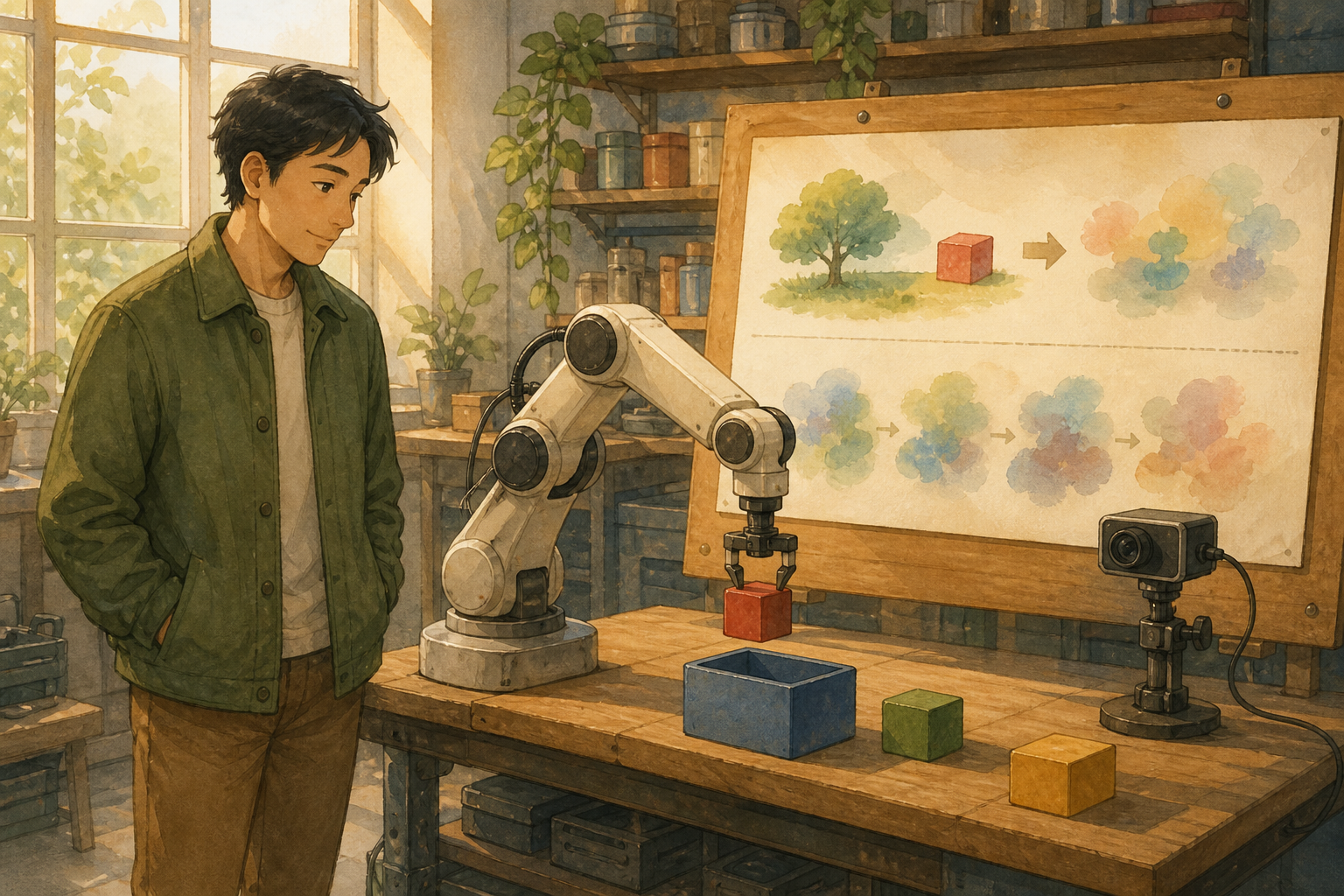 Part 6: What robots use today
Reading
Part 6: What robots use today
Typing practice
Type the text exactly. Timer starts with your first key.
Text to type: In real labs and factories, robots do not use only one magic model. They use a mix. First, classical control is still everywhere. This means clear math and rules for motors, balance, and safe speed. Second, deep learning helps with vision, like finding a cup in a camera picture. Third, Vision-Language-Action models, such as OpenVLA-style systems, help turn a spoken or written goal into actions. Fourth, world-model and JEPA-style ideas are growing. They try to predict what will happen next before the robot moves. Here is one concrete example. A robot arm must pick up a red block and place it in a box. Classical control keeps the arm smooth and safe. A vision model finds the red block in the camera image. A VLA or planner chooses the grasp and the place motion. A world model may help the robot imagine the block falling if the gripper is too loose. No single system does everything alone. So the honest picture is this. Text LLMs are useful for goals and talk. Robots still need eyes, hands, timing, and careful engineering. VLAs and JEPA-style world models are important new pieces, not the whole machine.
Ready. The timer starts with your first key.
Complete
Great job!
Strong finish — your speed stayed steady.
Your rhythm
Speed over time- Time
- 0:00
- Raw speed
- 0 WPM
- Wrong keys
- 0
- Corrected
- 0
Check your understanding
Check: Part 6: What robots use today
1. What four kinds of tools do robots often mix today?
Sample answer
Robots often mix classical control, deep learning for vision, Vision-Language-Action models, and growing world-model or JEPA-style ideas.
Think one step further
Do you think factory robots and home robots need the same mix of tools?
What you can do now
Final Reflection
If you could build one helpful robot for your home or workplace, what would it do, and which part of see-plan-act would you improve first?
Learning cards
My cards
Newest AI Research For Robotics: Means, Move, and Real
0 due · 0 new · about 1 min
Learn the sense first · then retrieve it
No saved cards yet
Open a word or phrase in the article and choose Save to My Words.
Focused Reading Mode is open.
Listening
Lesson audio
Listen from the beginning, or choose “Play this part” as you read along.
Reading
Part 1: What is changing in AI now
Reading
Part 2: Why robots need more than a text LLM
Reading
Part 3: Vision-Language-Action models
Reading
Part 4: What JEPA is
Reading
Part 5: V-JEPA 2 from Meta
Reading
Part 6: What robots use today
Finished listening?
Mark this listening practice complete when you have followed the lesson audio.
Listening complete
Listen Mode
Word-by-word syncPlay the audio and follow the highlighted word.
Article complete
Choose your next step
Open the next same-level lesson, replay the article, or save this page for later.
Listen Again
Replay the article once and notice how much more you understand.
One replay is enough. Then move on.