Tesla's New Roadster: How a Car Jumps, Flips and Lands
Quality checked lesson
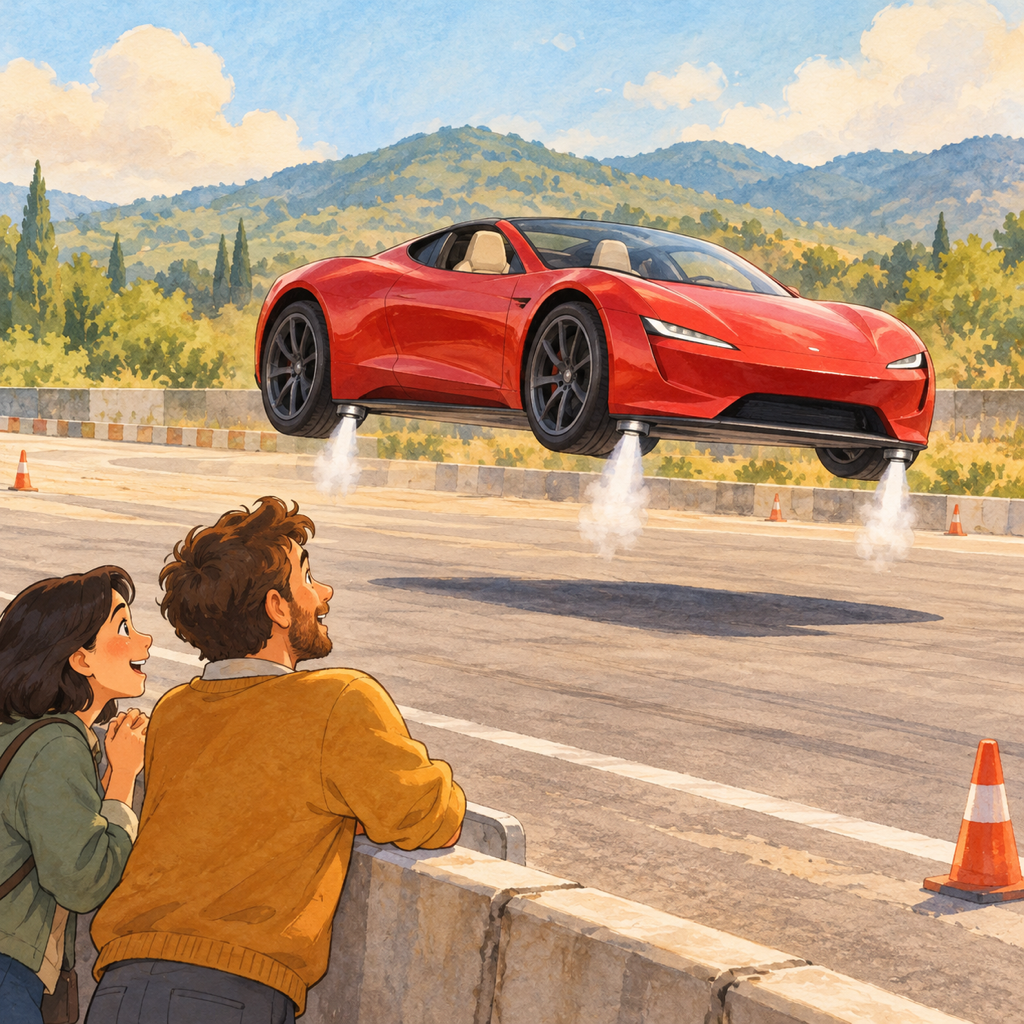
On 15 October 2026, outside Waco, Texas, a Tesla Roadster drove up a wall, flipped in the air and jumped over a line of other cars. It used compressed air and powerful fans to do this, but it can only do it for seconds, and many big questions are still open.
 English lesson
Article
Choose how to use this lesson
You can switch anytime.
Study mode
Introduction
Typing practice
Type the text exactly. Timer starts with your first key.
Text to type: On 15 October 2026, outside Waco, Texas, a Tesla Roadster drove up a wall, flipped in the air and jumped over a line of other cars. It used compressed air and powerful fans to do this, but it can only do it for seconds, and many big questions are still open.
Ready. The timer starts with your first key.
Complete
Great job!
Strong finish — your speed stayed steady.
Your rhythm
Speed over time- Time
- 0:00
- Raw speed
- 0 WPM
- Wrong keys
- 0
- Corrected
- 0
Before you begin
Warm-up
If someone told you a car could fly, what would you imagine it doing?
When a company shows a new product at a big event, how much do you usually believe?
Have you ever let go of a balloon before tying it? What happened?
 Part 1: A show of jumps, not a flight
Reading
Part 1: A show of jumps, not a flight
Typing practice
Type the text exactly. Timer starts with your first key.
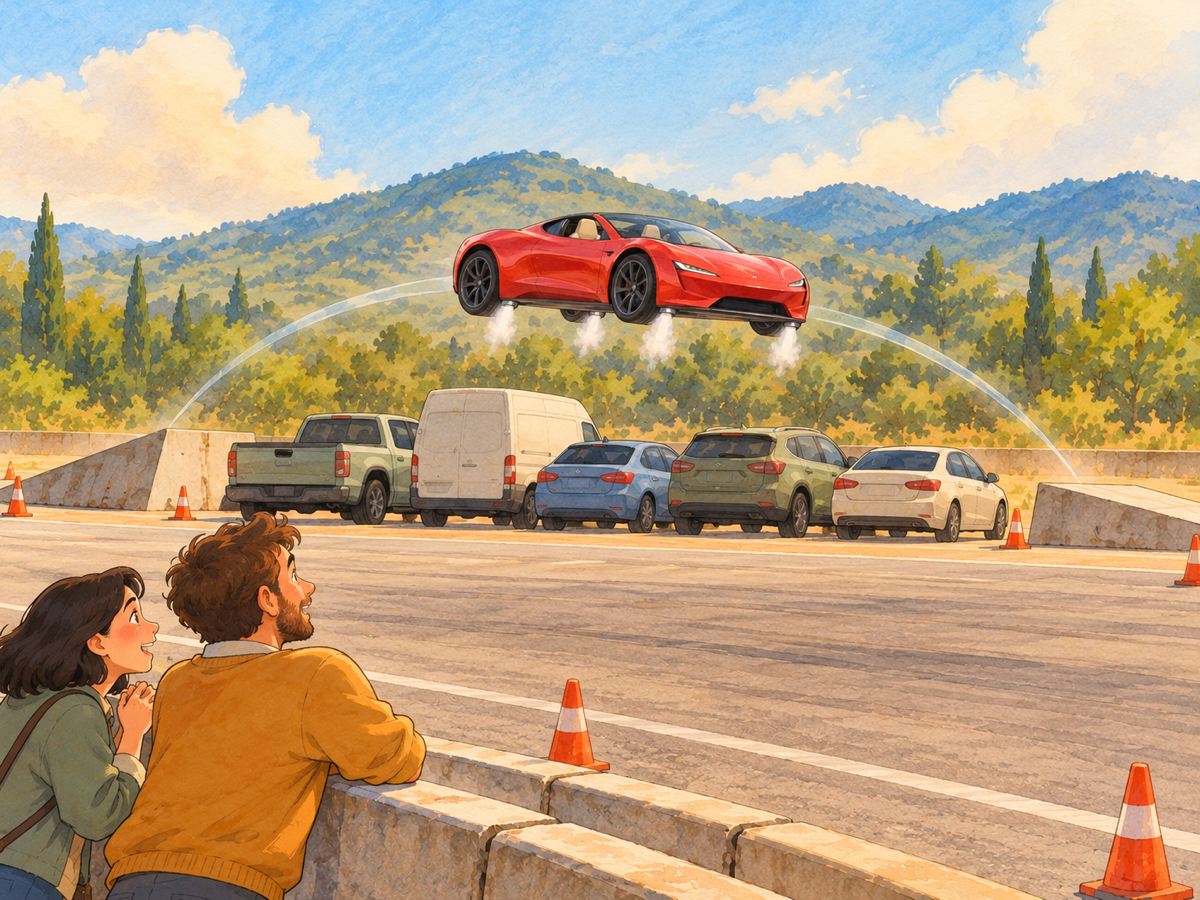
Text to type: Picture a car rolling toward a curved ramp. The ramp bends upward until it turns upside down. The car keeps driving, nose high, until it hangs about 21 metres above the ground. It reaches 170 degrees, so it is almost completely upside down. Then it drops, fires short bursts of air to slow itself down, and lands on the pavement. That was one of the demos Tesla showed for its redesigned Roadster. In another, the car jumped about 7 metres over a line of Tesla vehicles while it was spinning. The line included a Cybercab, a Cybertruck, a Tesla Semi, a Model Y and a Model 3. On a live run, the car also went from 0 to 96 km/h in 0.81 seconds. It looks like flying, but look again at each stunt. Every move is short, and every move ends quickly on the ground. The car pushes itself up and turns in the air. Then it comes back down in a controlled way. So "jumps, flips and lands" is a better description than "flies". This difference matters, because it tells us what kind of machine this really is. The event almost did not happen on time. It was planned for 1 October, but bad weather delayed it. It also came almost nine years after Tesla first showed this car in 2017.
Ready. The timer starts with your first key.
Complete
Great job!
Strong finish — your speed stayed steady.
Your rhythm
Speed over time- Time
- 0:00
- Raw speed
- 0 WPM
- Wrong keys
- 0
- Corrected
- 0
Check your understanding
Check: Part 1: A show of jumps, not a flight
1. Why is "jumps, flips and lands" a better description than "flies"?
Sample answer
Because each stunt was a short movement into the air that ended quickly with a controlled landing. The car did not travel through the air for a long time.
Think one step further
Which stunt sounds more surprising to you: driving upside down on a wall, or jumping over five cars? Why?
Reading
Part 2: Thrusters: a balloon with a very strong push
Typing practice
Type the text exactly. Timer starts with your first key.
Text to type: How does a car push itself into the air? Think about that balloon again. When you let it go, air rushes out of the back, and the balloon shoots forward. This is Newton's third law: when the air goes one way, the object goes the other way. A cold-gas thruster is the same idea, made strong and precise. A tank holds gas under high pressure. A valve opens, and the gas rushes out of a nozzle. It is the simplest kind of rocket. Nothing burns, and there is no fuel. The Roadster's thrusters use only compressed air. Spacecraft have used this kind of thruster for decades to make small, exact adjustments. The Roadster has ten nozzles. Four main thrusters sit at the back, under the car. Smaller thrusters at the four corners fire downward for landings and help turn the car in the air. Tesla says the total push is over 80 kN. That is roughly the force of eight tonnes resting on your hand. But there is a catch. Cold gas is not very efficient. It is great for short, sharp pushes, but poor for anything that lasts. The car carries about 250 kg of air in its tanks. A rough estimate, not a Tesla figure, says a 1,500 kg car would use about 25 kg of air every second just to stay still in the air. If that estimate is close, the car could hover for seconds, not minutes. So the limited air supply is a big reason why this machine cannot really fly for long, even if it can make powerful jumps.
Ready. The timer starts with your first key.
Complete
Great job!
Strong finish — your speed stayed steady.
Your rhythm
Speed over time- Time
- 0:00
- Raw speed
- 0 WPM
- Wrong keys
- 0
- Corrected
- 0
Check your understanding
Check: Part 2: Thrusters: a balloon with a very strong push
1. Why can the Roadster's thrusters do powerful jumps but not long flights?
Sample answer
Cold-gas thrusters give strong, short pushes but use gas very quickly. A rough estimate says the car would use up its stored air in seconds if it tried to stay in the air.
Think one step further
Why might it be useful that the thrusters burn nothing at all?
 Part 3: Fans: how a car stays on the ceiling
Reading
Part 3: Fans: how a car stays on the ceiling
Typing practice
Type the text exactly. Timer starts with your first key.
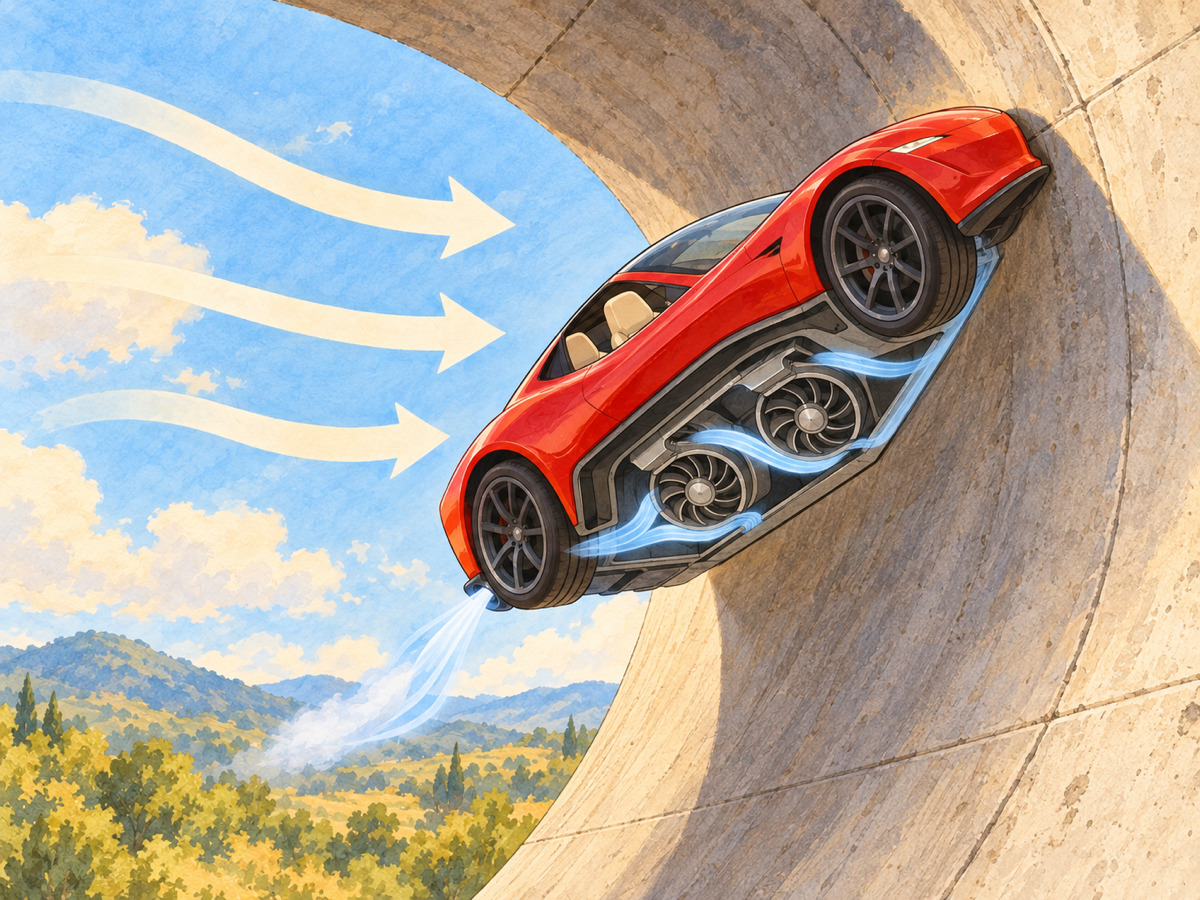
Text to type: Thrusters explain the jumps. But how did the car drive up a ramp that turned upside down? Upside down, gravity pulls the car away from the surface. Normally, gravity is what presses tyres onto the road. On a ceiling, it works against you. The answer is suction. Fans at the back of the car pull air out from under it. This creates lower pressure below the car. The higher air pressure around and above the car then pushes it hard against the surface. Imagine a vacuum cleaner stuck to a flat cushion. It is the same basic effect. Numbers help here. Engineers measure grip in "G", where 1 G is the pull of gravity. According to engineering vice president Lars Moravy, tyres alone give about 1.26 G. That is good for a fast car, but it does not solve the ceiling problem. Elon Musk said the fans can pull up to 2 G. To stay on a ceiling, the car must be pressed upward harder than gravity pulls it down. A force of 2 G is enough, he said, to hold the car upside down. This idea did not appear overnight. A Tesla patent granted in August 2025 describes the fan system. So the wall-climb stunt depends on two systems working as a team. The fans hold the car to the ramp. Then the thrusters control the drop and the landing.
Ready. The timer starts with your first key.
Complete
Great job!
Strong finish — your speed stayed steady.
Your rhythm
Speed over time- Time
- 0:00
- Raw speed
- 0 WPM
- Wrong keys
- 0
- Corrected
- 0
Check your understanding
Check: Part 3: Fans: how a car stays on the ceiling
1. Why would tyres alone not let the car drive upside down?
Sample answer
Upside down, gravity pulls the car away from the surface instead of pressing it down. The car needs a force pushing it onto the surface that is stronger than gravity, and the fans give this force.
Reading
Part 4: A car built around a tank of air
Typing practice
Type the text exactly. Timer starts with your first key.
Text to type: If air is the secret, the car must carry a lot of it. The Roadster has 600 litres of compressed air in two carbon-fibre tanks. Tesla said every usable space in the car is filled with these strong, light tanks. Lars Moravy said the air tank can be recharged. In other words, the car is designed around its air supply, almost like a small spacecraft. This choice shapes the three versions. The Performance version has two seats, moving aerodynamic parts and the suction system. The Thrust version has two seats and rear thrusters, and goes from 0 to 60 mph in under one second. The Rocket version has one seat and ten thrusters around the car, and you can only buy it by invitation. Notice the pattern: more thrusters means fewer seats. The air and the hardware need space, so something else must give. All versions have about 300 miles of range and top speeds above 230 mph. Reserving a Performance costs 50,000 dollars, and a Thrust costs 250,000 dollars. Musk said Tesla will build the car in 2028.
Ready. The timer starts with your first key.
Complete
Great job!
Strong finish — your speed stayed steady.
Your rhythm
Speed over time- Time
- 0:00
- Raw speed
- 0 WPM
- Wrong keys
- 0
- Corrected
- 0
Check your understanding
Check: Part 4: A car built around a tank of air
1. Why does the Rocket version have only one seat?
Sample answer
It has the most thrusters and hardware, and the car's design depends on fitting air tanks and thrusters into every usable space. More stunt equipment leaves less room for people.
Think one step further
If you could afford one, which version would you choose, and what would you use it for?
 Part 5: What was shown, and what is still unproven
Reading
Part 5: What was shown, and what is still unproven
Typing practice
Type the text exactly. Timer starts with your first key.
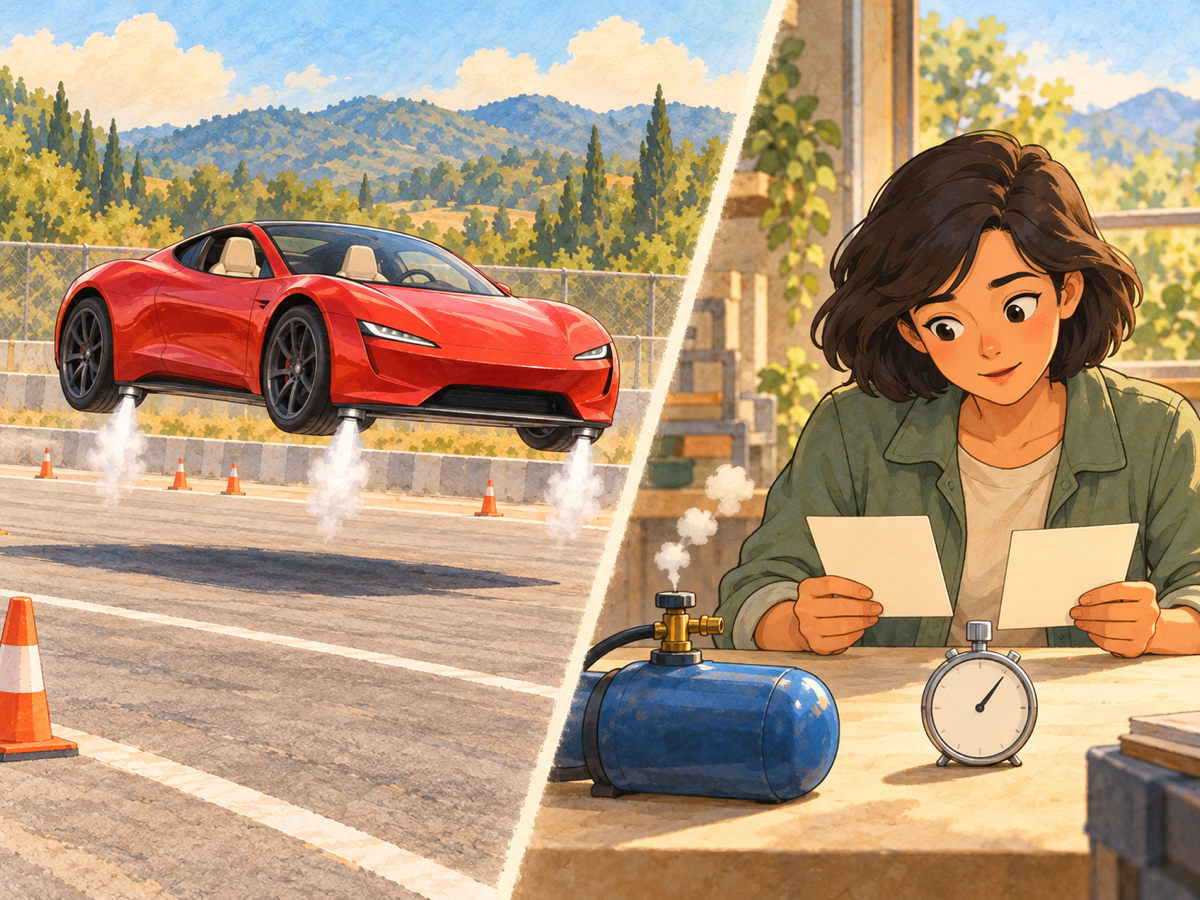
Text to type: The demos really happened. People saw the wall climb, the spin and the jump. The physics also makes sense: stored air can push, and fans can hold a car down. But a show and a product are not the same thing. First, who was driving? The cars were driving themselves during the demos. Tesla says the production car will be driven by a person. A stunt programmed by a computer is very different from a stunt done by a driver on a normal day. It is also unclear whether anyone was inside the demo cars at all. Second, safety and the law. Musk said safety is not the main goal of this car. The flying features are not approved for public roads. So you might own the car, but you probably could not jump over traffic on your way to work. Third, the numbers and the timing. YouTuber Marques Brownlee asked whether the reveal was a prank and questioned the claimed figures. That doubt is reasonable, because many important numbers come only from Tesla. The car has also been delayed several times since 2017. Production in 2028 is a promise, not a fact yet. So the fair judgement is this: the trick is real, and the physics works. What is still unproven is whether this can become a safe, legal car that ordinary owners drive.
Ready. The timer starts with your first key.
Complete
Great job!
Strong finish — your speed stayed steady.
Your rhythm
Speed over time- Time
- 0:00
- Raw speed
- 0 WPM
- Wrong keys
- 0
- Corrected
- 0
Check your understanding
Check: Part 5: What was shown, and what is still unproven
1. Name two things the demos did not prove.
Sample answer
They did not prove that a person driving manually can do the stunts, because the demo cars drove themselves. They also did not prove the car is safe or legal on roads, and they did not prove it will really be built in 2028.
Think one step further
Do you think it matters that a car like this is "exciting but not safe first"? Why or why not?
What you can do now
Final Reflection
At the start, it was easy to think Tesla had built a flying car. In fact, it built a car that throws bursts of air and pulls itself onto surfaces for a few amazing seconds. Its limits come from the same physics that makes it work.
Now that you know how it works, does the Roadster seem more impressive to you, or less? What changed your mind?
When you see the next "impossible" product reveal, what questions will you ask before you believe it?
Learning cards
My cards
Tesla's New Roadster: How a Car Jumps, Flips and Lands
0 due · 0 new · about 1 min
Learn the sense first · then retrieve it
No saved cards yet
Open a word or phrase in the article and choose Save to My Words.
Focused Reading Mode is open.
Listening
Lesson audio
Listen from the beginning, or choose “Play this part” as you read along.
Reading
Part 1: A show of jumps, not a flight
Reading
Part 2: Thrusters: a balloon with a very strong push
Reading
Part 3: Fans: how a car stays on the ceiling
Reading
Part 4: A car built around a tank of air
Reading
Part 5: What was shown, and what is still unproven
Finished listening?
Mark this listening practice complete when you have followed the lesson audio.
Listening complete
Listen Mode
Word-by-word syncPlay the audio and follow the highlighted word.
Article complete
Choose your next step
Open the next same-level lesson, replay the article, or save this page for later.
Listen Again
Replay the article once and notice how much more you understand.
One replay is enough. Then move on.