Fly Agaric
Quality checked lesson
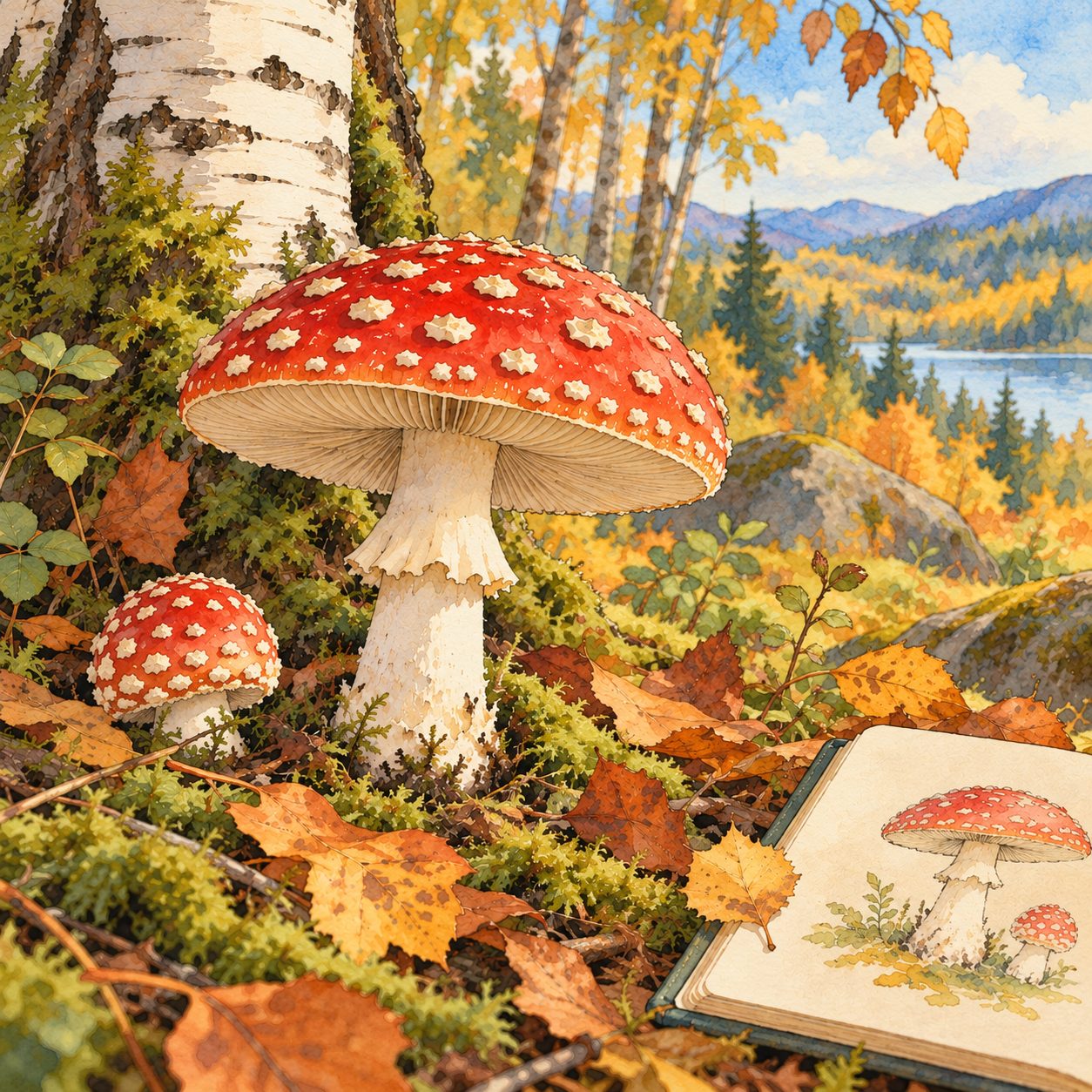
Picture a red mushroom with white spots. It looks friendly, like something from a fairy tale, but the fly agaric is poisonous.
 English lesson

Article
Choose how to use this lesson
You can switch anytime.
Study mode
Introduction
Typing practice
Type the text exactly. Timer starts with your first key.
Text to type: Picture a red mushroom with white spots. It looks friendly, like something from a fairy tale, but the fly agaric is poisonous. So why is it so famous? In this lesson, you will explore its history, its effects on the brain and how it compares with "magic mushrooms", separating real evidence from exciting myths.
Ready. The timer starts with your first key.
Complete
Great job!
Strong finish — your speed stayed steady.
Your rhythm
Speed over time- Time
- 0:00
- Raw speed
- 0 WPM
- Wrong keys
- 0
- Corrected
- 0
Before you begin
Warm-up
Where have you seen a red mushroom with white spots — in a book, a game, a film or a forest?
Bright colours on animals or plants are often a warning. Why might nature use colour in this way?
Why do you think some old stories are repeated for hundreds of years, even when nobody can prove they are true?
 Part 1: A Famous Mushroom of European Forests
Reading
Part 1: A Famous Mushroom of European Forests
Typing practice
Type the text exactly. Timer starts with your first key.
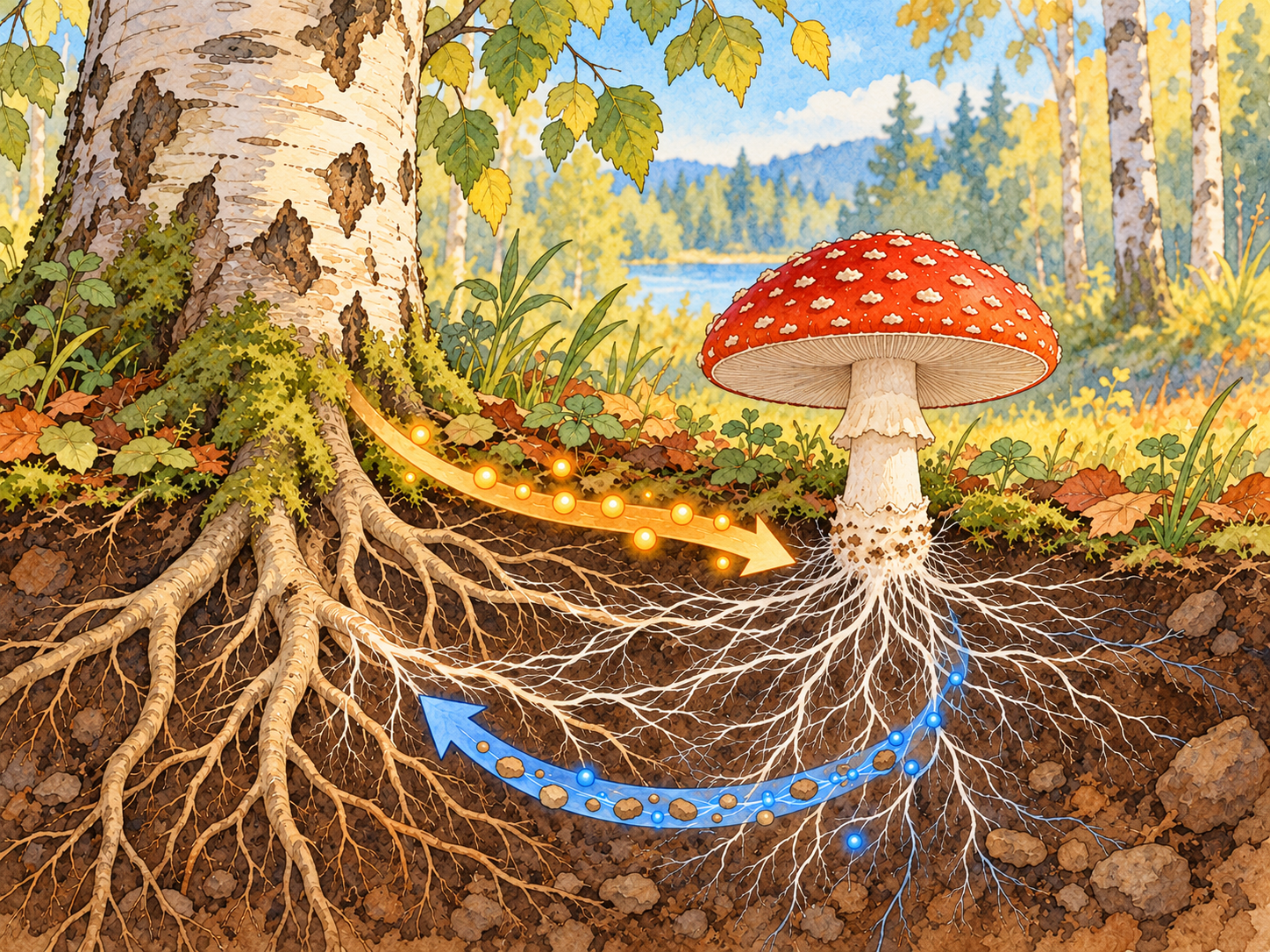
Text to type: The fly agaric's scientific name is Amanita muscaria. It has a red cap with white spots and a white stalk. In Britain and Ireland it is widespread, and it grows in woodland and at the edges of woods. You often find it near birch, pine and spruce trees, and this is not an accident. The mushroom we can see is only a small part of the fungus. It is the fruiting body, a bit like the fruit on a tree. Under the ground there is a large network of thin threads called mycelium. This network connects with tree roots, and the two work as partners. The fungus gives the tree nutrients from the soil, and the tree gives the fungus sugars. So a fly agaric next to a birch tree is part of a team. The white spots also have a story. When the mushroom is young, a protective layer called a veil covers it. As the cap grows, the veil breaks, and the white spots are pieces that stay behind. Rain can wash them away, so some fly agarics have no spots at all. This is one reason why colour and spots are not a reliable way to judge a mushroom. The English name comes from history. In the past, people used the mushroom against flies and other insects. It was a kind of insecticide, a substance that kills insects. Notice what the name tells us and what it does not tell us. It shows that people found a practical use for the mushroom. However, it does not show that they ate it. In fact, eating it can cause hallucinations and painful stomach cramps.
Ready. The timer starts with your first key.
Complete
Great job!
Strong finish — your speed stayed steady.
Your rhythm
Speed over time- Time
- 0:00
- Raw speed
- 0 WPM
- Wrong keys
- 0
- Corrected
- 0
Check your understanding
Check: Part 1: A Famous Mushroom of European Forests
1. Why is the mushroom called "fly agaric", and what does the name not prove?
Sample answer
It is called fly agaric because people used it in the past against flies and other insects. The name does not prove that people ate it.
Think one step further
The fly agaric looks friendly in pictures but is poisonous in real life. Why might this be a problem for children?
Reading
Part 2: Who Actually Ate It, and Where
Typing practice
Type the text exactly. Timer starts with your first key.
Text to type: However, its fame in European culture does not show that Europeans traditionally ate it. In northern Eurasia, especially Siberia, several groups used the fly agaric. These included the Nenets, Yukaghir, Koryak and Chukchi peoples. Their reasons were different. Sometimes they used it for fun and relaxation, and sometimes they used it in rituals. The mushroom could create dream-like experiences. Some people believed that, during these experiences, they met their ancestors or spirits. This was their belief and part of their way of understanding the world. It is not a scientific fact about the mushroom. What about Europe? Here the picture is much less clear. There is one story of Sámi people using the fly agaric in Finland. However, it is a single personal report, and it may describe something rare or isolated. One story cannot prove that a whole tradition existed. So we cannot say that the Sámi, or Europeans in general, regularly used the mushroom. You may also hear exciting stories about Viking warriors eating fly agaric before battle. Stories like these spread easily because they are dramatic. But the well-recorded use comes from Siberia, not from Viking Europe. A good rule is this: if a story is very exciting but has no clear record behind it, treat it as a guess. Modern myths about this mushroom are common, and many of them are more sensational than true.
Ready. The timer starts with your first key.
Complete
Great job!
Strong finish — your speed stayed steady.
Your rhythm
Speed over time- Time
- 0:00
- Raw speed
- 0 WPM
- Wrong keys
- 0
- Corrected
- 0
Check your understanding
Check: Part 2: Who Actually Ate It, and Where
1. Why can't we say that the Sámi had a widespread fly agaric tradition?
Sample answer
There is only one personal report of Sámi use in Finland, and it may describe an isolated case, so it cannot prove a widespread tradition.
Think one step further
Why do you think dramatic stories, like the Viking one, spread faster than careful, boring facts?
 Part 3: Ibotenic Acid and Muscimol
Reading
Part 3: Ibotenic Acid and Muscimol
Typing practice
Type the text exactly. Timer starts with your first key.
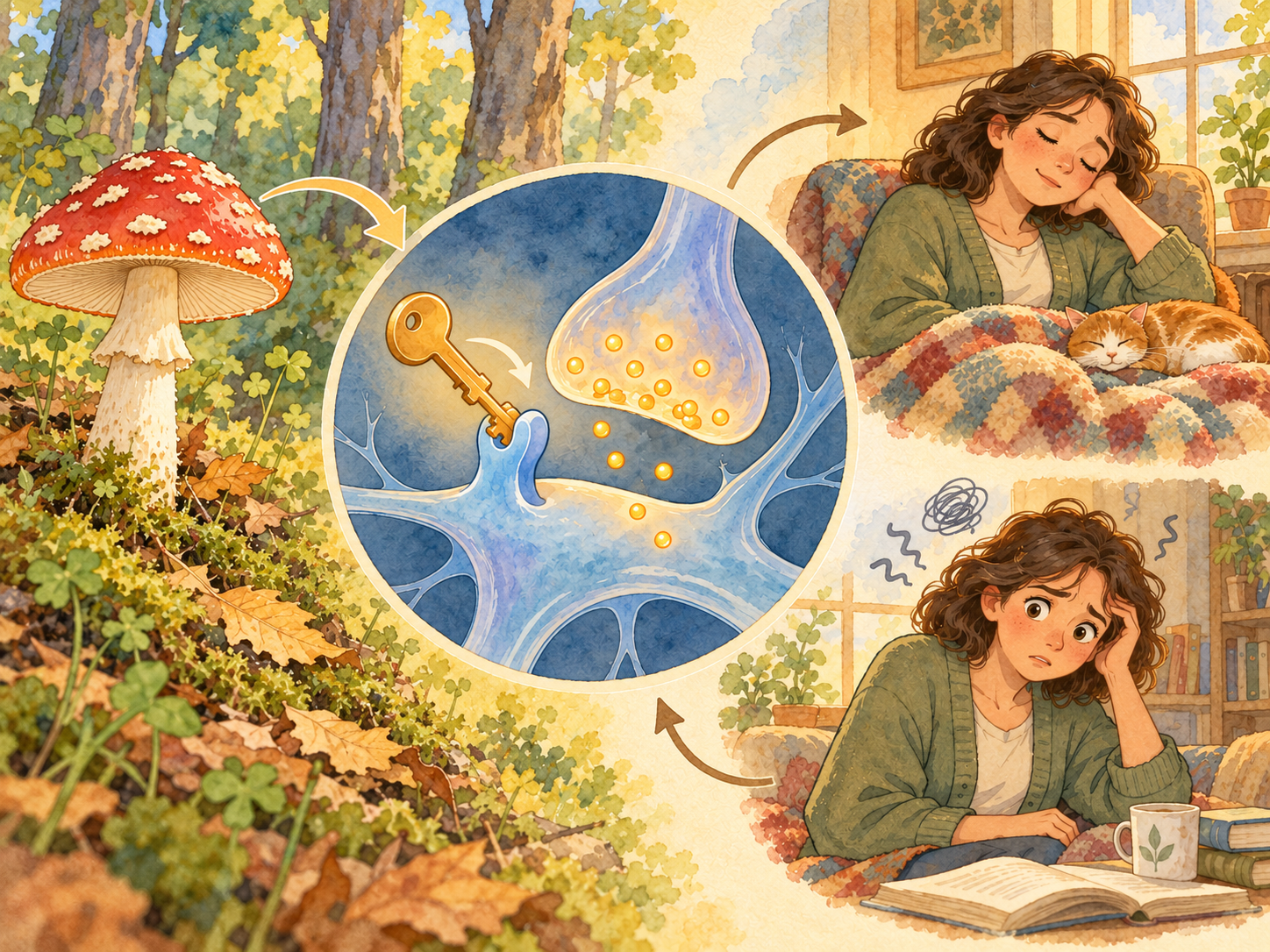
Text to type: Why does the fly agaric affect people at all? The answer is chemistry. The two main chemicals are ibotenic acid and muscimol. The main effects on the mind are linked to muscimol. To understand muscimol, think about how the brain sends messages. Brain cells talk to each other with chemical messages. Each message needs a receptor, a receiving place on a cell, like a lock that accepts only certain keys. One important messenger is called GABA. GABA usually tells brain cells to calm down and send fewer signals, a bit like a brake in a car. Muscimol acts on GABA-A receptors, so it pushes on this braking system. You might expect a brake to make a person simply sleepy. However, the effects of the fly agaric are stranger than that. A person may feel very sleepy and then suddenly become restless and agitated. These states can change back and forth. People can also become confused, see the world differently, have hallucinations or fall into delirium, a serious state of mental confusion. There is another danger. The amount of these chemicals is different from one mushroom to another. Because of this, a person’s reaction can be difficult to predict. This is a key reason why the fly agaric is treated as poisonous, not as a harmless natural experience.
Ready. The timer starts with your first key.
Complete
Great job!
Strong finish — your speed stayed steady.
Your rhythm
Speed over time- Time
- 0:00
- Raw speed
- 0 WPM
- Wrong keys
- 0
- Corrected
- 0
Check your understanding
Check: Part 3: Ibotenic Acid and Muscimol
1. Why are the effects of the fly agaric hard to predict?
Sample answer
The amount of chemicals changes from one mushroom to another, and the effects can switch between sleepiness and agitation, so a person’s reaction can be difficult to predict.
Reading
Part 4: Is It a "Magic Mushroom"?
Typing practice
Type the text exactly. Timer starts with your first key.
Text to type: People often put the fly agaric in the same group as "magic mushrooms". Usually, "magic mushrooms" means mushrooms that contain psilocybin, mostly from a group called Psilocybe. So is the fly agaric one of them? To answer, we need to compare how they work. In the body, psilocybin changes into another chemical called psilocin. Psilocin acts on receptors for serotonin, another brain messenger, especially the type called 5-HT2A. Muscimol, as you saw, works through the GABA system instead. Serotonin and GABA are separate signalling systems. So the two mushrooms are like two different keys that open two different locks. This leads to a clear answer. In a broad sense, both mushrooms are psychoactive, which means they change how the mind works and how people see the world. Because of that shared effect, it makes cultural sense to talk about them together, for example in history or in stories. But it does not make scientific sense to treat them as the same thing. The fly agaric is not a psilocybin mushroom. Its chemicals are different, they act in a different way, and one cannot replace the other. There is also a practical lesson. You cannot tell mushrooms apart safely just by looking at them. Even experts use much more than appearance, so a picture or a colour is never enough.
Ready. The timer starts with your first key.
Complete
Great job!
Strong finish — your speed stayed steady.
Your rhythm
Speed over time- Time
- 0:00
- Raw speed
- 0 WPM
- Wrong keys
- 0
- Corrected
- 0
Check your understanding
Check: Part 4: Is It a "Magic Mushroom"?
1. Why is the fly agaric not a "magic mushroom" in the scientific sense?
Sample answer
It does not contain psilocybin; its main chemical, muscimol, works through the GABA system, while psilocin works through serotonin receptors.
Think one step further
Can you think of other things that people group together because they seem similar, even though they work in very different ways?
 Part 5: Gummies, Labels and Modern Risks
Reading
Part 5: Gummies, Labels and Modern Risks
Typing practice
Type the text exactly. Timer starts with your first key.
Text to type: Today, the fly agaric is not only a forest mushroom or a fairy-tale picture. It has also become a product. In 2025, the German Federal Institute for Risk Assessment warned about gummies and other food-like products containing muscimol. These were being sold online. Both teenagers and adults were using them for fun, and poison centres were receiving cases. Children are especially at risk, because a gummy looks like an ordinary sweet. A similar problem appeared in the United States. In 2024, an investigation there tested mushroom gummies. Some products said they contained Amanita or a mix of mushrooms. However, several of them also contained psilocybin and psilocin, which were not on the label. Some people who ate gummies labelled with Amanita needed to be checked in hospital. Be careful about what this shows. It does not mean that the fly agaric naturally contains psilocybin. It means that some factory-made products did not contain what their labels said. Marketing often uses the word "mushroom" in a loose way, and this can mix up two groups that science keeps separate. As a result, a buyer may not know what they are really eating. This was also one small study in the US, so it does not tell us how common these products are in Europe. In the US, the food safety authority has also stated that fly agaric and its chemicals are not approved for use in normal food. It reported serious risks of poisoning. This is a US rule, not European law, but the main message applies everywhere. A product is not safe just because it is natural, traditional, sold online or packed in a colourful box. None of these things proves that a product is safe or that it works as medicine.
Ready. The timer starts with your first key.
Complete
Great job!
Strong finish — your speed stayed steady.
Your rhythm
Speed over time- Time
- 0:00
- Raw speed
- 0 WPM
- Wrong keys
- 0
- Corrected
- 0
Check your understanding
Check: Part 5: Gummies, Labels and Modern Risks
1. Why does finding psilocybin in some US Amanita gummies not mean that the fly agaric contains psilocybin?
Sample answer
The psilocybin was in factory-made products with wrong labels; this does not show that it comes naturally from the fly agaric.
Think one step further
Why do you think companies might use a fairy-tale image or the word "natural" on a risky product?
What you can do now
Final Reflection
The fly agaric belongs firmly to European forests, but the well-recorded tradition of eating it belongs mainly to Siberia, and many exciting European stories remain guesses. Muscimol acts on the brain's GABA system, so the fly agaric works differently from psilocybin "magic mushrooms". Pretty pictures, old stories and modern labels can all hide the same simple fact: it is poisonous.
Which surprised you more — the real history of the fly agaric or the modern problems with gummies and labels? Why?
How could you check whether an exciting story about history is well recorded or just a guess?
Learning cards
My cards
Fly Agaric
0 due · 0 new · about 1 min
Learn the sense first · then retrieve it
No saved cards yet
Open a word or phrase in the article and choose Save to My Words.
Focused Reading Mode is open.
Listening
Lesson audio
Listen from the beginning, or choose “Play this part” as you read along.
Reading
Part 1: A Famous Mushroom of European Forests
Reading
Part 2: Who Actually Ate It, and Where
Reading
Part 3: Ibotenic Acid and Muscimol
Reading
Part 4: Is It a "Magic Mushroom"?
Reading
Part 5: Gummies, Labels and Modern Risks
Finished listening?
Mark this listening practice complete when you have followed the lesson audio.
Listening complete
Listen Mode
Word-by-word syncPlay the audio and follow the highlighted word.
Article complete
Choose your next step
Open the next same-level lesson, replay the article, or save this page for later.
Listen Again
Replay the article once and notice how much more you understand.
One replay is enough. Then move on.