Japanese Gods and Why People Needed Them
Quality checked lesson
The kami are the powers of nature and the spirits of ancestors, their oldest myths explain the land, death, the sun, storms and rice, and people still honour them at shrines today.
 English lesson

Article
Choose how to use this lesson
You can switch anytime.
Study mode
Introduction
Typing practice
Type the text exactly. Timer starts with your first key.
Text to type: Today we will learn who the Japanese gods are and how people honour them. We will read four famous myths and see what each one teaches. Finally, we will see where these gods still appear in modern life.
Ready. The timer starts with your first key.
Complete
Great job!
Strong finish — your speed stayed steady.
Your rhythm
Speed over time- Time
- 0:00
- Raw speed
- 0 WPM
- Wrong keys
- 0
- Corrected
- 0
Before you begin
Warm-up
Which Japanese god or goddess do you know a story about?
Why do you think people in the past told stories about gods?
When did you last visit a shrine, and what did you do there?
 Part 1: Who the Kami Are
Reading
Part 1: Who the Kami Are
Typing practice
Type the text exactly. Timer starts with your first key.
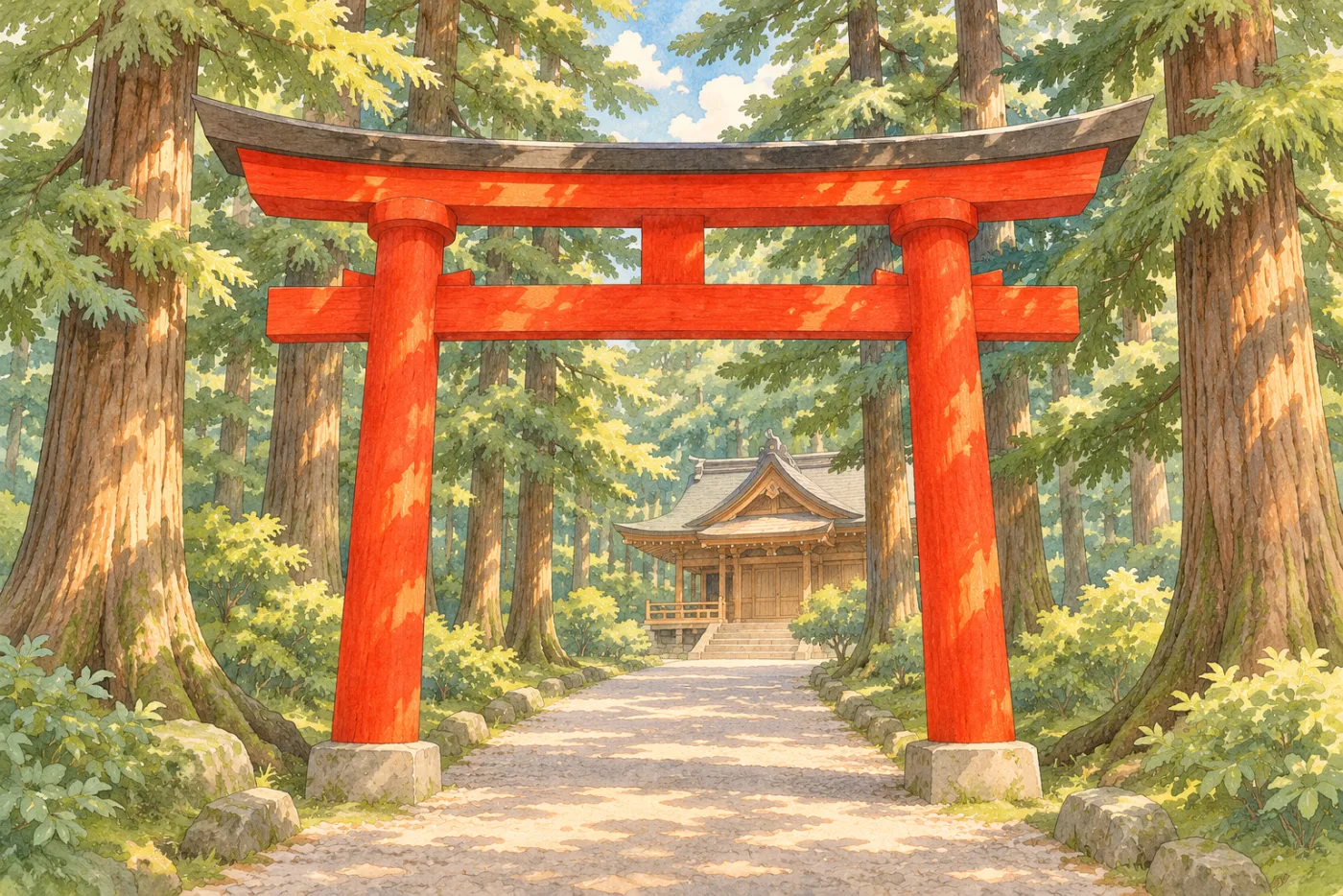
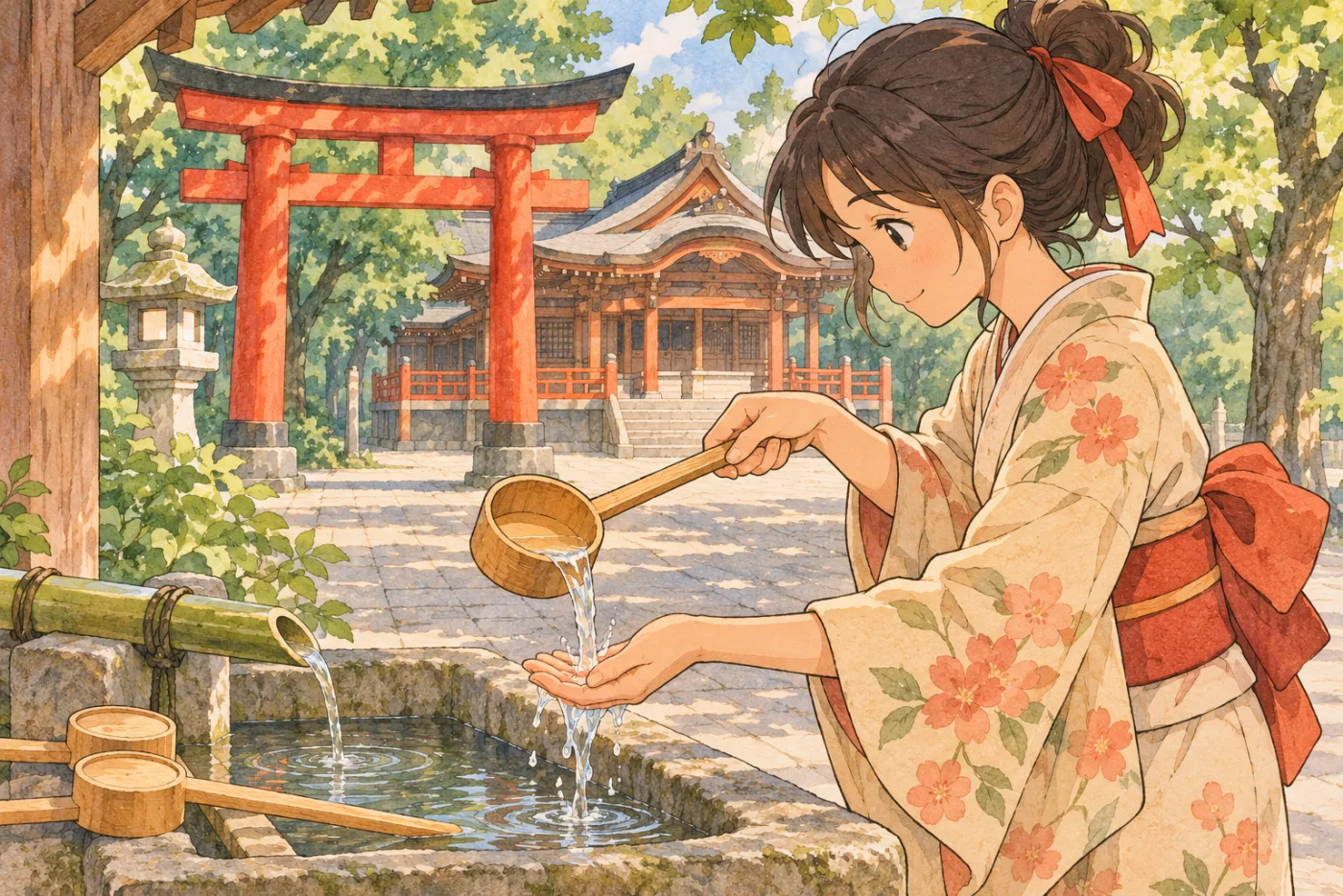
Text to type: In Japanese, a god is called a kami (神). But a kami is not only a person in the sky. Anything with a strong, special power can be a kami. Examples are a high mountain, a waterfall, a very old tree, the sun and the spirits of ancestors. In front of these things, people feel great respect and a little fear. Because kami are everywhere in nature, people speak of yaoyorozu no kami (八百万の神). Word for word, this means eight million gods, but nobody counts them. In old Japanese, eight was a number for very many, so the phrase means countless gods. The way of honouring the kami is called Shinto (神道), the way of the gods. People honour kami at a shrine, or jinja (神社). At the entrance stands a torii (鳥居), a gate that is often painted red. It is made of two posts and two long pieces of wood across the top. The torii marks a line: outside is the everyday world, and inside is the sacred home of the kami. Kami are believed to hate anything dirty. So visitors first purify themselves: they wash their hands and mouth with water at a stone basin. Then they drop a coin into the offering box, bow twice, clap twice and bow once more. The claps tell the kami that you are there, a little like knocking on a door. Priests also give the kami offerings of food they like, such as rice, sake and salt. Where do the stories of the kami come from? Most come from the Kojiki (古事記), Records of Ancient Matters, finished in 712. It is the oldest book in Japan that still exists. The Kojiki has three books, and the first one tells the myths of the kami. Three of the four stories in this lesson come from there.
Ready. The timer starts with your first key.
Complete
Great job!
Strong finish — your speed stayed steady.
Your rhythm
Speed over time- Time
- 0:00
- Raw speed
- 0 WPM
- Wrong keys
- 0
- Corrected
- 0
Check your understanding
Check: Part 1: Who the Kami Are
1. Why do visitors wash their hands and mouth before they pray?
Sample answer
Because kami hate anything dirty, so people must be clean to meet them.
 Part 2: Izanagi and Izanami, the First Couple
Reading
Part 2: Izanagi and Izanami, the First Couple
Typing practice
Type the text exactly. Timer starts with your first key.
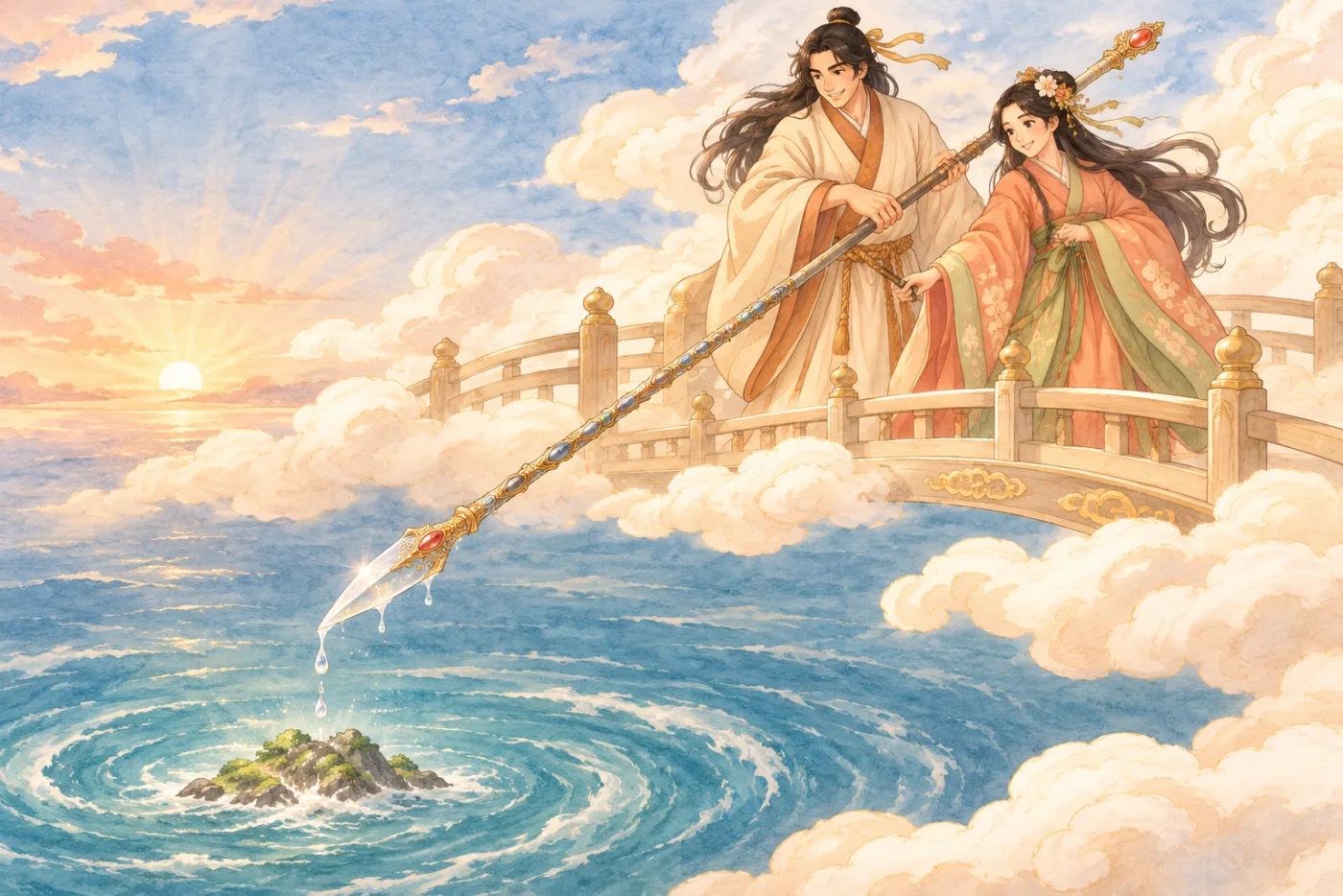
Text to type: Izanagi (イザナギ) and Izanami (イザナミ) are the husband and wife who made Japan. In the Kojiki, the older gods gave them a jewelled spear. They told the couple to make land from the soft world below, which had no shape yet. The two stood on a floating bridge in the sky and stirred the sea with the spear. When they lifted it, drops fell from its tip and piled up into the first island. Then Izanami gave birth to the islands of Japan and to many kami. After that, the story turns dark. Izanami gave birth to the god of fire, and the fire burned her so badly that she died. Izanagi missed her so much that he went down to Yomi (黄泉), the land of the dead. He wanted to bring her home. In the darkness she told him it was too late. She had already eaten food cooked in Yomi, and anyone who eats it must stay. She asked him to wait and not to look at her. But Izanagi could not wait. He made a small light and saw that her dead body was full of worms. He ran. Izanami, angry and ashamed, sent monsters after him. At the exit he blocked the road with a huge rock. From behind it, Izanami shouted that she would kill 1,000 people every day. Izanagi answered that he would then cause 1,500 people to be born every day. This is the point of the myth. It explains why people die. It also explains why there are still people in the world: every day, more are born than die. People needed this story to answer the biggest questions: where the land came from, and why we die. After his escape, Izanagi felt dirty from the land of the dead, so he washed in a river. This gives the reason for the water at every shrine. Izanagi was the first to wash away the dirt of death. As he washed, new kami were born. Amaterasu, the sun goddess, came from his left eye. Susanoo, the storm god, came from his nose.
Ready. The timer starts with your first key.
Complete
Great job!
Strong finish — your speed stayed steady.
Your rhythm
Speed over time- Time
- 0:00
- Raw speed
- 0 WPM
- Wrong keys
- 0
- Corrected
- 0
Check your understanding
Check: Part 2: Izanagi and Izanami, the First Couple
1. Why could Izanami not return to the world of the living?
Sample answer
Because she had already eaten food from Yomi.
 Part 3: Amaterasu, Goddess of the Sun
Reading
Part 3: Amaterasu, Goddess of the Sun
Typing practice
Type the text exactly. Timer starts with your first key.
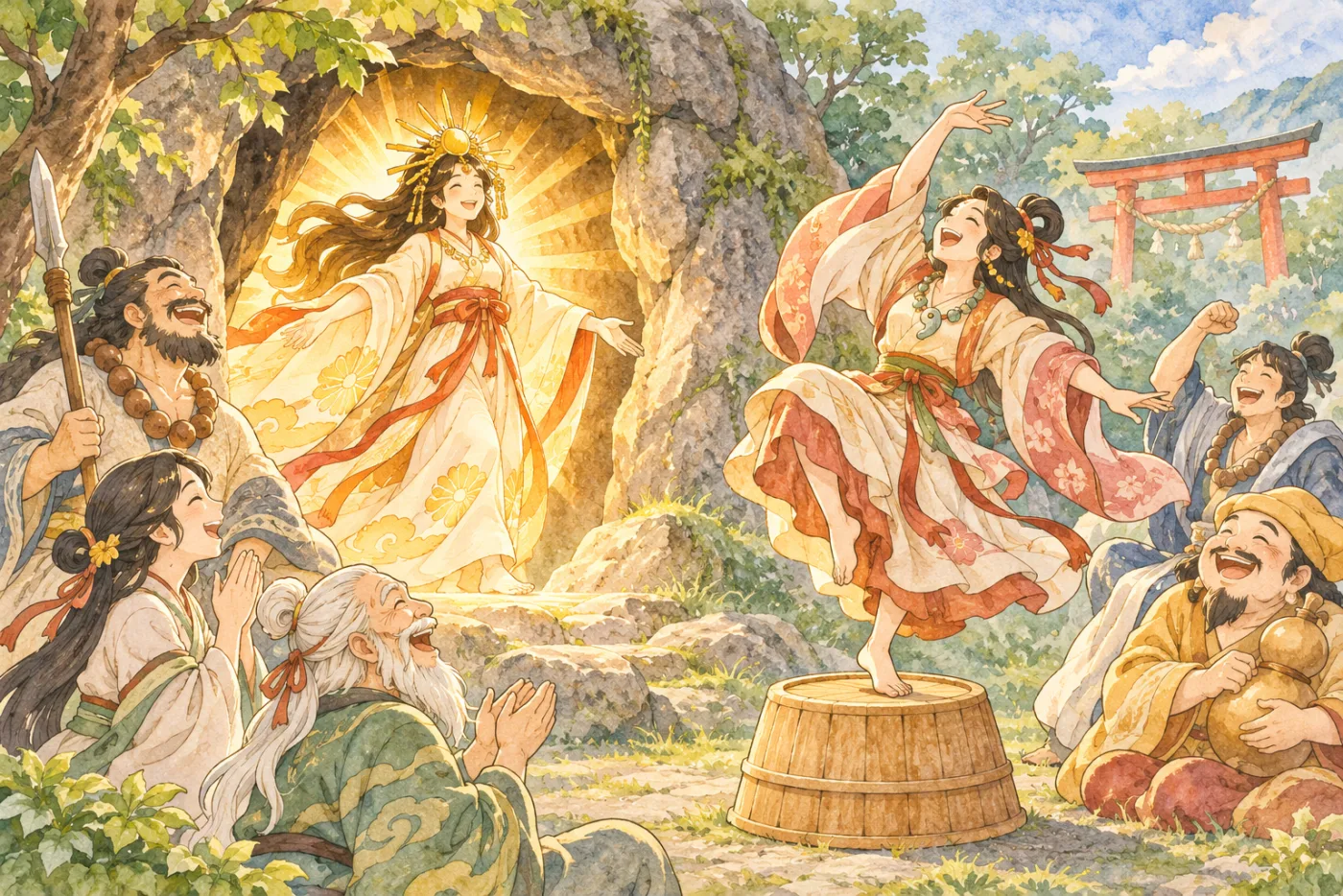
Text to type: Amaterasu (天照大神) is the goddess of the sun and the most important kami in Shinto. Her name means shining in heaven. Her younger brother Susanoo behaved very badly in heaven. He destroyed her rice fields. Then he threw a dead horse through the roof of the hall where her women made cloth. One woman died. Amaterasu was so shocked that she went into a cave and shut the door. The cave is called Ama-no-Iwato (天岩戸), the rock door of heaven. Without her, heaven and earth went dark, and trouble spread everywhere. The eight million gods met to find a way to bring her back. They made the chickens call out, as they do at sunrise. They hung a large mirror and strings of jewels on a sacred tree in front of the cave. Then the goddess Ame-no-Uzume (天宇受売命) turned over a large wooden bucket and stood on it. She danced wildly, stamping her feet and opening her clothes. The gods laughed so loudly that heaven shook. Inside, Amaterasu could not understand how they could be happy in the dark. So she opened the door a little and asked. Uzume answered that a goddess even greater than Amaterasu had come. The gods held up the mirror, and Amaterasu saw a bright face. As she leaned out to look closer, a very strong god took her hand and pulled her out. Another god put a straw rope across the cave so she could not go back. At last, light returned. The point of the myth is that life is impossible without the sun. It also shows that the gods did not use force first: they used a clever idea, laughter and teamwork. People needed Amaterasu because, for farmers, sunlight meant rice, and a dark sky meant hunger. The straw rope from the story is the shimenawa (注連縄). It still hangs at shrines today to mark a sacred place.
Ready. The timer starts with your first key.
Complete
Great job!
Strong finish — your speed stayed steady.
Your rhythm
Speed over time- Time
- 0:00
- Raw speed
- 0 WPM
- Wrong keys
- 0
- Corrected
- 0
Check your understanding
Check: Part 3: Amaterasu, Goddess of the Sun
1. How did the gods get Amaterasu out of the cave?
Sample answer
They laughed at the dance of Uzume, showed her the mirror, and pulled her out.
 Part 4: Susanoo and the Eight-Headed Serpent
Reading
Part 4: Susanoo and the Eight-Headed Serpent
Typing practice
Type the text exactly. Timer starts with your first key.
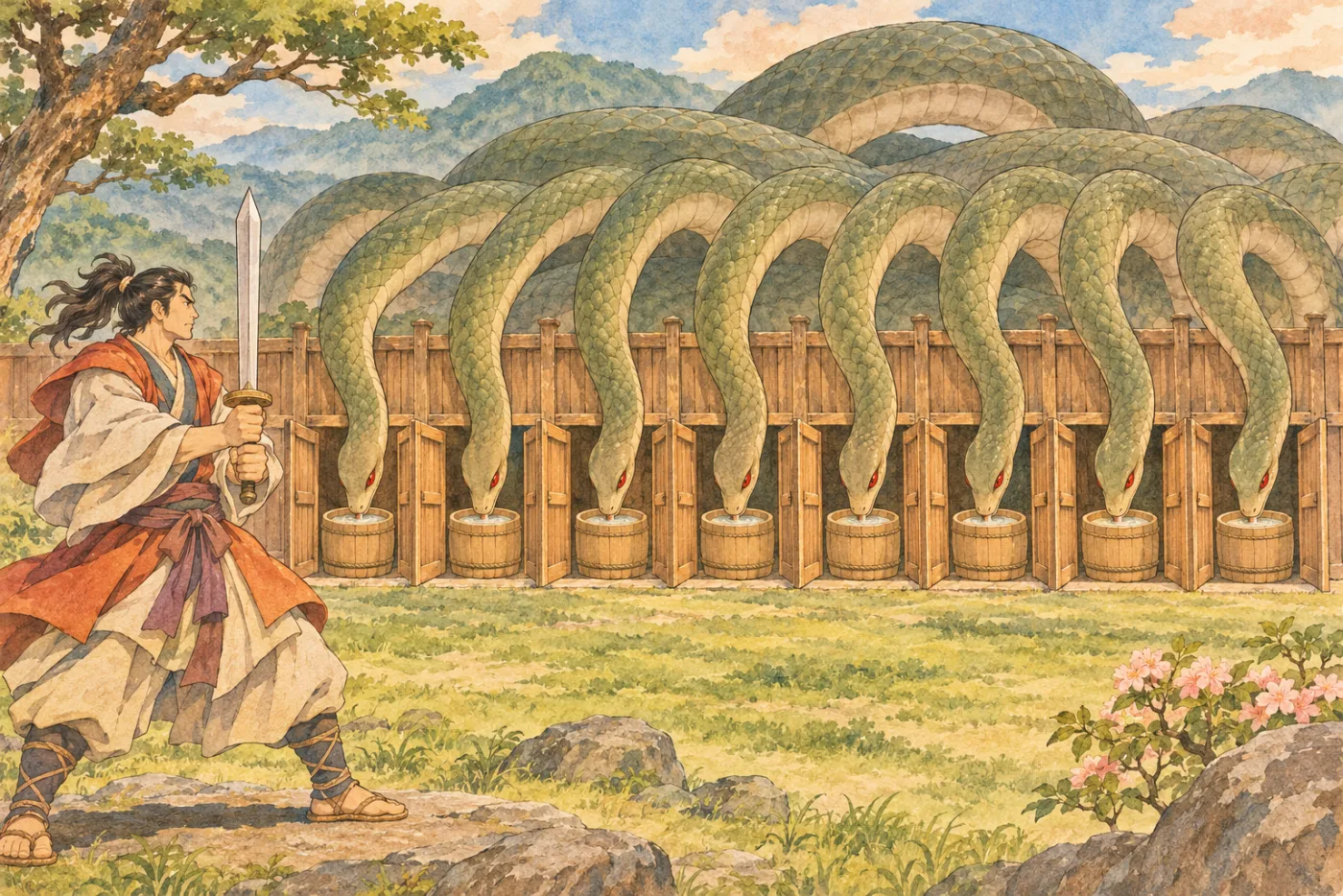
Text to type: Susanoo (須佐之男) is the kami of storms and the sea. Like a storm, he was wild, loud and often angry. After the trouble with the cave, the gods punished him and sent him out of heaven. He came down to Izumo (出雲), beside a river. There he found an old man and an old woman crying with their young daughter, Kushinada-hime (櫛名田比売). They once had eight daughters, but every year a monster had come and eaten one. Now only she was left, and the monster was coming again. It was Yamata no Orochi (八岐大蛇), a serpent, or giant snake, with eight heads and eight tails. Its eyes were as red as hōzuki fruit. Its body was as long as eight valleys and eight hills. Susanoo promised to kill it if he could marry the girl. To keep her safe, he turned her into a comb and put it in his hair. Then he told her parents to make very strong sake. They also built a fence with eight gates, with a barrel of sake at each gate. The serpent came, put one head into each barrel, drank everything and fell asleep. Susanoo cut it into pieces, and the river ran red with blood. In one tail, his sword broke on something hard. He cut the tail open and found a great sword. He gave it to Amaterasu as a gift to make peace. It is called Kusanagi (草薙剣), the grass cutter. The point of the myth is about power. The wild power of Susanoo caused trouble in heaven. On earth, with a clever plan, the same power saved people. The eights in the story also mean very many, just like the eight million gods. People needed a god like Susanoo because storms and floods could destroy the rice of a whole year. They wanted someone strong enough to fight the dangers that people could not.
Ready. The timer starts with your first key.
Complete
Great job!
Strong finish — your speed stayed steady.
Your rhythm
Speed over time- Time
- 0:00
- Raw speed
- 0 WPM
- Wrong keys
- 0
- Corrected
- 0
Check your understanding
Check: Part 4: Susanoo and the Eight-Headed Serpent
1. How did Susanoo beat the serpent?
Sample answer
He made it drink strong sake, and when it fell asleep, he cut it into pieces.
 Part 5: Inari, God of Rice
Reading
Part 5: Inari, God of Rice
Typing practice
Type the text exactly. Timer starts with your first key.
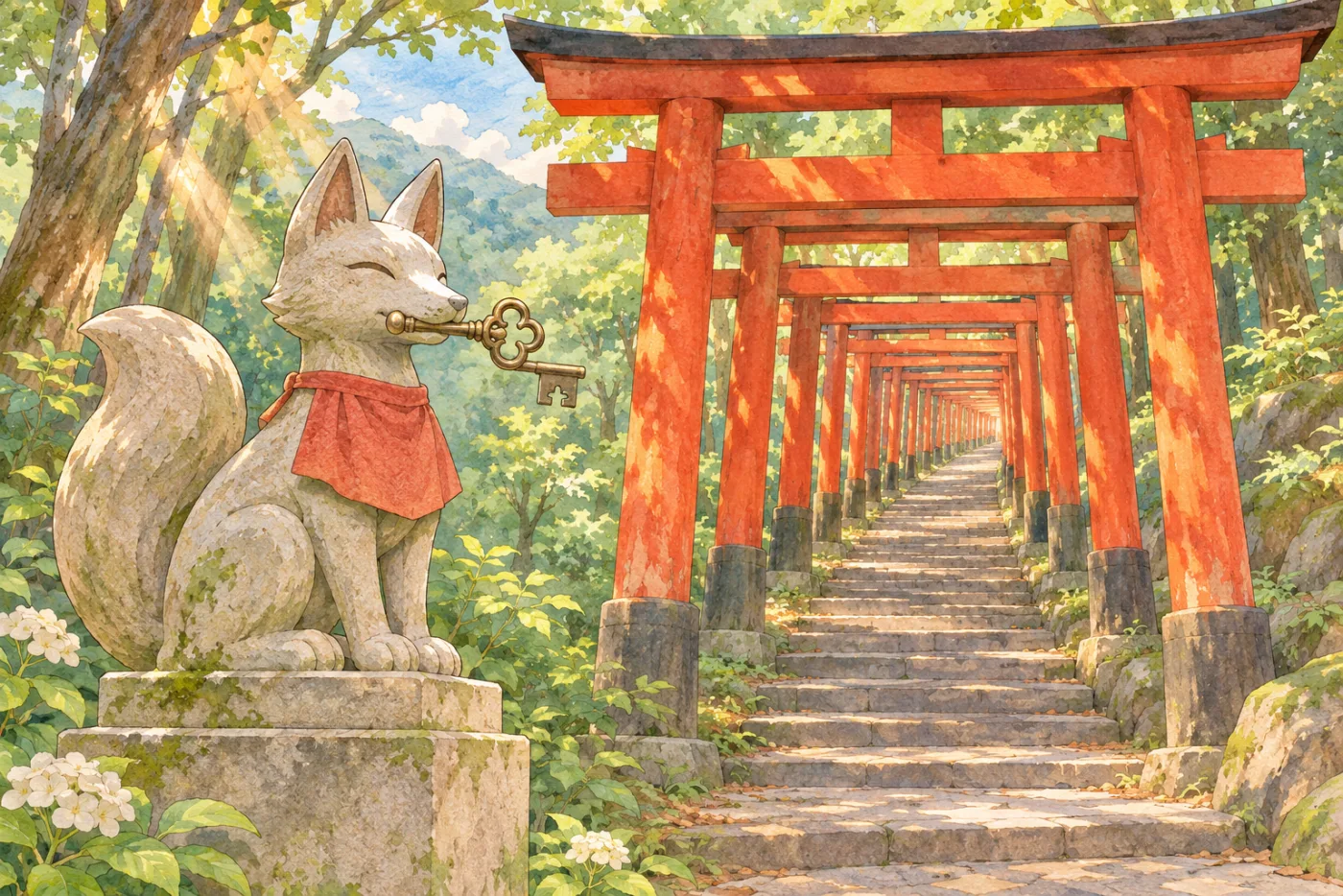
Text to type: Inari (稲荷) is the kami of rice. For most of the history of Japan, rice was the main food and also a kind of money. So a good harvest meant that a family could live. The main shrine of Inari is Fushimi Inari Taisha (伏見稲荷大社) in Kyoto. Its story does not come from the Kojiki, but from another old book about the Kyoto area. A rich man named Irogu had so much rice that he made mochi, or rice cakes. He used one as a target and shot arrows at it. When his arrow hit it, the mochi turned into a white bird and flew away to a mountain. Where the bird came down, rice plants grew. Irogu understood that a kami lived there, and he built a shrine. In old Japanese, rice grew is ine nari. The book says this is where the name Inari comes from. The point of the myth is that rice is not a toy. It is a gift from the kami, and it deserves respect. Later, when towns and cities grew, merchants began to pray to Inari for success in business too. When a wish comes true, a company or a person may give the shrine a new torii. The torii is a thank-you to the kami. Because of this, about 10,000 bright red-orange torii now cover the paths up the mountain behind the shrine. In many places they stand so close together that they look like long tunnels. At every Inari shrine you will also see stone foxes. They are not Inari, but messengers of Inari. Many hold a key in their mouths: the key to the place where the rice is kept.
Ready. The timer starts with your first key.
Complete
Great job!
Strong finish — your speed stayed steady.
Your rhythm
Speed over time- Time
- 0:00
- Raw speed
- 0 WPM
- Wrong keys
- 0
- Corrected
- 0
Check your understanding
Check: Part 5: Inari, God of Rice
1. Why did Irogu build a shrine on the mountain?
Sample answer
Because rice grew where the white bird came down, so he knew a kami lived there.
 Part 6: The Japanese Gods Today
Reading
Part 6: The Japanese Gods Today
Typing practice
Type the text exactly. Timer starts with your first key.
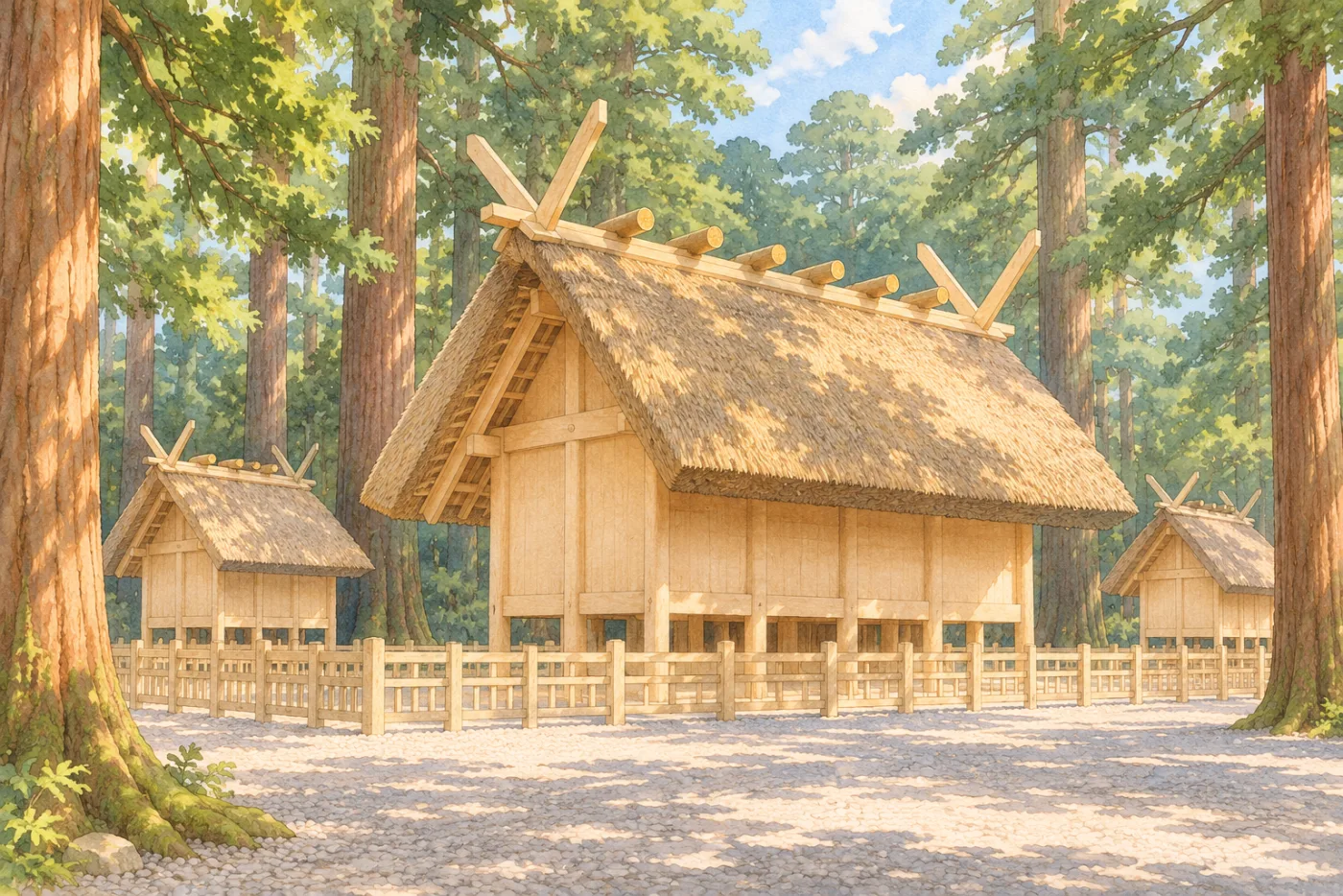
Text to type: In Ise (伊勢), the Inner Shrine of Ise Jingu (伊勢神宮) honours Amaterasu. The mirror from the cave story is said to be kept there. Every 20 years, the main buildings are built again on the land next to the old ones. They are built in exactly the same simple style, and then the kami is moved into the new home. This has happened 62 times since 690. The idea is often described as changing in order to stay the same. The shrine is always new and clean, as kami like, but it never really changes. In Nagoya, Atsuta Jingu (熱田神宮) keeps the Kusanagi sword that Susanoo found in the tail of the serpent. It is kept hidden, and the public has never seen it. With the mirror and a jewel, it is one of the three sacred treasures of the emperor. The Kojiki says the emperors of Japan come from the family of Amaterasu. She gave the treasures to her grandson when she sent him down from heaven to lead Japan. People also dance the cave story. The dance of Uzume in front of the cave is said to be the beginning of kagura (神楽). Kagura is sacred dance for the kami. People believe the cave is in the town of Takachiho (高千穂). There, Takachiho Shrine shows kagura to visitors every evening, and the dance of Uzume is part of it.
Ready. The timer starts with your first key.
Complete
Great job!
Strong finish — your speed stayed steady.
Your rhythm
Speed over time- Time
- 0:00
- Raw speed
- 0 WPM
- Wrong keys
- 0
- Corrected
- 0
Check your understanding
Check: Part 6: The Japanese Gods Today
1. Why is Ise Jingu built again every 20 years?
Sample answer
So the shrine is always new and clean for the kami, while its style never changes.
What you can do now
Final Reflection
The kami explained the world people lived in, from the first island to the rice they ate.
Which of the four kami do you think mattered most to ordinary people in old Japan, and why?
Which myth from today would you tell a friend from another country?
How are the Japanese gods similar to the Greek gods, and how are they different?
Where have you seen these kami in your own life?
Learning cards
My cards
Japanese Gods and Why People Needed Them
0 due · 0 new · about 1 min
Learn the sense first · then retrieve it
No saved cards yet
Open a word or phrase in the article and choose Save to My Words.
Focused Reading Mode is open.
Listening
Lesson audio
Listen from the beginning, or choose “Play this part” as you read along.
Reading
Part 1: Who the Kami Are
Reading
Part 2: Izanagi and Izanami, the First Couple
Reading
Part 3: Amaterasu, Goddess of the Sun
Reading
Part 4: Susanoo and the Eight-Headed Serpent
Reading
Part 5: Inari, God of Rice
Reading
Part 6: The Japanese Gods Today
Finished listening?
Mark this listening practice complete when you have followed the lesson audio.
Listening complete
Listen Mode
Word-by-word syncPlay the audio and follow the highlighted word.
Article complete
Choose your next step
Open the next same-level lesson, replay the article, or save this page for later.
Listen Again
Replay the article once and notice how much more you understand.
One replay is enough. Then move on.
Lesson resources
Resources
Sources and fact review (16)
- Kojiki (Wikipedia)
Presented in 712, oldest surviving Japanese book, three volumes, first volume holds the myths of the kami
- Kami (Wikipedia)
Kami as nature, forces and ancestors, awe; yaoyorozu no kami means countless; purifying hands and mouth; bow twice, clap twice, bow once to get the kami's attention
- Shinto Shrines and Festivals (LibreTexts, World Religions)
The torii separates the sacred space of the shrine from the outside world
- Onogoro Island (Wikipedia)
Jewelled spear, floating bridge, drops from the spear forming the first island
- Izanami (Wikipedia)
Islands and kami born; death from the fire god; Yomi food; the light; boulder; 1,000 deaths and 1,500 births; Amaterasu and Susanoo born from the left eye and nose after washing
- Amaterasu (Wikipedia)
Susanoo's acts, the cave, roosters, mirror and jewels on the sakaki tree, Uzume's dance on a tub, laughter, the strong god, the shimenawa rope; ancestress of the imperial house through her grandson; Ise Inner Shrine and the mirror
- Yamata no Orochi (Wikipedia)
Susanoo expelled to Izumo, old couple with eight daughters, Kushinada-hime as a comb, strong sake, eight gates, serpent description, sword found in the tail and given to Amaterasu, name Grass Cutter
- Fushimi Inari-taisha (Wikipedia)
Fudoki legend of Irogu's rice cake turning into a white bird and rice growing; kami of rice and business; about 10,000 torii donated in thanks for wishes; foxes as messengers holding the granary key
- Fushimi Inari Taisha (official site)
Main Inari shrine; prayers for harvests and business prosperity
- Shikinen Sengu (Ise-Shima Tourism)
Rebuilt every 20 years since 690; 62nd time in 2013; changing to remain unchanged
- Kusanagi no Tsurugi (Wikipedia)
Kept at Atsuta Shrine and not available for public display; no one is allowed to see the sword
- Atsuta Jingu (japan-guide.com)
Atsuta Jingu in Nagoya enshrines the Kusanagi sword, which is never shown to the public
- Atsuta Jingu (japan.travel)
Atsuta Jingu in Nagoya as the home of the sacred sword
- Atsuta Shrine (Wikipedia)
Home of the Kusanagi sword, one of the three Imperial Regalia
- Imperial Regalia of Japan (Wikipedia)
The mirror, sword and jewel came down with Amaterasu's grandson when she sent him to rule Japan; kept from public view
- Takachiho Tourism Association
Kagura said to begin with Ame-no-Uzume's dance in front of the Amano-Iwato cave; Takachiho night kagura