One Day, Many Rhythms: Europe, Japan, and Argentina
Quality checked lesson
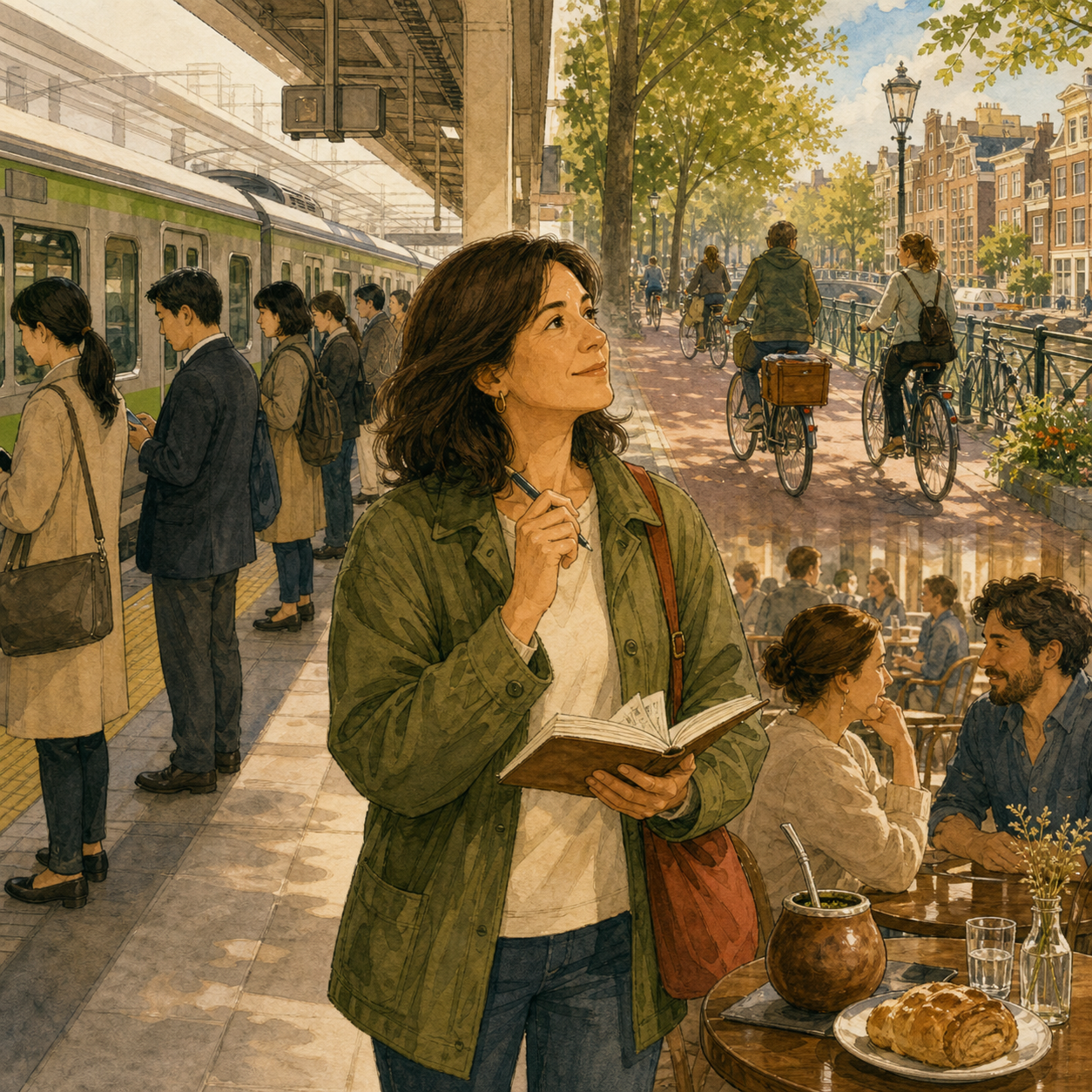
A normal day changes with transport, meal times, school routines, and social rules. By comparing named places rather than stereotypes, we can see how daily habits respond to local systems and expectations.
 English lesson
Article
Choose how to use this lesson
You can switch anytime.
Study mode
Introduction
Typing practice
Type the text exactly. Timer starts with your first key.
Text to type: A normal day changes with transport, meal times, school routines, and social rules. By comparing named places rather than stereotypes, we can see how daily habits respond to local systems and expectations.
Ready. The timer starts with your first key.
Complete
Great job!
Strong finish — your speed stayed steady.
Your rhythm
Speed over time- Time
- 0:00
- Raw speed
- 0 WPM
- Wrong keys
- 0
- Corrected
- 0
Before you begin
Warm-up
Which part of your daily routine would surprise a visitor?
What time do people usually eat dinner where you live?
How do you normally greet a friend, a teacher, and a new colleague?
 Part 1: Europe Is Not One Daily Routine
Reading
Part 1: Europe Is Not One Daily Routine
Typing practice
Type the text exactly. Timer starts with your first key.
Text to type: Europe contains many countries, languages, and cultural traditions, so it is not useful to imagine one “European day.” A routine in Madrid may be different from one in Amsterdam or Berlin. We will compare those named examples with Japan and Argentina through four daily clocks. The movement clock is how people travel and behave on the way. The meal clock is when and how they eat. The contact clock is how they greet and share space. The shared-time clock is how schools, shops, and weekends are organized. These clocks are not exact times. They are a simple way to notice how local transport, rules, and social expectations shape an ordinary day. They describe common patterns, not every individual.
Ready. The timer starts with your first key.
Complete
Great job!
Strong finish — your speed stayed steady.
Your rhythm
Speed over time- Time
- 0:00
- Raw speed
- 0 WPM
- Wrong keys
- 0
- Corrected
- 0
Check your understanding
Check: Part 1: Europe Is Not One Daily Routine
1. Why does the lesson compare named European places instead of one European routine?
Sample answer
Europe contains many different countries and traditions, so named places create clearer and more accurate comparisons.
Reading
Part 2: The Movement Clock
Typing practice
Type the text exactly. Timer starts with your first key.
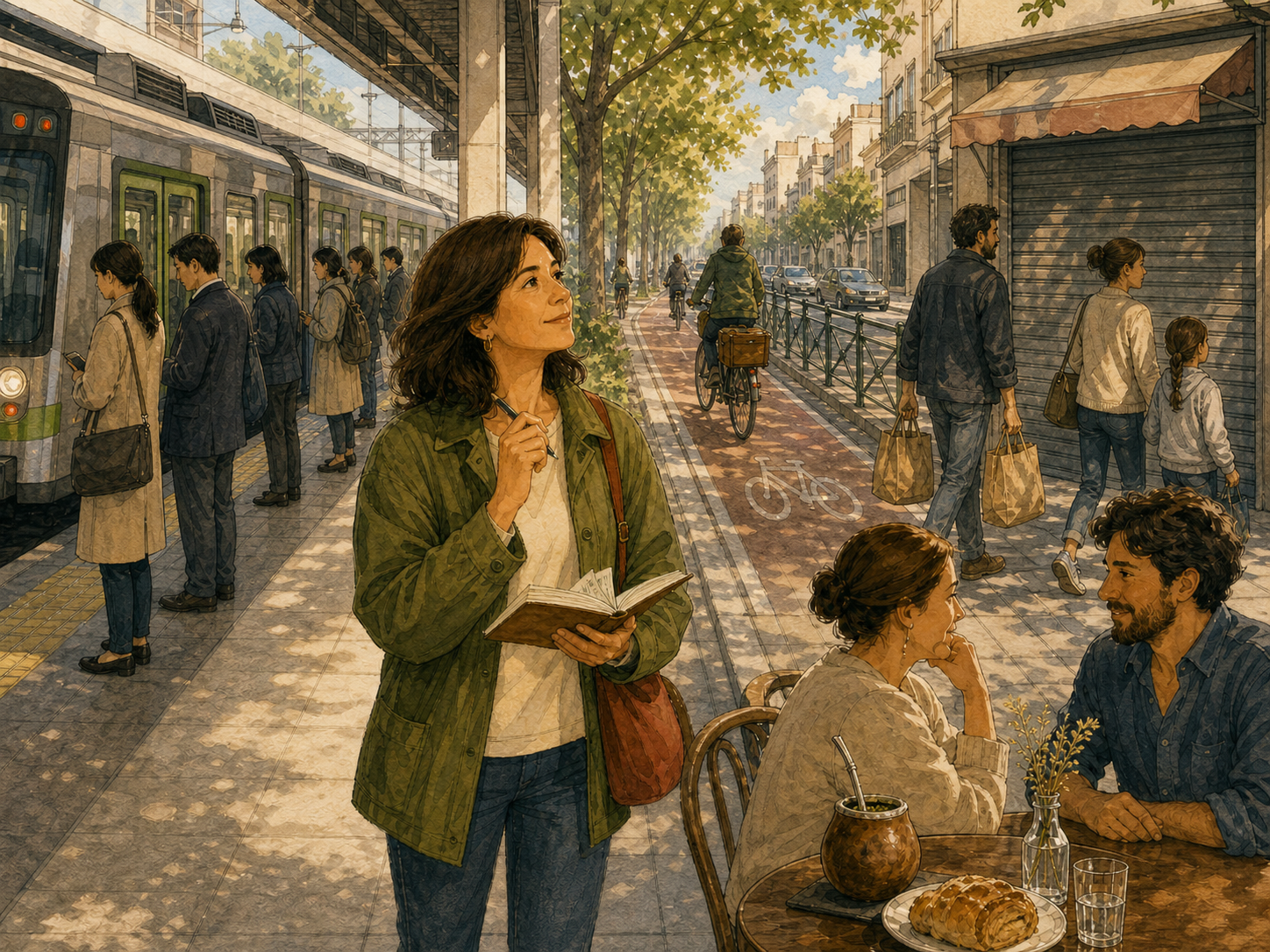
Text to type: A morning journey shows how the movement clock works. In Japan’s major cities, public transport carries millions of people each day. Official guidance asks passengers to line up, keep conversations quiet, and avoid phone calls on trains. In the Netherlands, bicycles are an everyday form of transport: the national government says that 27 percent of all journeys are made by bicycle. Buenos Aires has another pattern. People use buses called colectivos and an underground system called the subte, and both use a rechargeable SUBE card. City buses operate all day and night. A commuter in Japan, a cyclist in the Netherlands, and a bus passenger in Buenos Aires all need to reach work or school, but their streets and transport systems produce different habits.
Ready. The timer starts with your first key.
Complete
Great job!
Strong finish — your speed stayed steady.
Your rhythm
Speed over time- Time
- 0:00
- Raw speed
- 0 WPM
- Wrong keys
- 0
- Corrected
- 0
Check your understanding
Check: Part 2: The Movement Clock
1. How can transport systems create different daily habits?
Sample answer
They change how people move, what they carry, and what behavior is expected during the journey.
Think one step further
Which of these transport routines would work best in your town, and why?
Reading
Part 3: The Meal Clock
Typing practice
Type the text exactly. Timer starts with your first key.
Text to type: The meal clock can make the same hour feel completely different. Official European employment guidance says that a normal lunch time in Spain is from 1:30 p.m. to 3:30 p.m., while dinner is commonly between 9 p.m. and 11 p.m. In Buenos Aires, the traditional merienda is a late-afternoon snack, often coffee with cake or a pastry, and many people plan dinner and social activities later in the evening. Japan offers a different kind of convenience. Bento boxes are a large part of daily life and are sold in specialist shops, supermarkets, and convenience stores for people who need a prepared meal. At 2 p.m., one person may be sitting down to lunch in Madrid while another is buying a quick bento in Tokyo. Daily schedules change when people meet, rest, and eat together.
Ready. The timer starts with your first key.
Complete
Great job!
Strong finish — your speed stayed steady.
Your rhythm
Speed over time- Time
- 0:00
- Raw speed
- 0 WPM
- Wrong keys
- 0
- Corrected
- 0
Check your understanding
Check: Part 3: The Meal Clock
1. What does the 2 p.m. example show about the meal clock?
Sample answer
The same hour can be a long lunch time in Madrid and a time for a quick prepared meal in Tokyo.
Think one step further
Which meal clock would require the biggest change to your own day, and why?
 Part 4: The Contact Clock
Reading
Part 4: The Contact Clock
Typing practice
Type the text exactly. Timer starts with your first key.
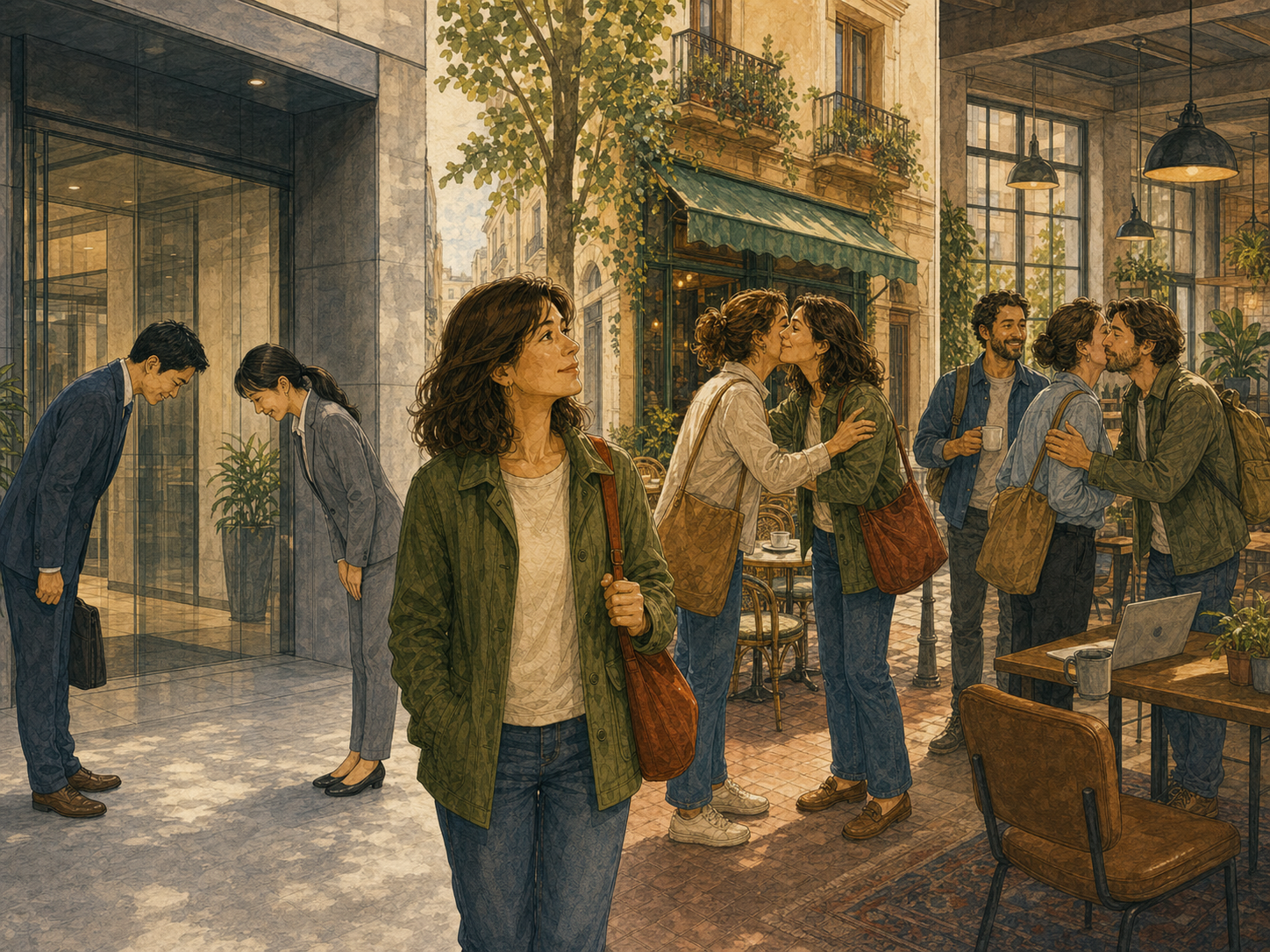
Text to type: Greetings reveal the contact clock. In everyday Japanese interactions, body contact is less common, and a polite bow is often an appropriate greeting. Official European guidance says that a kiss on each cheek or a hug is common in informal social relations in Spain. Buenos Aires’s official visitor guide describes one kiss on the cheek as a common greeting, even between colleagues. The important skill is not memorizing one national rule. It is reading the relationship and the setting. A close friend, a new colleague, and a customer may not receive the same greeting. Someone who expects a bow may find a kiss surprisingly close, while someone who expects a kiss may read greater distance as coldness.
Ready. The timer starts with your first key.
Complete
Great job!
Strong finish — your speed stayed steady.
Your rhythm
Speed over time- Time
- 0:00
- Raw speed
- 0 WPM
- Wrong keys
- 0
- Corrected
- 0
Check your understanding
Check: Part 4: The Contact Clock
1. What two things should a person notice before choosing a greeting?
Sample answer
A person should notice the relationship between the people and whether the setting is formal or informal.
Think one step further
In your experience, what helps you choose a greeting when you meet someone new, and why?
Reading
Part 5: School Changes the Family Day
Typing practice
Type the text exactly. Timer starts with your first key.
Text to type: School routines shape life beyond the classroom. Japan’s education ministry shows school lunch and cleaning as normal parts of elementary school life. After lunch, students in the ministry’s guide clean places such as their classroom together. Buenos Aires public primary schools offer several schedules. A simple school day may run from 8 a.m. to 12:15 p.m. or from 1 p.m. to 5:15 p.m. A full day has morning and afternoon sessions, and children may eat at home or in the school dining room. These systems affect when families wake up, prepare food, travel, and arrange care. They also show different ways to organize responsibility: shared care of the school space in Japan and several timetable choices in Buenos Aires.
Ready. The timer starts with your first key.
Complete
Great job!
Strong finish — your speed stayed steady.
Your rhythm
Speed over time- Time
- 0:00
- Raw speed
- 0 WPM
- Wrong keys
- 0
- Corrected
- 0
Check your understanding
Check: Part 5: School Changes the Family Day
1. How do the Japanese and Buenos Aires examples organize the school day differently?
Sample answer
Japanese students often share lunch and cleaning duties, while Buenos Aires schools offer morning, afternoon, and full-day schedules.
 Part 7: Read the System Behind the Habit
Reading
Part 7: Read the System Behind the Habit
Typing practice
Type the text exactly. Timer starts with your first key.
Text to type: Imagine planning one Saturday in several places. In Tokyo, you may prepare for a quiet train journey and remove your shoes when entering a home. In Amsterdam, a bicycle may be the easiest choice. In Madrid, lunch can continue well into the afternoon. In Buenos Aires, you may load a SUBE card, meet friends for merienda, and share mate. In Munich, you may buy groceries before shops close for Sunday. The deeper lesson is that infrastructure, opening rules, meal schedules, and ideas about consideration make certain habits practical. This does not mean one routine is better. A system may save time in one place, support shared responsibility in another, or protect a quiet day. When a habit looks strange, ask what system or expectation makes this useful here; that question produces a more thoughtful comparison than simply asking what people from a country are like.
Ready. The timer starts with your first key.
Complete
Great job!
Strong finish — your speed stayed steady.
Your rhythm
Speed over time- Time
- 0:00
- Raw speed
- 0 WPM
- Wrong keys
- 0
- Corrected
- 0
Check your understanding
Check: Part 7: Read the System Behind the Habit
1. What question helps us understand a cultural habit without using a stereotype?
Sample answer
We can ask what local system or expectation makes the habit useful in that place.
What you can do now
Final Reflection
Choose one named place in Europe, Japan, or Argentina. Which daily clock would you need to adapt to first, and what would you change in your own day?
Learning cards
My cards
One Day, Many Rhythms: Europe, Japan, and Argentina
0 due · 0 new · about 1 min
Learn the sense first · then retrieve it
No saved cards yet
Open a word or phrase in the article and choose Save to My Words.
Focused Reading Mode is open.
Listening
Lesson audio
Listen from the beginning, or choose “Play this part” as you read along.
Reading
Part 1: Europe Is Not One Daily Routine
Reading
Part 2: The Movement Clock
Reading
Part 3: The Meal Clock
Reading
Part 4: The Contact Clock
Reading
Part 5: School Changes the Family Day
Reading
Part 7: Read the System Behind the Habit
Finished listening?
Mark this listening practice complete when you have followed the lesson audio.
Listening complete
Listen Mode
Word-by-word syncPlay the audio and follow the highlighted word.
Article complete
Choose your next step
Open the next same-level lesson, replay the article, or save this page for later.
Listen Again
Replay the article once and notice how much more you understand.
One replay is enough. Then move on.