Stock Investing: One Company or an Index Fund?
Quality checked lesson
 English lesson
Article
Choose how to use this lesson
You can switch anytime.
Study mode
Introduction
Typing practice
Type the text exactly. Timer starts with your first key.
Text to type: When a company needs money to grow, it can sell small pieces of ownership to the public. Those pieces are called shares, and buying them makes you a part-owner of the business. Investors study revenue, profit, debt, valuation, dividends, and risk. They also decide whether to choose one company or spread money across many companies.
Ready. The timer starts with your first key.
Complete
Great job!
Strong finish — your speed stayed steady.
Your rhythm
Speed over time- Time
- 0:00
- Raw speed
- 0 WPM
- Wrong keys
- 0
- Corrected
- 0
Before you begin
Warm-Up
Have you ever bought something hoping it would be worth more money later? What was it?
If you owned a small part of a successful restaurant, what would you expect in return?
Why might putting all your savings into one company feel risky?
 Part 2 — Revenue, Profit, and Company Value
Reading
Part 2 — Revenue, Profit, and Company Value
Typing practice
Type the text exactly. Timer starts with your first key.
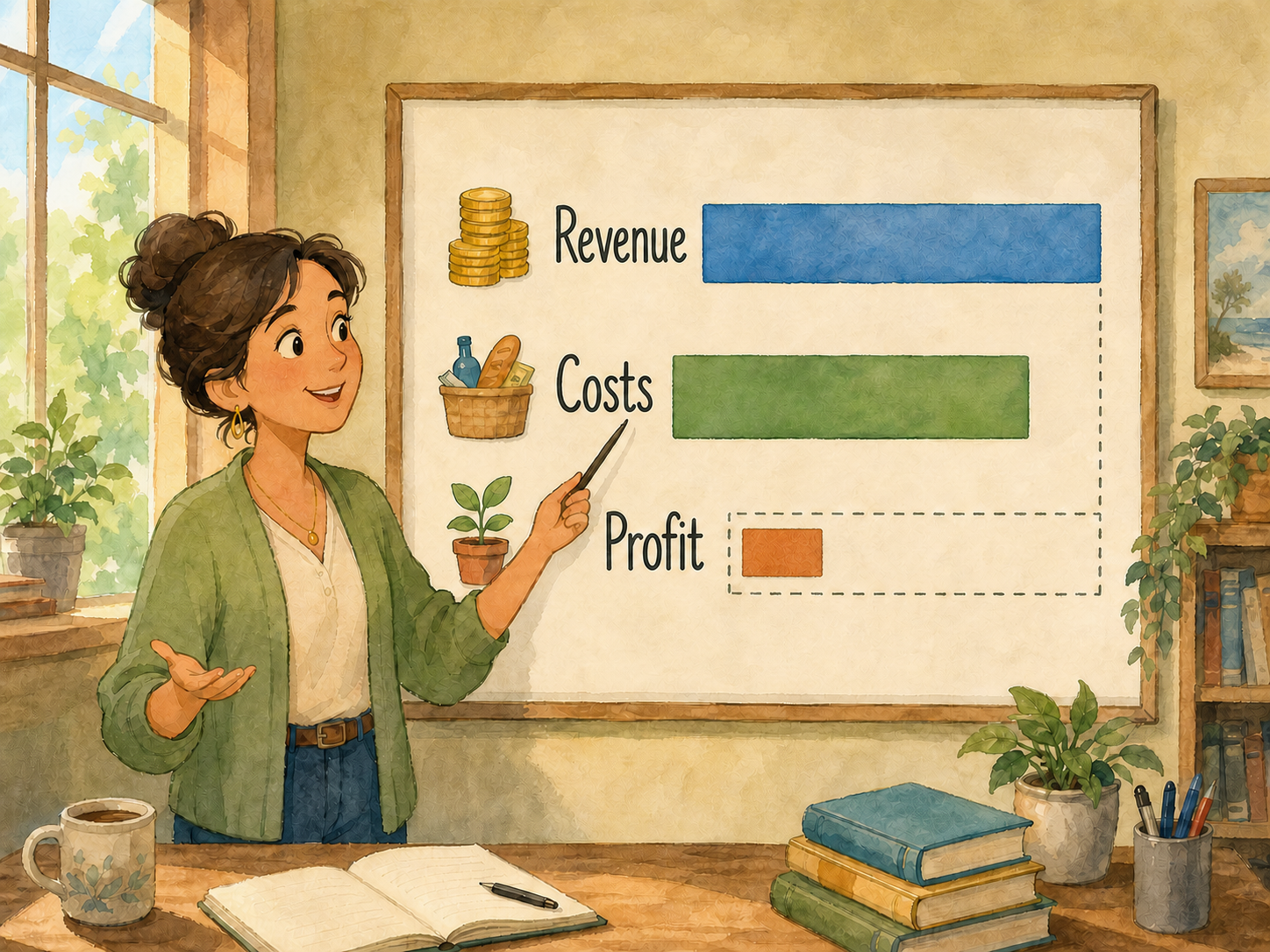
Text to type: Stock investing fundamentals start with business revenue and profit. Revenue is the total money a company receives from selling products or services. Profit is what remains after paying all costs. A company can have high revenue but low profit when its costs are also high. Microsoft reported $281.7 billion in revenue and $101.8 billion in net income for the year ended June 30, 2025. ASML, a Dutch maker of chip-making machines, reported €32.7 billion in net sales and €9.6 billion in net income for 2025. These numbers describe business performance, but they do not show whether a share price is low or high. Valuation is the market's judgment of what a company is worth. Investors compare price with measures such as profit, but future results are uncertain.
Ready. The timer starts with your first key.
Complete
Great job!
Strong finish — your speed stayed steady.
Your rhythm
Speed over time- Time
- 0:00
- Raw speed
- 0 WPM
- Wrong keys
- 0
- Corrected
- 0
Check your understanding
Check — Revenue, Profit, and Value
1. Why might a company with high revenue still have a low share price?
Sample answer
High revenue does not guarantee high profit. If costs are also very high, profit will be small, and investors may not value the company highly. Share prices reflect expected future profit, not revenue alone.
Reading
Part 3 — Debt and Risk
Typing practice
Type the text exactly. Timer starts with your first key.
Text to type: Companies often borrow money to expand. This borrowing is called debt. Debt is not always bad because it can fund useful growth. However, a company must make interest payments and later repay the debt. Those payments reduce the money available to shareholders. If the business becomes weak, heavy debt can make its problems worse. Risk is the possibility that an investment loses value. Share prices can fall because profit falls, debt rises, competition grows, or the economy weakens. Toyota depends partly on demand for vehicles and the cost of making them. ASML depends partly on chipmakers ordering its machines. A real company can be strong today and still face future risk.
Ready. The timer starts with your first key.
Complete
Great job!
Strong finish — your speed stayed steady.
Your rhythm
Speed over time- Time
- 0:00
- Raw speed
- 0 WPM
- Wrong keys
- 0
- Corrected
- 0
Check your understanding
Check — Debt and Risk
1. Give one reason why debt increases the risk of owning shares in a company.
Sample answer
A company with high debt must pay interest before shareholders receive anything. If the company's earnings fall, it may struggle to cover those payments, reducing or eliminating profit for shareholders.
Reading
Part 4 — Dividends
Typing practice
Type the text exactly. Timer starts with your first key.
Text to type: Some companies share part of their profits directly with shareholders. These payments are called dividends. The payment schedule differs by company, and a company may raise, reduce, or stop its dividend. A dividend is normally calculated per share, so an owner with more shares receives more money. Microsoft reports both dividend payments and continued investment in its business. Other companies may keep more profit to build factories, develop products, or repay debt. A dividend can provide cash even when a share price does not rise, but it does not make a stock safe: the share price can still fall by more than the dividend paid.
Ready. The timer starts with your first key.
Complete
Great job!
Strong finish — your speed stayed steady.
Your rhythm
Speed over time- Time
- 0:00
- Raw speed
- 0 WPM
- Wrong keys
- 0
- Corrected
- 0
Check your understanding
Check — Dividends
1. How do dividends benefit an investor even if the share price stays the same?
Sample answer
Dividends provide a regular cash payment from the company's profit. Even if the share price does not increase, the investor earns income simply by holding the shares.
 Part 5 — Individual Stocks vs. Index Funds
Reading
Part 5 — Individual Stocks vs. Index Funds
Typing practice
Type the text exactly. Timer starts with your first key.
Text to type: The difference between an individual stock and an index fund is concentration. An individual stock gives you ownership in one company. If that company does poorly, your investment can fall sharply. An index fund holds shares in many companies at once, so your money is spread across the companies it tracks. The S&P 500 covers 500 large U.S. companies, including Microsoft, and State Street's SPY ETF aims to follow that index before expenses. A TOPIX index fund follows a market-capitalization-weighted benchmark covering an extensive part of the Japanese stock market, including Toyota. A STOXX Europe 600 index fund follows 600 large, mid-sized, and small companies from 17 European countries, including ASML. Each regional index fund spreads company-specific risk, but it can still fall when its whole market falls.
Ready. The timer starts with your first key.
Complete
Great job!
Strong finish — your speed stayed steady.
Your rhythm
Speed over time- Time
- 0:00
- Raw speed
- 0 WPM
- Wrong keys
- 0
- Corrected
- 0
Check your understanding
Check — Individual Stocks vs. Index Funds
1. Why might an index fund like the TOPIX or the S&P 500 be less risky than buying shares in only one company?
Sample answer
An index fund holds many companies at once. If one company's shares fall, the others may stay steady or rise, so the overall loss is smaller. With a single company, a fall in that stock affects your entire investment.
 Part 6 — Diversification
Reading
Part 6 — Diversification
Typing practice
Type the text exactly. Timer starts with your first key.
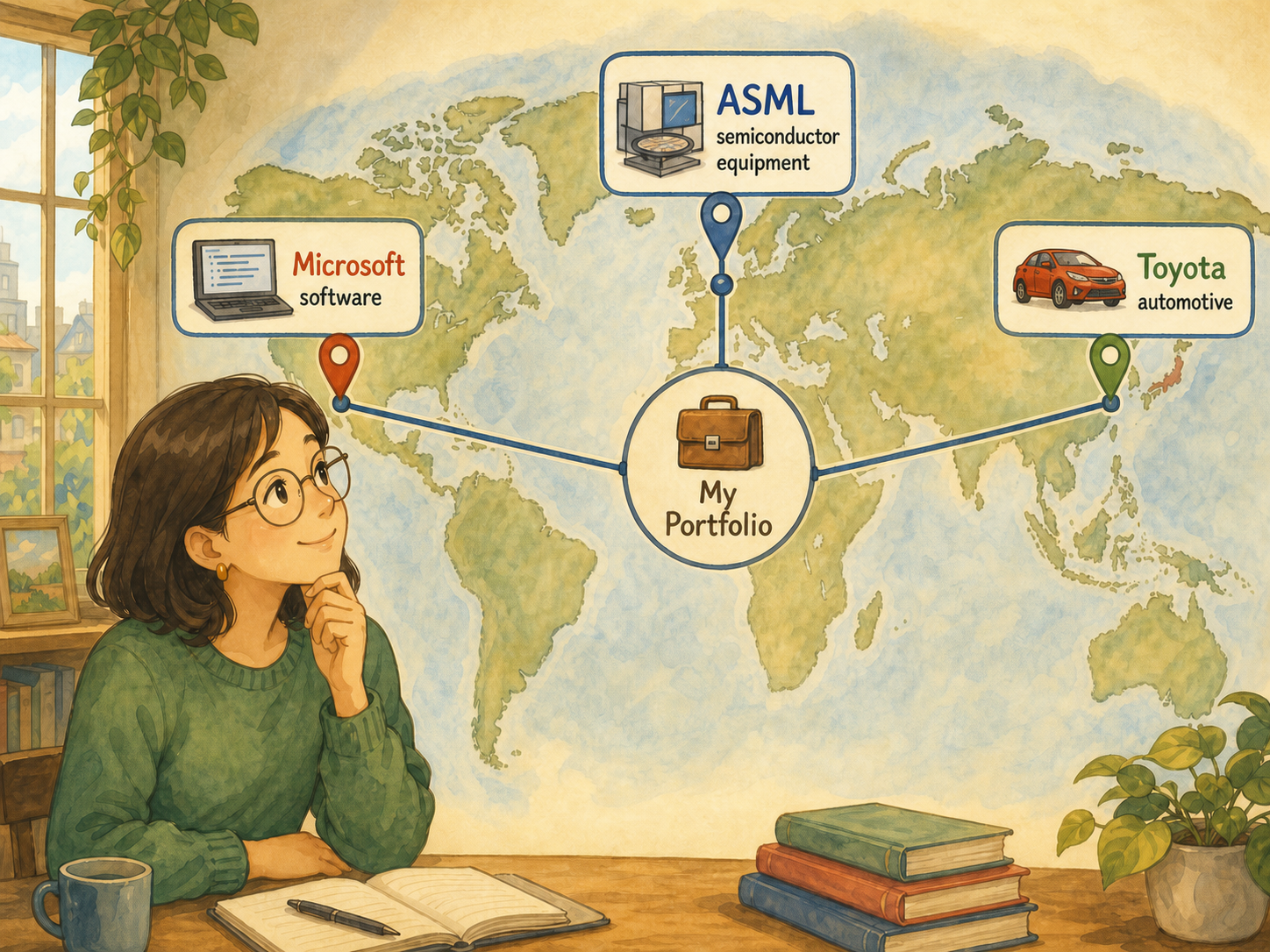
Text to type: Diversification means spreading investments across different companies, industries, and countries to reduce risk. If a portfolio contains only car companies and the car industry struggles, its investments may fall together. If it also holds technology, healthcare, and companies from different countries, a fall in one area may have less effect on the whole portfolio. For example, Toyota operates in Japan's automotive industry, ASML is a Dutch maker of semiconductor equipment, and Microsoft is a U.S. software and cloud company. Holding these three stocks is more diversified than holding only one, but three stocks are still a small portfolio. A broad index fund can hold hundreds of companies. Diversification does not remove all risk. Many markets can fall at the same time, and a fund focused on one region is not the same as a global fund. Diversification mainly reduces the damage that one company or one industry can cause.
Ready. The timer starts with your first key.
Complete
Great job!
Strong finish — your speed stayed steady.
Your rhythm
Speed over time- Time
- 0:00
- Raw speed
- 0 WPM
- Wrong keys
- 0
- Corrected
- 0
Check your understanding
Check — Diversification
1. Describe how an investor holding Toyota, ASML, and Microsoft is more diversified than one holding only Toyota shares.
Sample answer
The investor holds companies in three different industries — automotive, semiconductor equipment, and software — and in three different countries: Japan, the Netherlands, and the USA. A problem specific to one industry or one country is less likely to affect all three at the same time.
What you can do now
Final Reflection
Compare two fictional plans for €1,000: Plan A buys one company, while Plan B uses a broad index fund. Which plan has more company-specific risk, and why? Use at least two ideas such as profit, debt, dividends, valuation, or diversification.
Learning cards
My cards
Stock Investing: One Company or an Index Fund?
0 due · 12 new · about 3 min
Learn the sense first · then retrieve it
Focused Reading Mode is open.
Listening
Lesson audio
Listen from the beginning, or choose “Play this part” as you read along.
Reading
Part 2 — Revenue, Profit, and Company Value
Reading
Part 3 — Debt and Risk
Reading
Part 4 — Dividends
Reading
Part 5 — Individual Stocks vs. Index Funds
Reading
Part 6 — Diversification
Finished listening?
Mark this listening practice complete when you have followed the lesson audio.
Listening complete
Listen Mode
Word-by-word syncPlay the audio and follow the highlighted word.
Article complete
Choose your next step
Open the next same-level lesson, replay the article, or save this page for later.
Listen Again
Replay the article once and notice how much more you understand.
One replay is enough. Then move on.