The Universe That Reproduces
Quality checked lesson
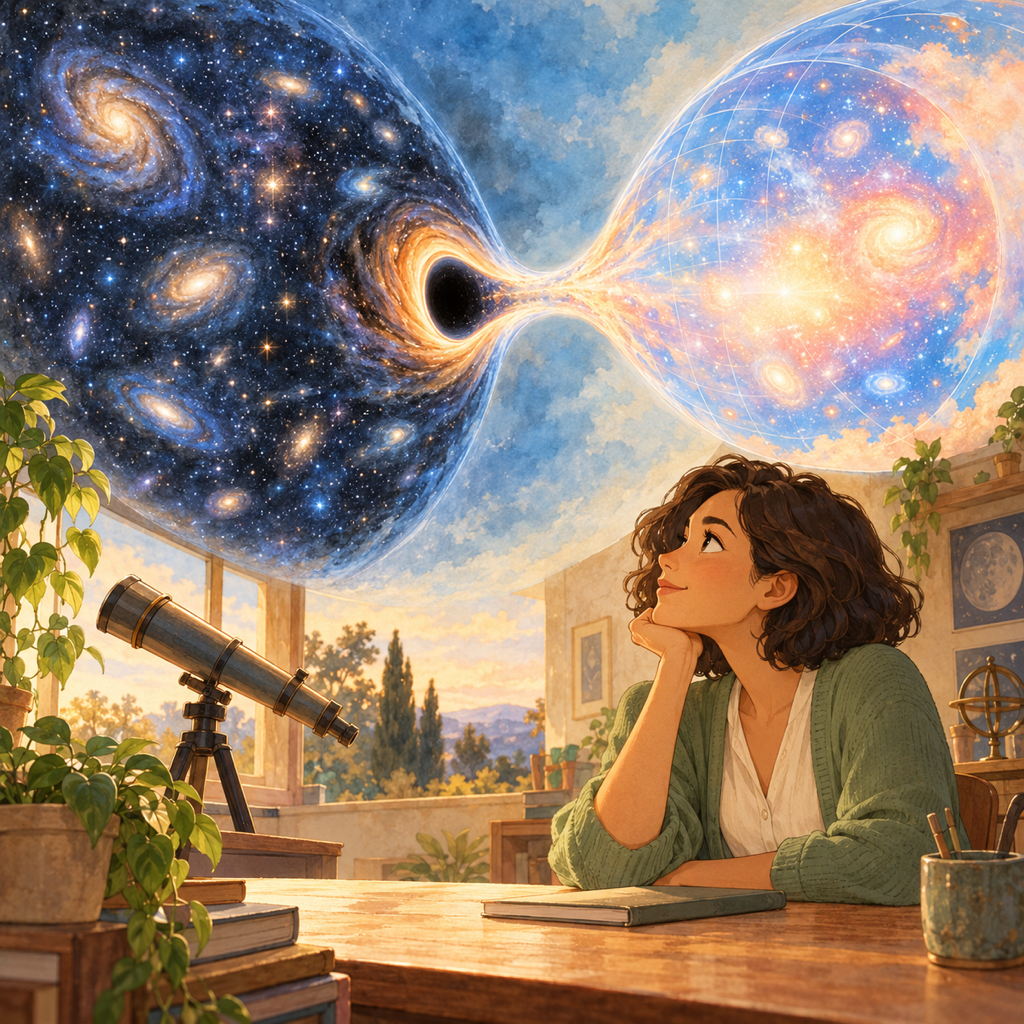
Could Black Holes Be the Children of Other Universes?
 English lesson
Article
Choose how to use this lesson
You can switch anytime.
Study mode
Introduction
Typing practice
Type the text exactly. Timer starts with your first key.
Text to type: Some physicists have explored the possibility that black holes could create new universes. Physicist Lee Smolin took this idea further: perhaps universes reproduce, slightly change, and go through something similar to natural selection. This is a serious scientific hypothesis, but it has not been proven.
Ready. The timer starts with your first key.
Complete
Great job!
Strong finish — your speed stayed steady.
Your rhythm
Speed over time- Time
- 0:00
- Raw speed
- 0 WPM
- Wrong keys
- 0
- Corrected
- 0
Before you begin
Warm-up
What do you already know about black holes and the Big Bang?
Have you ever thought about whether our universe could have a 'parent' universe?
What does the term 'natural selection' mean to you, and can it apply outside biology?
 Part 1: What if our universe had a parent?
Reading
Part 1: What if our universe had a parent?
Typing practice
Type the text exactly. Timer starts with your first key.
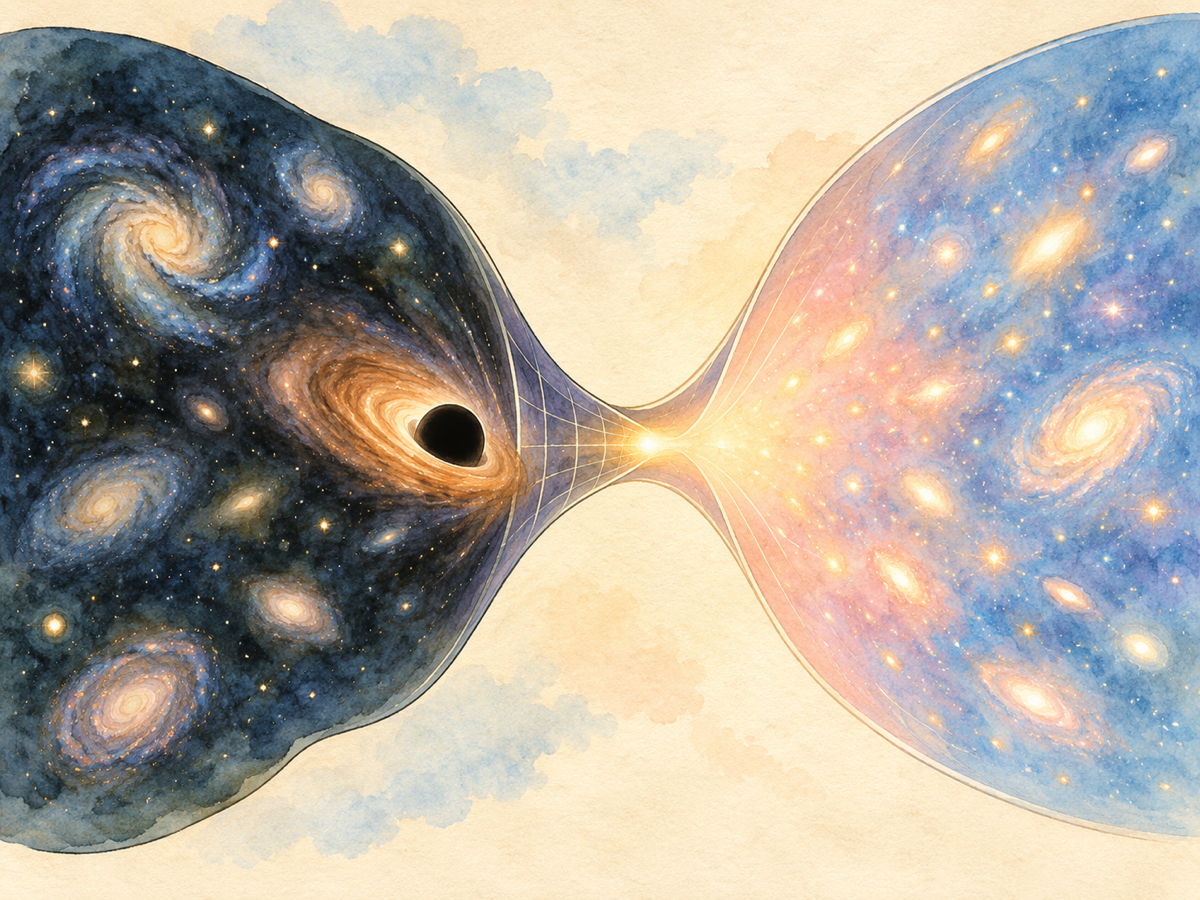
Text to type: We normally imagine the Big Bang as the absolute beginning. About 13.8 billion years ago, our observable universe was extremely hot and dense. Space expanded, matter formed, stars appeared, planets developed, and eventually life became possible. But this leaves one enormous question: Why did the Big Bang happen at all? And another: Was it truly the beginning, or did something exist before it? One strange possibility is that our universe was born inside something else. Imagine a black hole existing in an older universe. From the outside, matter falls into the black hole and seems to disappear behind the event horizon. But perhaps the story does not end there. Some speculative theories of quantum gravity suggest that the extreme collapse inside a black hole might not continue forever into an infinitely dense singularity. Instead, the collapse could somehow “bounce.” That bounce might create a new expanding region of spacetime. From inside that new region, the event might look surprisingly similar to a Big Bang. This leads to the first crazy possibility: A black hole in one universe could become the beginning of another universe.
Ready. The timer starts with your first key.
Complete
Great job!
Strong finish — your speed stayed steady.
Your rhythm
Speed over time- Time
- 0:00
- Raw speed
- 0 WPM
- Wrong keys
- 0
- Corrected
- 0
Check your understanding
Check: Part 1: What if our universe had a parent?
1. How could a black hole possibly be connected to the birth of a new universe?
Sample answer
Some speculative theories suggest that the collapse inside a black hole might 'bounce' and create a new expanding region of spacetime, which from inside looks like a Big Bang, so a black hole in one universe could become the beginning of another universe.
Think one step further
If our Big Bang came from a black hole in another universe, would you still call the Big Bang the “beginning”?
Reading
Part 2: Why black holes are important
Typing practice
Type the text exactly. Timer starts with your first key.
Text to type: A black hole forms when enough matter becomes concentrated in a small region. Its gravity becomes so strong that beyond the event horizon, even light cannot escape. According to classical general relativity, matter falling deep inside eventually approaches a singularity—a region where the equations predict extreme curvature and our normal description of spacetime breaks down. But physicists do not usually interpret this as proof that nature literally contains an infinitely dense point. It may instead mean: Our current theory has reached its limit. General relativity describes gravity extremely well. Quantum mechanics describes very small systems extremely well. Inside a black hole, however, we need to understand both extreme gravity and quantum physics at the same time. We still do not have a complete theory of quantum gravity. Because of this, we do not know with confidence what happens at the deepest interior of a black hole. And that uncertainty leaves room for ideas such as a bounce or a baby universe.
Ready. The timer starts with your first key.
Complete
Great job!
Strong finish — your speed stayed steady.
Your rhythm
Speed over time- Time
- 0:00
- Raw speed
- 0 WPM
- Wrong keys
- 0
- Corrected
- 0
Check your understanding
Check: Part 2: Why black holes are important
1. Why can't current physics confidently tell us what happens at the center of a black hole?
Sample answer
Because we do not have a complete theory of quantum gravity, we cannot confidently know what happens at the deepest interior of a black hole; current theories reach their limits and produce infinities that suggest incompleteness.
Think one step further
When a scientific equation produces an infinity, do you think that infinity is probably real, or a sign that the theory is incomplete?
Reading
Part 4: Lee Smolin's strange next step
Typing practice
Type the text exactly. Timer starts with your first key.
Text to type: The idea becomes much stranger with physicist Lee Smolin. Smolin asked: If black holes create new universes, what happens if the new universes are slightly different from their parents? Suppose a universe has physical constants. These constants control things such as: • particle masses • forces • nuclear reactions • gravity • star formation Now imagine that when a black hole produces a child universe, these values change slightly. Not completely. Just a little. The child therefore resembles the parent but is not exactly identical. This gives us something surprisingly similar to biological reproduction. Biology Parent organism → child → slightly different genes Cosmology Parent universe → black hole → child universe → slightly different physical constants Once reproduction and variation exist, another possibility appears: selection.
Ready. The timer starts with your first key.
Complete
Great job!
Strong finish — your speed stayed steady.
Your rhythm
Speed over time- Time
- 0:00
- Raw speed
- 0 WPM
- Wrong keys
- 0
- Corrected
- 0
Check your understanding
Check: Part 4: Lee Smolin's strange next step
1. What would have to change slightly between parent and child universes for cosmic evolution to occur?
Sample answer
The physical constants would have to change slightly between parent and child universes for cosmic evolution to occur, allowing the child to resemble but not be identical to the parent.
Think one step further
Does it make sense to describe universes as having “children,” or is that analogy too biological?
Reading
Part 5: Natural selection — but for universes
Typing practice
Type the text exactly. Timer starts with your first key.
Text to type: Consider biological evolution. Some organisms have traits that help them reproduce. Those organisms produce more children. Their traits therefore become more common in future generations. Smolin asked whether something similar could happen to universes. Imagine two kinds of universe. Universe A Its physical laws produce very few stars. Very few stars means very few black holes. It produces: 10 child universes Universe B Its physical laws are excellent for creating large stars. Many large stars eventually collapse into black holes. It produces: 1,000,000 child universes If the child universes inherit approximately similar physical laws, then after many generations, universes like B become much more common. Not because somebody designed them. Not because they are trying to survive. Simply because: Universes that make more black holes make more universes. Smolin called this idea Cosmological Natural Selection.
Ready. The timer starts with your first key.
Complete
Great job!
Strong finish — your speed stayed steady.
Your rhythm
Speed over time- Time
- 0:00
- Raw speed
- 0 WPM
- Wrong keys
- 0
- Corrected
- 0
Check your understanding
Check: Part 5: Natural selection — but for universes
1. Why would universes that create many black holes become more common in this model?
Sample answer
Universes that create many black holes produce more child universes, so over many generations, these universes become more common simply because they reproduce more.
Think one step further
Is this really “natural selection” if universes are not alive and do not compete consciously?
Reading
Part 6: The incredible consequence: physical laws may have evolved
Typing practice
Type the text exactly. Timer starts with your first key.
Text to type: Normally we ask: “Why do the laws of physics have these particular values?” For example, why does gravity have its exact strength? Why do particles have their particular masses? Why do nuclear reactions work in a way that allows stars to exist? Usually these values are treated as basic facts of our universe. Smolin's hypothesis suggests a radically different possibility: Perhaps these values have a history. They may be similar to biological traits. Imagine changing one physical constant slightly. Perhaps stars become unstable. Then fewer black holes form. That universe produces fewer descendants. Another set of constants may produce enormous numbers of long-lived stars and black holes. Those universes reproduce more successfully. After many cosmic generations, the population of universes could become concentrated around laws that are especially good at producing black holes. In this picture, the laws of nature that look “special” may not have been chosen. They may have been selected. That is an enormous conceptual change. Instead of asking: “Who designed these constants?” or: “Did we simply get lucky?” we could ask: “Did these constants evolve?”
Ready. The timer starts with your first key.
Complete
Great job!
Strong finish — your speed stayed steady.
Your rhythm
Speed over time- Time
- 0:00
- Raw speed
- 0 WPM
- Wrong keys
- 0
- Corrected
- 0
Check your understanding
Check: Part 6: The incredible consequence: physical laws may have evolved
1. How could cosmological natural selection explain why physical constants have particular values?
Sample answer
Cosmological natural selection suggests that physical constants have evolved because universes with constants that produce more black holes reproduce more successfully, concentrating the population around those values.
Think one step further
Which idea seems stranger to you: laws of physics being fixed forever, or laws of physics having an evolutionary history?
 Part 7: Where do humans fit into this?
Reading
Part 7: Where do humans fit into this?
Typing practice
Type the text exactly. Timer starts with your first key.
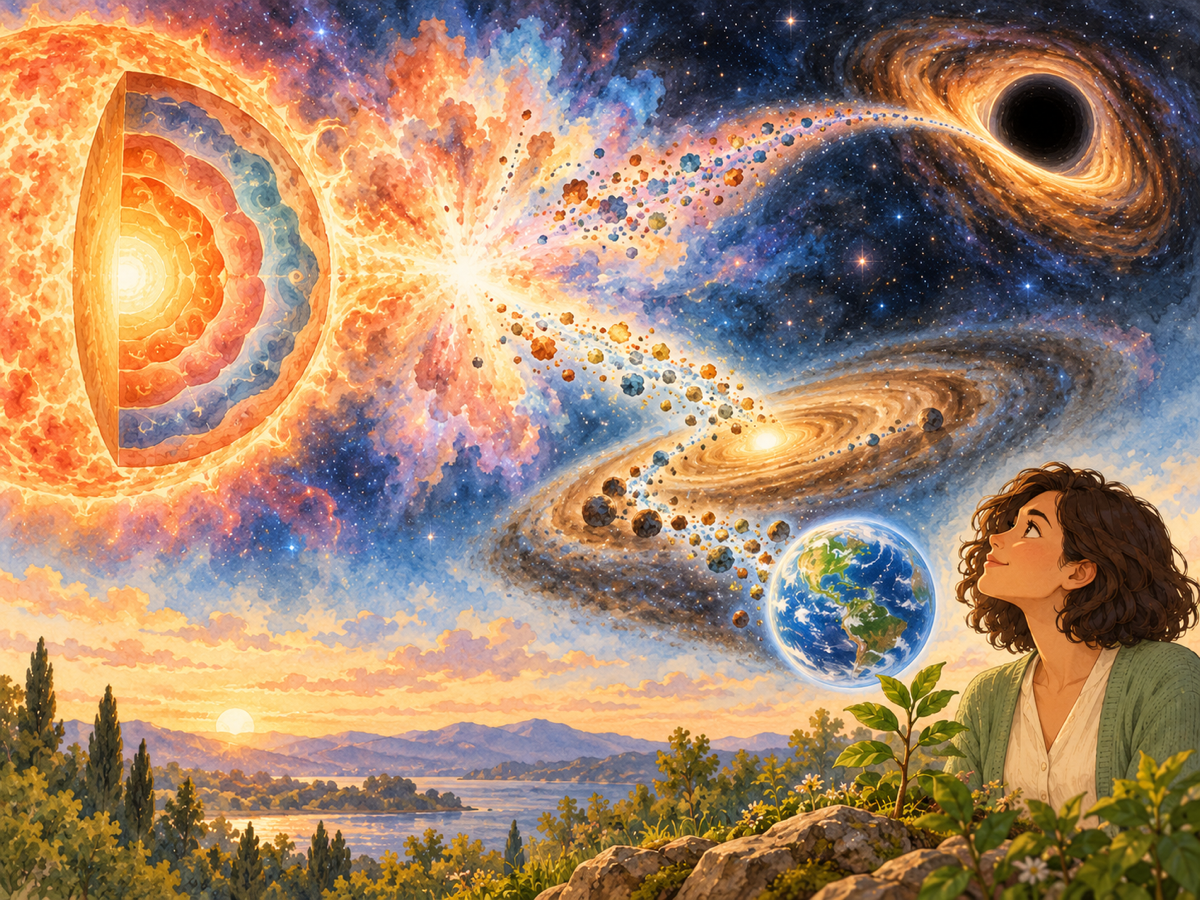
Text to type: This produces another fascinating idea. Our universe happens to have laws that allow: • stable stars • heavy chemical elements • carbon • planets • complex chemistry • life This is sometimes called the fine-tuning problem. Why does the universe seem so suitable for complexity? One answer is the anthropic principle: We observe a universe compatible with life because otherwise we would not exist to observe it. But cosmological natural selection gives a different possibility. Perhaps the universe was not selected for life. Perhaps it was selected for black holes. Life might simply be a side effect. Why? The conditions that help create black holes also require complex astrophysics: stars → nuclear fusion → heavy elements → supernovae → black holes Those same stars also create the carbon, oxygen, iron, and other elements needed for planets and life. So perhaps: The universe was not “designed” for us at all. We may simply benefit from physical conditions that were good at producing stars and black holes. Life could be an accidental passenger inside a universe optimized for something completely different.
Ready. The timer starts with your first key.
Complete
Great job!
Strong finish — your speed stayed steady.
Your rhythm
Speed over time- Time
- 0:00
- Raw speed
- 0 WPM
- Wrong keys
- 0
- Corrected
- 0
Check your understanding
Check: Part 7: Where do humans fit into this?
1. Why could conditions that produce many black holes also accidentally help life exist?
Sample answer
The conditions that produce many black holes also require complex astrophysics that creates heavy elements and stars, which are necessary for life, so life might be a side effect of a universe selected for black holes.
Think one step further
How would your view of humanity change if life were only a side effect of a universe selected to produce black holes?
Reading
Part 8: A cosmic family tree
Typing practice
Type the text exactly. Timer starts with your first key.
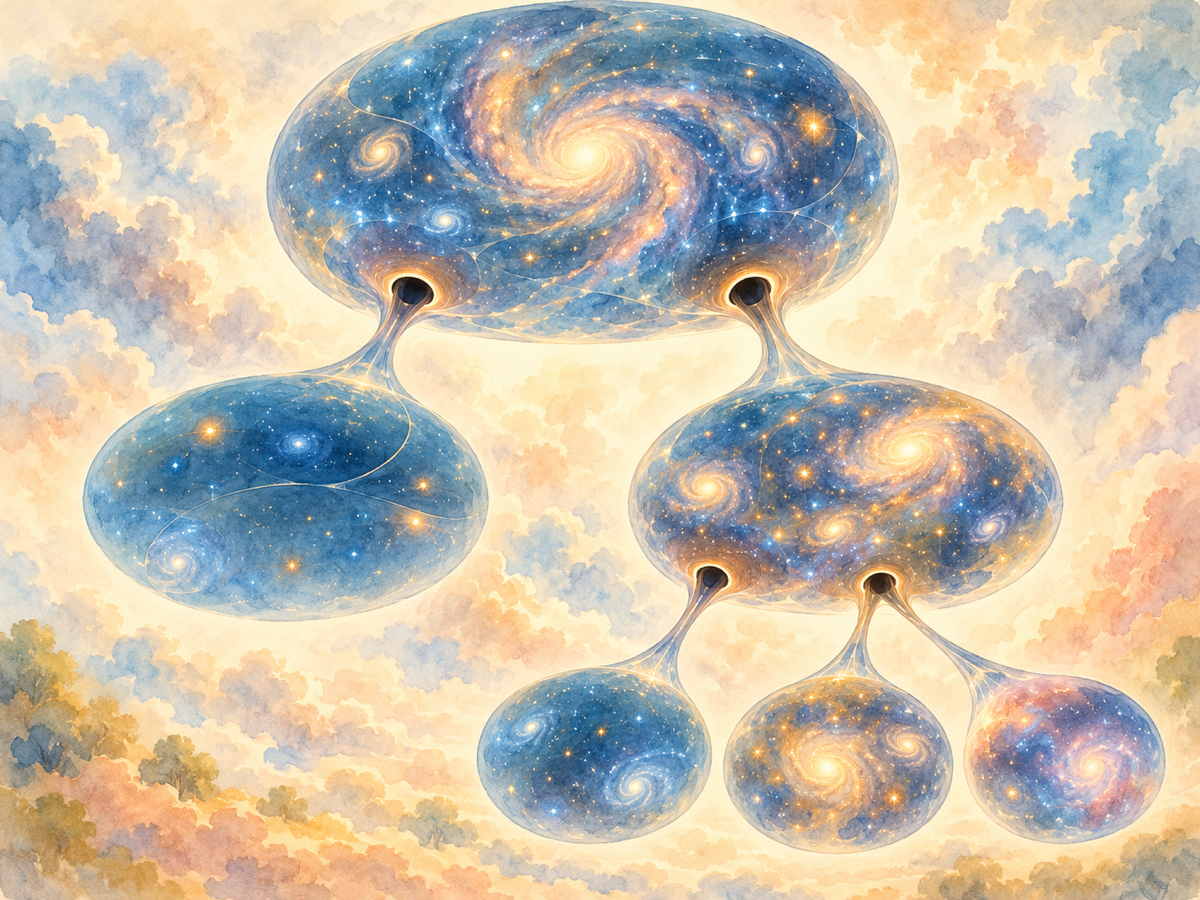
Text to type: If this process happened repeatedly, reality might contain a gigantic family tree of universes. Imagine: Universe 1 ↓ 1,000 black holes ↓ 1,000 child universes ↓ each produces thousands of black holes ↓ millions of grandchildren universes After enough generations, the number could become enormous. Some branches would die quickly because their physics produces almost no black holes. Other branches would reproduce extremely successfully. The multiverse would therefore not be a random collection of universes. It could have: • ancestry • generations • inheritance • variation • selection In other words: The multiverse could have a history. Just as every human belongs to an enormous biological family tree, our universe might belong to a cosmic family tree stretching through realities we can never directly observe.
Ready. The timer starts with your first key.
Complete
Great job!
Strong finish — your speed stayed steady.
Your rhythm
Speed over time- Time
- 0:00
- Raw speed
- 0 WPM
- Wrong keys
- 0
- Corrected
- 0
Check your understanding
Check: Part 8: A cosmic family tree
1. Why would this theory create a family tree rather than simply a random collection of universes?
Sample answer
Because universes reproduce with variation and selection, some branches die out and others reproduce successfully, creating a family tree with ancestry, generations, inheritance, variation, and selection rather than a random collection.
Think one step further
If our universe had a parent universe, do you think there could be any possible clue left from that parent?
Reading
Part 9: Black holes become something completely different
Typing practice
Type the text exactly. Timer starts with your first key.
Text to type: This hypothesis also changes the meaning of a black hole. Normally, black holes represent destruction. Matter falls inside. Stars disappear. Information seems trapped. They are often described as cosmic graves. But under the baby-universe idea, a black hole could simultaneously be: death from one perspective and: birth from another. A collapsing star in our universe could produce a Big Bang somewhere else. This creates a beautiful symmetry: Star dies → black hole forms → new universe begins → new stars form → new black holes form → more universes begin Destruction becomes reproduction. The objects we call the “dead ends” of spacetime could actually be its reproductive organs. That is perhaps the wildest part of the idea.
Ready. The timer starts with your first key.
Complete
Great job!
Strong finish — your speed stayed steady.
Your rhythm
Speed over time- Time
- 0:00
- Raw speed
- 0 WPM
- Wrong keys
- 0
- Corrected
- 0
Check your understanding
Check: Part 9: Black holes become something completely different
1. How does the baby-universe hypothesis completely change the usual meaning of a black hole?
Sample answer
The baby-universe hypothesis changes a black hole from being just destruction to also being a birth, where a collapsing star forms a black hole that simultaneously ends one universe and begins another.
Think one step further
Why do humans naturally separate “creation” and “destruction” when many natural systems contain both?
Reading
Part 10: Could our Big Bang have been a black hole?
Typing practice
Type the text exactly. Timer starts with your first key.
Text to type: Now reverse the idea. If black holes in our universe create baby universes, perhaps our universe is also a baby universe. Then somewhere in a parent cosmos, billions of years—or perhaps a completely different kind of time—ago, a star or other enormous structure may have collapsed. A black hole formed. From the parent's perspective: matter disappeared behind an event horizon. From our perspective: spacetime began expanding. Our Big Bang could therefore be the inside view of something that looked like a black hole from outside. If true, asking: “What happened before the Big Bang?” might be similar to asking: “What happened in the parent universe?” But there is a serious difficulty. The causal structure of a black hole may prevent information from the parent universe from reaching us. We might literally be unable to look backward beyond our own cosmic birth.
Ready. The timer starts with your first key.
Complete
Great job!
Strong finish — your speed stayed steady.
Your rhythm
Speed over time- Time
- 0:00
- Raw speed
- 0 WPM
- Wrong keys
- 0
- Corrected
- 0
Check your understanding
Check: Part 10: Could our Big Bang have been a black hole?
1. How could a Big Bang and a black hole possibly be two descriptions of related physics?
Sample answer
A Big Bang could be the inside view of what looks like a black hole from outside; from the parent's perspective, matter disappears behind an event horizon, while from our perspective, spacetime begins expanding.
Think one step further
How would science deal with a theory if important parts of it were permanently impossible to observe directly?
Reading
Part 11: The biggest problem: where is the evidence?
Typing practice
Type the text exactly. Timer starts with your first key.
Text to type: This is where we must separate fascinating physics from established physics. We know black holes exist. We have strong astronomical evidence for them, including gravitational-wave detections and images of black-hole environments. But we do not know that black holes create universes. That requires physics beyond our currently confirmed understanding of black-hole interiors. Smolin tried to make his theory scientifically useful by proposing a prediction. If universes have evolved to maximize black-hole production, then the physical constants in our universe should be close to values that produce unusually many black holes. If scientists could change one constant slightly in a theoretical model and reliably produce more black holes, that could challenge the hypothesis. This makes the proposal more interesting than simply saying: “Maybe other universes exist.” It tries to connect the idea to things we can calculate about our universe. However, scientists continue to debate whether these tests are strong enough and whether the biological natural-selection analogy really works.
Ready. The timer starts with your first key.
Complete
Great job!
Strong finish — your speed stayed steady.
Your rhythm
Speed over time- Time
- 0:00
- Raw speed
- 0 WPM
- Wrong keys
- 0
- Corrected
- 0
Check your understanding
Check: Part 11: The biggest problem: where is the evidence?
1. What kind of observation or calculation could potentially challenge cosmological natural selection?
Sample answer
If scientists could change one physical constant slightly in a theoretical model and reliably produce more black holes, that could challenge the hypothesis of cosmological natural selection.
Think one step further
Should scientists seriously study ideas that may be extremely difficult to test?
Reading
Part 12: Why the idea remains scientifically interesting
Typing practice
Type the text exactly. Timer starts with your first key.
Text to type: Cosmological natural selection is not the standard accepted explanation of our universe. But the broader questions behind it remain active in theoretical physics. Researchers continue to study: • black-hole interiors • quantum gravity • singularity removal • cosmological bounces • wormholes • baby universes Even in 2026, theoretical papers continue exploring mathematical models where baby universes can emerge from black-hole interiors or early-universe processes. This does not mean Smolin's full theory has been confirmed. It means the deeper question— Can one region of spacetime produce another expanding universe? —remains a serious theoretical question.
Ready. The timer starts with your first key.
Complete
Great job!
Strong finish — your speed stayed steady.
Your rhythm
Speed over time- Time
- 0:00
- Raw speed
- 0 WPM
- Wrong keys
- 0
- Corrected
- 0
Check your understanding
Check: Part 12: Why the idea remains scientifically interesting
1. Why does the idea of cosmological natural selection remain scientifically interesting?
Sample answer
Because researchers continue to study related theoretical physics questions like black-hole interiors, quantum gravity, singularity removal, cosmological bounces, wormholes, and baby universes, and the question of whether one region of spacetime can produce another expanding universe remains serious.
Think one step further
What do you think are the challenges and benefits of studying scientific ideas that are difficult to test directly?
 Part 13: The deepest philosophical idea
Reading
Part 13: The deepest philosophical idea
Typing practice
Type the text exactly. Timer starts with your first key.
Text to type: The most powerful part of this hypothesis may not even be the black holes. It is the idea that we might be thinking about the laws of nature incorrectly. We usually imagine: laws first → universe follows laws But cosmological natural selection suggests: universes reproduce → laws vary → some laws reproduce more successfully Now the laws themselves become part of history. This is similar to what Darwin did to biology. Before Darwin, species seemed fixed. A tiger was simply a tiger. After Darwin, a tiger became the current result of a historical process. Smolin asks whether we could make the same conceptual change in physics. Perhaps an electron's mass or gravity's strength is not simply: “the number nature chose.” Perhaps it is: the surviving result of a cosmic evolutionary history. Whether this is true or not, that question completely changes how we think about the universe.
Ready. The timer starts with your first key.
Complete
Great job!
Strong finish — your speed stayed steady.
Your rhythm
Speed over time- Time
- 0:00
- Raw speed
- 0 WPM
- Wrong keys
- 0
- Corrected
- 0
Check your understanding
Check: Part 13: The deepest philosophical idea
1. What is the deepest philosophical idea behind cosmological natural selection?
Sample answer
That the laws of nature might not be fixed but could have evolved through a cosmic evolutionary history, making the laws themselves part of history, similar to how Darwin changed the understanding of biological species.
Think one step further
How does thinking of physical laws as evolving rather than fixed change your perspective on the universe?
What you can do now
Final Reflection
How does the idea that universes might reproduce and evolve change your view of the cosmos?
Learning cards
My cards
The Universe That Reproduces
0 due · 0 new · about 1 min
Learn the sense first · then retrieve it
No saved cards yet
Open a word or phrase in the article and choose Save to My Words.
Focused Reading Mode is open.
Listening
Lesson audio
Listen from the beginning, or choose “Play this part” as you read along.
Introduction
Reading
Part 1: What if our universe had a parent?
Reading
Part 2: Why black holes are important
Reading
Part 4: Lee Smolin's strange next step
Reading
Part 5: Natural selection — but for universes
Reading
Part 6: The incredible consequence: physical laws may have evolved
Reading
Part 7: Where do humans fit into this?
Reading
Part 8: A cosmic family tree
Reading
Part 9: Black holes become something completely different
Reading
Part 10: Could our Big Bang have been a black hole?
Reading
Part 11: The biggest problem: where is the evidence?
Reading
Part 12: Why the idea remains scientifically interesting
Reading
Part 13: The deepest philosophical idea
Finished listening?
Mark this listening practice complete when you have followed the lesson audio.
Listening complete
Listen Mode
Word-by-word syncPlay the audio and follow the highlighted word.
Article complete
Choose your next step
Open the next same-level lesson, replay the article, or save this page for later.
Listen Again
Replay the article once and notice how much more you understand.
One replay is enough. Then move on.