The Science of Cultural Spread: Networks, Attention, and Influence
Quality checked lesson
Memes do not spread because of one magic formula. Learn how content, social influence, networks, attention, and algorithms interact—and why popularity is not evidence of truth.
 English lesson
Article
Choose how to use this lesson
You can switch anytime.
Study mode
Introduction
Typing practice
Type the text exactly. Timer starts with your first key.
Text to type: Memes do not spread because of one magic formula. Learn how content, social influence, networks, attention, and algorithms interact—and why popularity is not evidence of truth.
Ready. The timer starts with your first key.
Complete
Great job!
Strong finish — your speed stayed steady.
Your rhythm
Speed over time- Time
- 0:00
- Raw speed
- 0 WPM
- Wrong keys
- 0
- Corrected
- 0
Before you begin
Warm-up
What is one idea, phrase, image, or habit that seemed to appear everywhere?
When many people share something, does that make you more likely to trust it? Why or why not?
Think of an online trend that changed as people copied it. What changed?
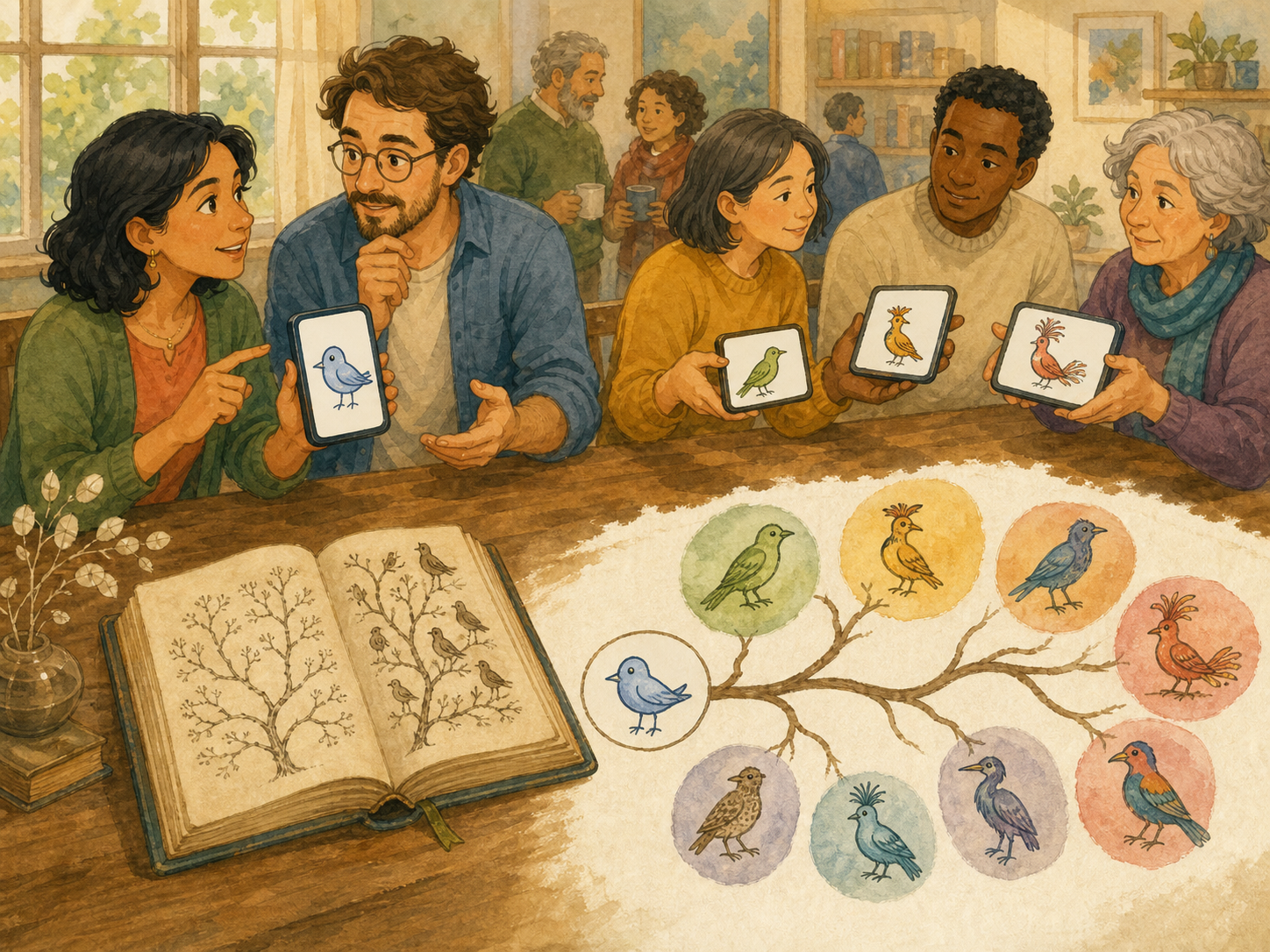 Part 1: A Meme Is More Than a Funny Picture
Reading
Part 1: A Meme Is More Than a Funny Picture
Typing practice
Type the text exactly. Timer starts with your first key.
Text to type: Today, a meme often means a captioned image or video that people copy and change online. To understand why ideas go viral, we can start with The Selfish Gene (1976), where Richard Dawkins proposed “meme” as a name for a unit of cultural transmission: an idea, tune, fashion, or practice that passes from person to person. His comparison with genes was powerful because it directed attention towards copying and survival. However, cultural information is not literally DNA. People can misunderstand it, combine it with other ideas, or deliberately redesign it. Modern cultural-evolution research therefore treats the gene comparison as a useful starting point, not a complete explanation of culture.
Ready. The timer starts with your first key.
Complete
Great job!
Strong finish — your speed stayed steady.
Your rhythm
Speed over time- Time
- 0:00
- Raw speed
- 0 WPM
- Wrong keys
- 0
- Corrected
- 0
Check your understanding
Check: Part 1: A Meme Is More Than a Funny Picture
1. Why is the gene comparison useful but incomplete?
Sample answer
It focuses attention on copying and survival, but people actively interpret, combine, and change cultural information.
Reading
Part 2: Transmission, Variation, and Selection
Typing practice
Type the text exactly. Timer starts with your first key.
Text to type: Cultural evolution can be described through three linked processes. Transmission happens when information moves between people through speech, imitation, writing, teaching, or media. Variation appears when the information changes, either by accident or by design. Selection happens when some versions are copied or remembered more than others. Here, “selected” does not mean morally good, factually true, or biologically superior. It only means that one version became more common or lasted longer in a particular environment. A joke may become shorter because short versions are easier to retell. A recipe may become more detailed because accuracy matters to the cooks using it. Human goals shape each step.
Ready. The timer starts with your first key.
Complete
Great job!
Strong finish — your speed stayed steady.
Your rhythm
Speed over time- Time
- 0:00
- Raw speed
- 0 WPM
- Wrong keys
- 0
- Corrected
- 0
Check your understanding
Check: Part 2: Transmission, Variation, and Selection
1. In cultural evolution, what does it mean when a version is selected?
Sample answer
It means that the version is copied or remembered more than competing versions in a particular environment.
Think one step further
Think of a popular phrase, recipe, fashion, or online meme. Which variation do you remember most, and why do you think it survived?
Reading
Part 3: We Choose What—and Whom—to Copy
Typing practice
Type the text exactly. Timer starts with your first key.
Text to type: Copying is not random. People may notice content because it is surprising, useful, frightening, funny, or easy to remember. They may also copy a person who seems respected or successful. In one narrative experiment, both the content of a story and the supposed prestige of its source influenced transmission; prestige mattered, but several content effects were stronger. Social information can then create a feedback loop. In a controlled online music experiment, 14,341 people chose songs by unknown bands. When participants could see earlier download numbers, popular songs became more unequal and final rankings became less predictable. Quality still had some influence, but early popularity helped create later popularity.
Ready. The timer starts with your first key.
Complete
Great job!
Strong finish — your speed stayed steady.
Your rhythm
Speed over time- Time
- 0:00
- Raw speed
- 0 WPM
- Wrong keys
- 0
- Corrected
- 0
Check your understanding
Check: Part 3: We Choose What—and Whom—to Copy
1. What did the music experiment show about social influence?
Sample answer
Seeing earlier choices made popularity more unequal and final success less predictable, although song quality still mattered partly.
Reading
Part 4: Popularity and Truth Are Different Tests
Typing practice
Type the text exactly. Timer starts with your first key.
Text to type: A transmission test asks, “Will people pass this on?” A truth test asks, “Is the claim supported by reliable evidence?” These tests can produce different answers. A large study followed about 126,000 stories shared on Twitter from 2006 to 2017 and used six fact-checking organizations to classify them. In that dataset, false stories travelled farther, faster, deeper, and more broadly than true stories. The researchers also found that false news tended to be more novel. This does not prove that every false claim beats every true one, or that the same pattern exists on every platform. It shows why share counts cannot replace evidence.
Ready. The timer starts with your first key.
Complete
Great job!
Strong finish — your speed stayed steady.
Your rhythm
Speed over time- Time
- 0:00
- Raw speed
- 0 WPM
- Wrong keys
- 0
- Corrected
- 0
Check your understanding
Check: Part 4: Popularity and Truth Are Different Tests
1. Why can a high share count not serve as a truth test?
Sample answer
Sharing measures transmission, while truth depends on the quality of evidence supporting a claim.
Think one step further
If a claim is popular but uncertain, what evidence would you want before passing it on?
 Part 5: A Million Views May Not Be Viral
Reading
Part 6: Some Ideas Need Reinforcement
Typing practice
Type the text exactly. Timer starts with your first key.
Text to type: The language of contagion is another model, not a claim that ideas are diseases. In a simple contagion, one contact may be enough to transmit information, as when you learn that a concert exists. A complex contagion requires reinforcement from several people before someone adopts a risky, costly, or uncertain behavior. Joining a protest, using an unfamiliar technology, or accepting a new group rule may work this way. In a randomized online experiment with 1,528 participants, a health behavior spread farther and faster through clustered networks than through random networks. Repeated social signals helped adoption. The result does not mean clustering always wins; it shows that the kind of decision changes which network structure is useful.
Ready. The timer starts with your first key.
Complete
Great job!
Strong finish — your speed stayed steady.
Your rhythm
Speed over time- Time
- 0:00
- Raw speed
- 0 WPM
- Wrong keys
- 0
- Corrected
- 0
Check your understanding
Check: Part 6: Some Ideas Need Reinforcement
1. Why might a complex contagion need several social contacts?
Sample answer
A person may need repeated confirmation before adopting a behavior that feels risky, costly, uncertain, or socially unusual.
Think one step further
Which would probably need more reinforcement: hearing a new fact or changing a daily habit? What could change your answer?
Reading
Part 7: Clusters Reinforce; Bridges Carry
Typing practice
Type the text exactly. Timer starts with your first key.
Text to type: A network is a pattern of connections between people or groups. Dense clusters create repeated contact, shared expectations, and trust, so they can support complex adoption. Bridges connect different clusters and carry information into new communities. Yet one weak bridge may deliver a message without providing enough reinforcement for action. Complex-contagion theory therefore highlights bridge width: several independent links between groups may matter more than one long connection. There is no universally perfect network. Tight clusters can strengthen support but also trap an idea inside one group. Numerous bridges can increase reach but may weaken repeated confirmation. The outcome depends on what is spreading and what adoption requires.
Ready. The timer starts with your first key.
Complete
Great job!
Strong finish — your speed stayed steady.
Your rhythm
Speed over time- Time
- 0:00
- Raw speed
- 0 WPM
- Wrong keys
- 0
- Corrected
- 0
Check your understanding
Check: Part 7: Clusters Reinforce; Bridges Carry
1. Why can several links between groups be more useful than one link?
Sample answer
Several links can carry the idea across groups while also providing the repeated confirmation that complex adoption may require.
Reading
Part 8: Attention and Algorithms Create a Selection Environment
Typing practice
Type the text exactly. Timer starts with your first key.
Text to type: People cannot inspect every message they receive. In one agent-based model, limited attention and network structure produced large differences in meme popularity even when the modeled items had equal quality. This does not prove that real ideas are equal; it reveals how competition for attention can magnify small accidents. Platforms add another layer by ranking what users see. A large randomized Twitter experiment found that an algorithmic timeline changed the relative visibility of political content compared with a reverse-chronological feed. Content matters too: in selected political discussions, moral-emotional language was associated with more sharing, especially inside ideological groups. That finding was observational, so it is not a universal recipe. Algorithms, human choices, and content interact in feedback loops.
Ready. The timer starts with your first key.
Complete
Great job!
Strong finish — your speed stayed steady.
Your rhythm
Speed over time- Time
- 0:00
- Raw speed
- 0 WPM
- Wrong keys
- 0
- Corrected
- 0
Check your understanding
Check: Part 8: Attention and Algorithms Create a Selection Environment
1. What does it mean to say that a platform creates a selection environment?
Sample answer
Limited attention and ranking systems affect which items become visible, so some messages receive more opportunities to be copied than others.
 Part 9: Use a Layered Model, Not a Viral Formula
What you can do now
Final Reflection
Choose an idea that deserves wider attention. How would you improve its content, source, network path, timing, or platform presentation without weakening its truthfulness?
Learning cards
My cards
The Science of Cultural Spread: Networks, Attention, and Influence
0 due · 0 new · about 1 min
Learn the sense first · then retrieve it
No saved cards yet
Open a word or phrase in the article and choose Save to My Words.
Focused Reading Mode is open.
Listening
Lesson audio
Listen from the beginning, or choose “Play this part” as you read along.
Reading
Part 1: A Meme Is More Than a Funny Picture
Reading
Part 2: Transmission, Variation, and Selection
Reading
Part 3: We Choose What—and Whom—to Copy
Reading
Part 4: Popularity and Truth Are Different Tests
Reading
Part 6: Some Ideas Need Reinforcement
Reading
Part 7: Clusters Reinforce; Bridges Carry
Reading
Part 8: Attention and Algorithms Create a Selection Environment
Finished listening?
Mark this listening practice complete when you have followed the lesson audio.
Listening complete
Listen Mode
Word-by-word syncPlay the audio and follow the highlighted word.
Article complete
Choose your next step
Open the next same-level lesson, replay the article, or save this page for later.
Listen Again
Replay the article once and notice how much more you understand.
One replay is enough. Then move on.